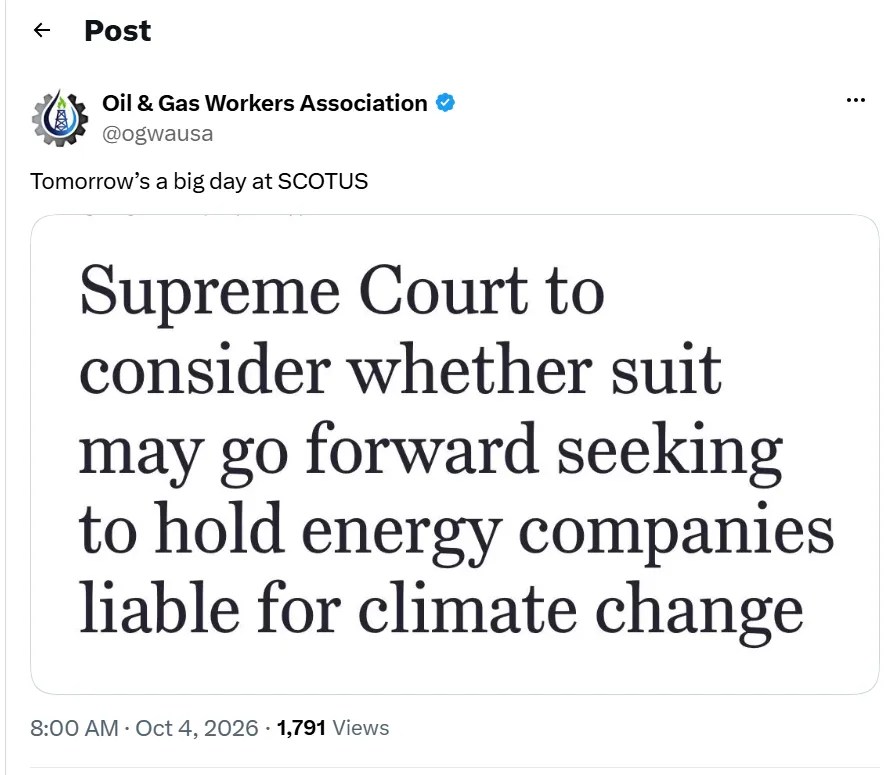
“The bottom line in this case is whether it’s…a public nuisance theory, whether it’s a consumer protection theory, what it really is an effort through litigation, backed by deep pocketed billionaires and a bunch of 1 percenters, to force their preferred lifestyle on the rest of the world.”
Climate Lawfare Rings In Monday’s Supreme Court Session
David Blackmon, Energy Additions, October 3, 2026(subscription required)
When the U.S. Supreme Court gavels in for its 2026-27 term on Monday, it will hear oral arguments in one of the key energy cases in recent years. It is no exaggeration to say that the Court’s ultimate ruling in the case styled Suncor Energy v. Boulder County could determine the success or failure of the American Energy Dominance agenda being pursued by President Donald Trump.
In a guest piece for the Wall Street Journal, former attorney general William Barr asserts that Boulder County should not be allowed to write American energy policy from a Colorado courtroom. Speaking to an audience in Texas this week, Barr said Boulder County’s case claims “interstate emissions have always been subject to regulation by the state. That’s not true.” He isn’t wrong.
Barr went on to add that “if Colorado doesn’t like what ExxonMobil is doing…they cannot sue ExxonMobil under their law for activities in Texas. That’s basic…and the plaintiffs’ theory ignores it.” There is no doubt the plaintiffs’ theory does ignore this basic facet of federal law – that the federal government has always held primacy when it comes to regulating air pollution under the Clean Air Act. That longstanding legal principle has led to a long series of similar cases brought by different plaintiffs using the same left-wing law firms being thrown out of courts all over the country over the last half decade.
The joint US-Ukrainian reconstruction investment fund has sealed its first critical minerals deal alongside four other new projects, one of its top US officials told Reuters.
US-Ukrainian investment fund seals first critical minerals deal
Reuters, October 4, 2026
The fund, established as part of the minerals pact the two countries signed in April last year following a push by US President Donald Trump, is focused on five strategic sectors from minerals and defense to energy and infrastructure.
Conor Coleman, head of investments at the US International Development Finance Corporation (DFC), said the fund’s projects now total around $70 million and showed Washington’s support for Kyiv in the long-running war with Russia.
“It’s absolutely imperative for the Ukrainian people that we’re investing now,” Coleman said in an interview, referring to the ongoing damage to Ukraine as it faces another winter.
The long-anticipated first minerals deal will inject roughly $30 million into a “joint investment platform” with BGV Group, a firm founded by Hennadii Butkevych, the billionaire co-owner of Ukraine’s largest supermarket chain ATB.
Coleman said it would initially focus on early-stage mining projects across Ukraine and target rare earths, uranium, beryllium and zirconium deposits.
“They are all on the US critical minerals list, so it ties in very well with what we’re looking to do from a (US) administration priority (standpoint),” Coleman said.
Power projects
Two of the other new projects announced on Friday aim to shore up Ukraine’s power and heating networks after a rise in Russian attacks on key infrastructure ahead of winter.
Coleman said one would add to the near $100 million the DFC has just agreed to lend Ukraine’s largest private energy company DTEK for a new battery system that will provide backup power to approximately 600,000 Ukrainian homes for up to two hours.
The project will also have “access to capital if damages arise.”
The fund will also take an equity stake in a combined heat and power co-generation platform designed to help build and run off a number of “energy hubs” aimed at restoring damaged electricity and heat supplies to households.
Coleman also said the fund was looking for more capital to increase its capacity.
The last time Alaska North Slope crude production averaged more than 550,000 barrels per day was March 2012, at about 558,000 bpd, according to US Energy Information Administration monthly data.
North Slope oil output spikes to 551,247 barrels as Alaska’s production recovery gains ground
Suzanne Downing, The Alaska Story, October 2, 2026
Alaska North Slope oil production has posted a daily reading of 551,247 barrels, an encouraging jump as new production from the Pikka oil field adds momentum to the state’s petroleum industry. That’s an amount not seen in 14 years.
The figure puts daily output well above the 500,000-barrel mark and substantially ahead of August’s average
“The North Slope renaissance is real, and we’re seeing it in the barrels flowing through TAPS. Stability matters—when Alaska provides a predictable investment climate, companies invest, projects move forward, and new production comes online. Our members are continuing the investment in Alaska’s future,” said Steve Wackowski, president and CEO of the Alaska Oil and Gas Association.
North Slope production had already crossed 500,000 barrels earlier in September. Alaska Department of Revenue daily reports showed production of 510,389 barrels on Sept. 2, when Alaska North Slope crude was priced at $93.60 per barrel.