

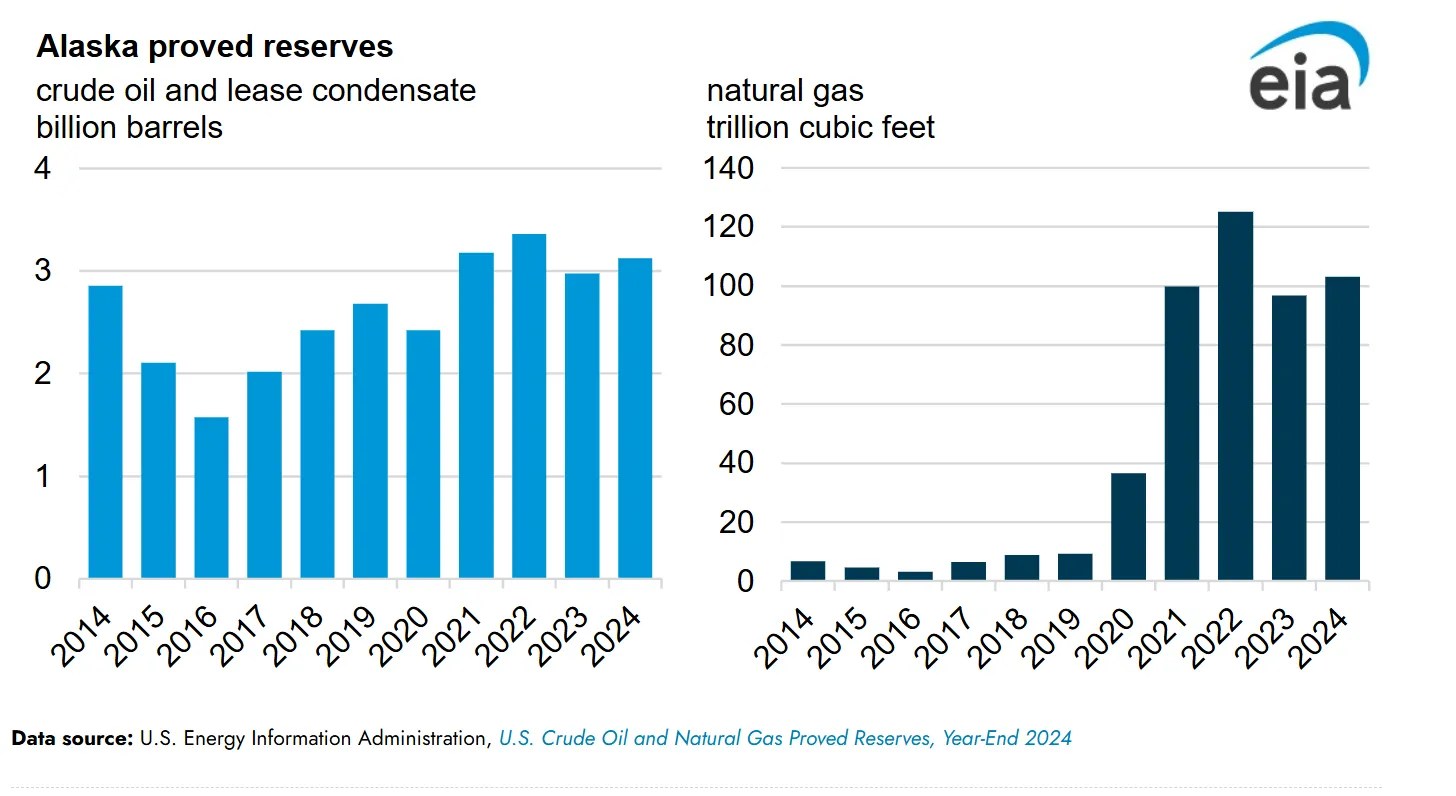
Oil and gas producers operating in Alaska reported increases in proved reserves in 2024 at a time when low prices triggered a decrease in nationwide proved reserves, according to our recently released
Alaska proved reserves increased in 2024, while nationwide proved reserves fell
U.S. Energy Information Administration, April 29, 2026
Oil and gas producers operating in Alaska reported increases in proved reserves in 2024 at a time when low prices triggered a decrease in nationwide proved reserves, according to our recently released U.S. Crude Oil and Natural Gas Proved Reserves, Year-End 2024 report. Alaska’s crude oil and lease condensate proved reserves increased 5%, and natural gas proved reserves increased nearly 7% in 2024.
U.S. proved reserves of crude oil and lease condensate totaled about 46 billion barrels at year-end 2024, a 1% decline from 2023. U.S. proved reserves of natural gas also fell, decreasing 3% to 584 trillion cubic feet (Tcf) at year-end 2024.
Proved reserves are operator estimates of oil and natural gas volumes that geological and engineering data demonstrate with reasonable certainty are recoverable under existing economic and operating conditions.
Exploration and development in Alaska in 2024 increased, supporting upward revisions in reserves there despite the lower prices. Natural gas reserves increased from 97 Tcf in 2023 to 103 Tcf in 2024, and crude oil reserves increased from 3.0 billion barrels in 2023 to 3.1 billion barrels in 2024. During 2024, Conoco Phillips’ Nuna project became operational and contributed to higher oil proved reserves in Alaska. Planned projects, including new wells at Prudhoe Bay in Alaska’s North Slope and new infrastructure to bring North Slope production to market, such as the Alaska LNG Project, could contribute to increasing proved reserves in the future.
More recently, changes in federal policies are aimed at increasing Alaskan production. On January 20, 2025, President Donald J. Trump issued an Executive Order, Unleashing Alaska’s Extraordinary Resource Potential, which expedites the permitting and leasing of energy and natural resource projects in Alaska and prioritizes the development of Alaska’s liquefied natural gas (LNG) potential. The order highlights the sale and transportation of Alaska’s LNG to other regions of the United States and allied nations within the Pacific region. On March 18, 2026, the Bureau of Land Management awarded 1.3 million acres in a National Petroleum Reserve lease sale.
The CS to HB 381 keeps the Governor’s deal, leaves the Senate’s overlays behind, and adds some Alaska teeth.
The House AKLNG Bill Got Closer
Representative Kevin McCabe, April 28, 2026
Last week I wrote about two AKLNG bills and two ways of thinking about resource development. SB 280, the Governor’s bill, was written to help a project get built. SB 275, out of Senate Resources, was written to maximize the state’s take whether the project gets built or not. I closed that piece by saying we needed a House Resources committee substitute that pulled the few good accountability pieces out of SB 275 and folded them into SB 280.
The Committee Substitute to HB 381 came out this week. That’s closer to what we need, and the House Resources Chair and the committee have done a pretty good job.
The CS keeps the core trade the Governor put on the table. No property tax during construction. A low volumetric tax once gas is moving. That is the whole reason this approach can work, and the House did not touch it.
The numbers did move. SB 280 set abatement at up to ten years or until the line hit one billion cubic feet per day, then six cents per Mcf escalating one percent a year. The CS for HB 381 sets it at six years or 250 million cubic feet per day, then five cents on the pipeline and ten cents at the LNG plant, escalating with the five-year CPI for urban Alaska.
That is a shorter, tighter abatement window and a split rate that charges more at liquefaction. House Resources is basically saying we will do the Governor’s deal, but on a faster clock, and we will charge more where the margin is. Whether that still works for Glenfarne is a question DOR and the developer have to answer. It is not a hostile rewrite. But it is a tougher one.
As I wrote last week, the Gulf Coast terminals all got ten-year exemptions, so six years with a hard throughput trigger is tighter than what those states offered, and Alaska is the higher-cost build.
The Bureau of Land Management will convey more than 1,085 acres of land to an Alaska Native Corporation that intends to mine it, the agency announced on April 1. The parcel is near Flat, a ghost town in Western Alaska, and lies just north of the proposed Donlin Gold project.
Doyon seeks to mine gold on Western Alaska land transferred by federal government
Shelley Herbert, KUAC, April 28, 2026
Doyon, Limited spokesperson Cheyenna Kuplack said in an email that the corporation started exploring the land’s mineral potential in the 1970s and is now working with Canadian Mining company Tectonic Metals.
The corporation plans to begin a large exploration drilling program this year.
Environmental groups say they’re monitoring the situation. In an emailed statement, Northern Alaska Environmental Center president Krystal Lapp encouraged transparency for such projects and said it was “important for the public to understand how land ownership changes can shape long-term decisions about development, conservation, and subsistence resources.”
Federal officials say the land transfer was a legal obligation under the Alaska Native Claims Settlement Act, which gives Alaska Native corporations the right to select millions of acres of federal land — and that it was not related to recent executive orders seeking to advance mining and oil development in Alaska.
Doyon is still entitled to over 200,000 acres of untransferred land under the Alaska Native Claims Settlement Act.
