

Fifteen Democratic-led states have dropped a six-year-old lawsuit challenging the legality of a federal plan that allowed oil and gas drilling in the coastal plain of the Arctic National Wildlife Refuge in Alaska.
Washington and other Democratic-led states drop lawsuit against Arctic refuge oil drilling in Alaska
James Brooks, Alaska Beacon, February 11, 2026.
The states announced their plans in a notice filed Monday in the U.S. District Court for the District of Alaska, where the lawsuit was filed in February 2020.
The state of Washington was the lead plaintiff. Mike Faulk, deputy communications director for the Washington State Attorney General’s office, confirmed that the states are dropping their case but said they will continue their opposition to ANWR drilling.
“Washington is proud to have led the multistate lawsuit challenging the 2020 actions regarding the Arctic Refuge,” he said. “New congressional and administration actions require a new course of action on our part. We are evaluating the best path forward to continue to advocate for a clean and healthy Arctic, including supporting the litigation of Alaska Native organizations and community groups.”
The coastal plain is to the east of the vast Prudhoe Bay oil deposits and is believed to hold similarly large amounts of oil and gas. The Trump administration has made drilling in the refuge a top priority as it seeks to expand American oil and gas production.
The other participating states were California, Connecticut, Delaware, Illinois, Maine, Maryland, Massachusetts, Michigan, Minnesota, New Jersey, New York, Oregon, Rhode Island and Vermont.
New study finds Southcentral port uniquely suited to meet state’s expanding mineral export needs.
Port Mac poised as AK mineral export hub
Shane Lasley, North of 60 Mining News, February 9, 2026
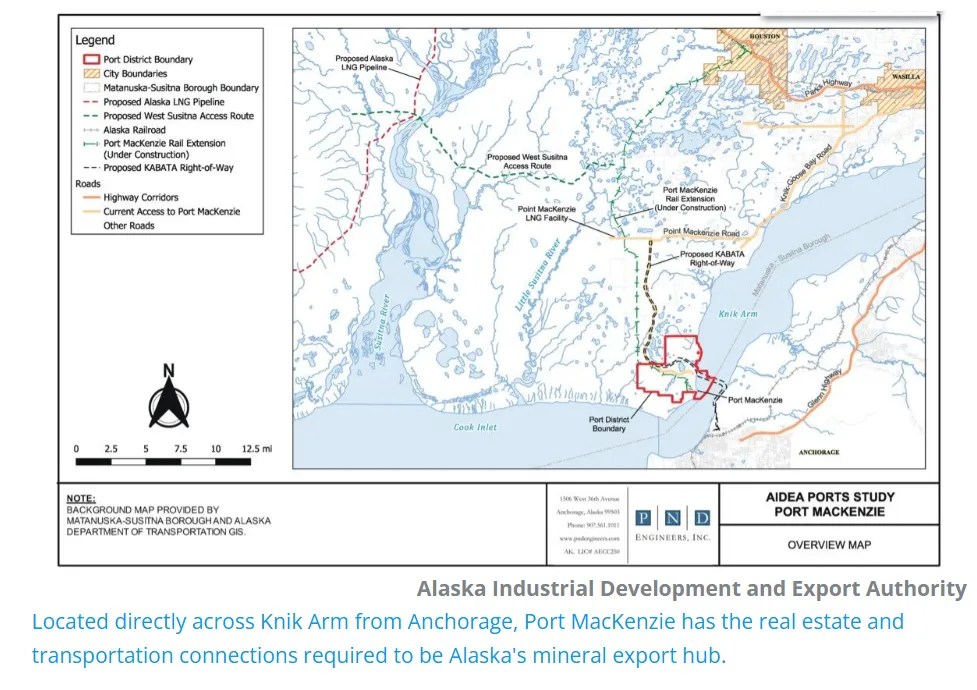
Global mining executives consider Alaska the richest jurisdiction on the planet in terms of mineral potential, but among the poorest when it comes to the transportation network required to realize that potential. A recent study prepared for the Alaska Industrial Development and Export Authority (AIDEA) envisions a transportation network anchored by Port MacKenzie in Southcentral Alaska as the solution.
“Port MacKenzie is uniquely positioned to support projected statewide mineral export demand,” PND Engineers wrote in the “Alaska mineral production, transportation, and port capacity study” prepared for AIDEA.
Currently, most of Alaska’s businesses and residents rely on the Port of Anchorage as the port- and rail-linked hub for ocean transport of goods. Situated on a strip of land between downtown Anchorage and the upper end of Cook Inlet, however, this port is limited by real estate and logistical constraints.
Just across the inlet, about 2.5 miles northwest of the Port of Anchorage, Port Mackenzie offers an alternative with large tracts of undeveloped land designated for industrial use, a connection to Alaska’s highway system, and a partially developed 32-mile rail extension that would connect the industrial port to the Alaska Railroad.
“When evaluated against throughput requirements, expansion potential, and lifecycle performance, Port MacKenzie emerges as the only port capable of scaling to accommodate sustained, high-volume, multi-commodity mineral exports,” PND concluded.
The report recommends strategic development at Port MacKenzie that begins with facilities to meet anticipated near-term transportation needs but is designed with the flexibility to scale as Alaska mines deliver increasing quantities of minerals and metals needed by the energy, tech, and industrial sectors of the 21st century.
Greek container vessel owner Danaos Shipping may need to order up to ten liquefied natural gas carriers to serve Glenfarne’s Alaska LNG project, according to Danaos CEO John Coustas.
Danaos sees need for up to 10 Alaska LNG carriers
LNG Prime Staff, February 11, 2026 (subscription required)
Last month, Danaos announced that it will make a $50 million equity investment in the Alaska LNG project, while it will also be the preferred tonnage provider to construct and operate at least six LNG carriers.
This is the company’s first move in LNG.
Coustas provided further details regarding the development during the Danaos fourth-quarter earnings call on Tuesday.
He was asked about the project timeline, the number of ships Danaos could bring to the project, and the duration of the charters.
“Well, the current timeline for the completion of the project is 2030,” he said.
“In terms of the number of ships, there are going to be between six and ten ships required for these volumes,” he said.
“It depends a bit also on the exact routing where these ships are going to be employed, but it will definitely be from Alaska to the Far East,” Coustas said.