

What the industry had been watching was not simply whether the field would flow, but what the Arctic would cost the machine to keep it flowing.
Across 100 miles of Arctic pipeline on Alaska’s western North Slope, a new oil field delivered its first barrels this spring and reset what the frozen tundra can produce
Hugo Rojas, Energies Media, September 21, 2026
Steel pilings hold every structure off the ground here, thermosyphons keeping the permafrost beneath them locked solid against the heat of the equipment above.
There are no roads in, no power grid to tap, and no room for error when the nearest warm building is a flight away.
This spring, crude from Pikka crossed more than a hundred miles of fresh pipeline and reached the Trans-Alaska Pipeline System for the first time.
The operator targets a production rate of 80,000 barrels per day for Pikka Phase 1, the ceiling the surface equipment was designed to handle as the well count grows.
What the industry had been watching was not simply whether the field would flow, but what the Arctic would cost the machine to keep it flowing.
Why the western North Slope presents a different engineering problem than anything to the east
The Pikka Unit sits within the Nanushuk Formation, a rock sequence known to geologists for years but long dismissed as too shallow and too tight to be commercially attractive. What changed was drilling technology: horizontal wells with long lateral reaches unlocked reservoirs that vertical drilling had left untouched, and the economics shifted fast.
Permafrost is the governing fact of construction here. Every surface structure must be elevated on thermosyphon cooled pilings that keep the ground frozen beneath them, because a warm foundation would soften the permafrost and sink. The gravel pads that underlie the drill sites required years of preparation, laid down during winter construction seasons when the tundra is solid enough to carry heavy loads without rutting.
So the field’s physical footprint was assembled piece by piece across four or five winter campaigns, with personnel and materials ferried in by ice road each season. That rhythm makes first oil a cumulative result of many cold-weather construction winters, not a single dramatic moment.
Selkirk Copper gives $200K US to scope out Port of Skagway to get ore to tidewater
Alaska port gets 1st funds from Yukon mine to study options for shipping critical minerals
Dana Hatherly, CBC News, September 21, 2026
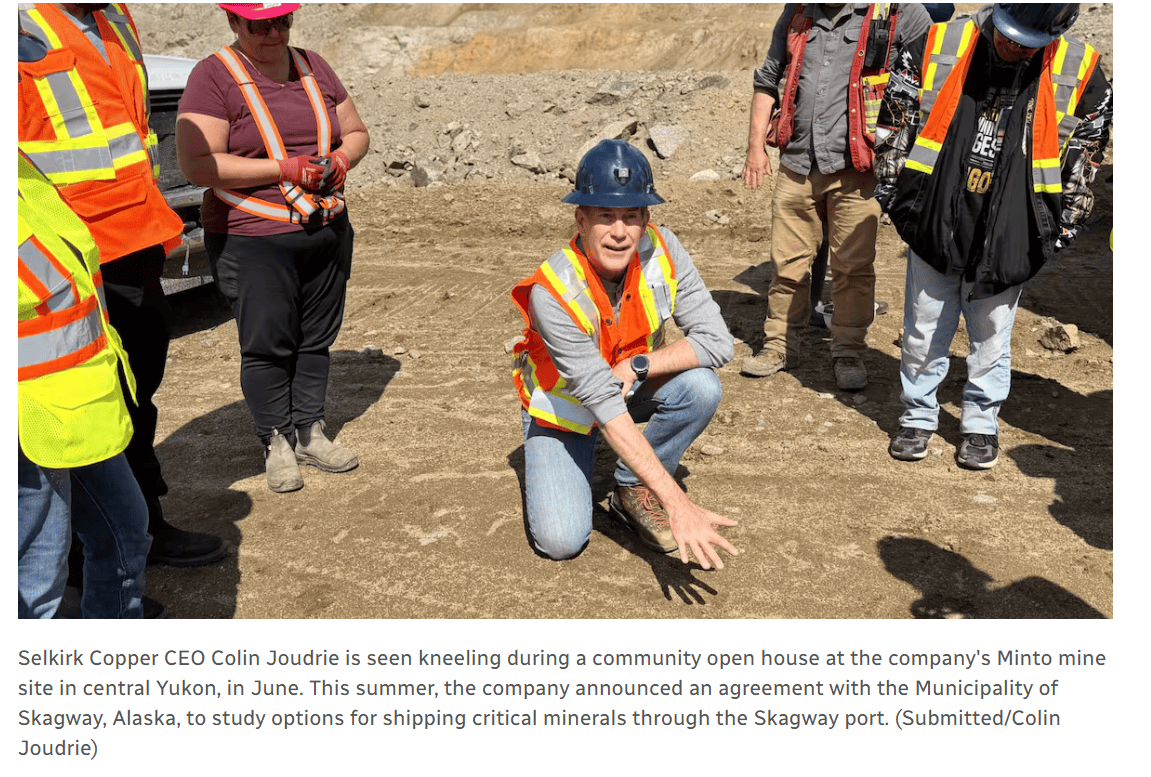
An Alaska port is getting its first swap of money from a Yukon mine to study options for shipping critical minerals to international markets.
Selkirk First Nation, based in Pelly Crossing, Yukon, has controlling interest in Selkirk Copper Mines Ltd., the proponent that’s looking to restart the former Minto copper-gold-silver mine. The mine, which is on the First Nation’s traditional territory, was abandoned by its previous owners in 2023.
Last month, Selkirk Copper announced an agreement with the Municipality of Skagway, Alaska, to finance a study “to evaluate options to safely, environmentally responsibly, and sustainably ship critical mineral concentrates” through the Skagway port.
Colin Joudrie, who heads Selkirk Copper, confirmed the $200,000 US from the mining company to Skagway marks the first exchange of funds between the parties to advance this work.
Joudrie said this particular relationship persists across the international border amid an escalating trade war between Canada and the U.S., initiated by President Donald Trump.
“The North is filled with people who want to do things and want to do things well. There’s a lot of community support both ways. I think there’s a long history here,” Joudrie said.
“I don’t think we should ever try to conflate things beyond what they actually are, in my view […] let’s focus on the task at hand and do our best. And if we can learn, and maybe other people can learn from it, then that’s a good thing.”
Jonathan Kreiss Tomkins and Bernadette Wilson advise caution, while Dave Bronson and Treg Taylor see economic opportunity
Where do Alaska’s four governor candidates stand on data centers?
James Brooks, Alaska Beacon, September 18, 2026
On the day that his campaign announced it had accepted hundreds of thousands of dollars in donations from employees of a California-based artificial intelligence company, Democratic governor candidate Jonathan Kreiss-Tomkins said that if elected, he will seek to temporarily ban new computing data centers in Alaska.
As Americans grow frustrated with artificial intelligence software and concerned about the side effects of data centers, they have become a major issue in this year’s midterm elections. Alaska’s gubernatorial race is no exception, particularly since the Alaska Industrial Development and Export Authority announced plans for a development that could include data centers in Southcentral Alaska.
All four candidates — Republicans Dave Bronson, Treg Taylor and Bernadette Wilson and the Democratic Kreiss-Tomkins — have staked out different policy positions before Alaskans vote this fall.
Data centers need reliable connections to the internet, cheap electricity and a cooling method. Currently, the North Slope is the most promising location for all three.
One $500 million proposal on the North Slope intends to burn local natural gas for power and use the natural cold air of the Arctic.
Another shipping-container-sized plan involves a gas-powered data center processing Bitcoin.