
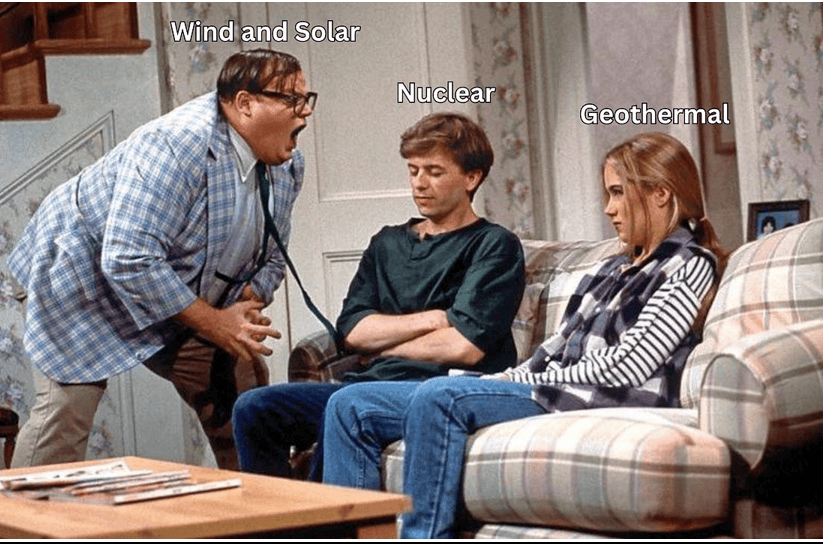
| GOP’s “Phase Out” of IRA Subsidies Isn’t Good Enough Isaac Orr, Mitch Rolling, Energy Bad Boys Without your money, wind and solar would be living in a van down by the river This week, the House Republicans released their initial draft reconciliation package for the energy subsidies in the so-called Inflation Reduction Act (IRA). Unfortunately, it appears they are not working to immediately eliminate the IRA subsidies for wind and solar, but are instead looking to “phase them out” starting in 2028 and completely eliminating them by 2032. This is simply not good enough because we’ve seen this movie too many times already, and it’s a bad one. It goes like this: Since the original Production Tax Credit (PTC) passed in 1992, when Isaac’s favorite show was Sesame Street and Mitch was a mere twinkle in his father’s eye, Republican lawmakers have been promising to “phase out” these subsidies in the future. However, when it comes time for the subsidies to actually go away, they are extended (often retroactively), and we continue the system of wealth transfers from hardworking Americans to unreliable energy producers. The problem with “phase-outs” is that they never come to fruition. In the past, the renewal of the wind and solar subsidies has not been a major issue for grid reliability, but those days are over. In the next five to ten years, the grid will face a growing risk of widespread rolling blackouts due to surging power demand, federal regulations incentivizing the retirement of reliable coal and natural gas power plants, and a proliferation of unreliable wind and solar resources that are a direct result of the federal subsidies. The main problem with the proposal by House Republicans is that they appear to view the wind and solar subsidies as a budgetary issue, and not a grid reliability issue. If we are going to subsidize any sources of energy, they should be dispatchable resources with the potential to outgrow the helping hand of government subsidization. Wind and solar have proven unable to do either. PTC “Phase Outs” If the history of the PTC—and many other “temporary” government programs—teaches us anything, it’s that you can’t trust a politician unless their mouth is closed. As we wrote in Grassley v. The Grid, when the first PTC was implemented in 1992, Senator Chuck Grassley, the “Father of the PTC,” noted that the intent of the subsidy was to be a temporary “jump start” to a fledgling wind industry in it’s “infancy,” reflected in the fact that it ended eligibility in December 1999. While not a “phase out,” the intent was clear: the subsidies weren’t supposed to last forever. Looking back, we wonder how many people understood “temporary” to mean over 40 years, or possibly forever, which it will hit according to the IRA. A History of Extensions The PTC has been extended 11 times since its inception in 1999, 2002, 2004, 2005, 2006, 2009, 2013, 2014, 2015, 2020, and 2021. The graph below shows when the PTC was enacted and extended, and for how long each time. While the original purpose involved “jump-starting” the industry to compete with other resources, it didn’t take long for the goalposts to move. As Tom Pyle argued in an excellent piece, lawmakers have since argued for PTC extensions using any excuse they can imagine: to artificially prop up jobs, aid in economic recoveries, create certainty for green investors and uncertainty for fossil fuel investors, and so on. It’s interesting to note that none of these are the proper roles of the energy industry, which is to provide a quality and affordable product to consumers,but once a government program, always a government program. Senator Grassley was a key figure in arguing for almost every PTC extension. In 2002, he argued for an extension, saying, “Extending the wind energy tax credit is vital to keep this clean energy source growing and creating jobs, especially in rural areas hit hard by economic challenges.” In 2004, he promoted another extension, saying, “Without the production tax credit, wind energy projects would grind to a halt. This extension keeps the industry moving forward and supports thousands of jobs.” Over 20 years later, and he’s still not wrong: even today, wind projects would plummet without subsidies. In 2009, he again called for another extension, this time using the Great Recession as justification, asserting that, “Extending it through 2012 ensures we keep building this industry, especially when our economy needs every job we can get.” In 2012—the twentieth anniversary of the PTC—the subsidy officially ended with no phase out… until it was resurrected and extended once again, thanks in part to Grassley, who argued, “If we let the wind tax credit expire, we’ll lose thousands of jobs and billions in investment. This extension is critical to keep the industry alive.” While some Republicans had been calling for a phase-out of the subsidies as early as 2005, the first official phase-out wasn’t implemented until 2015. This phase-out was canceled in 2020, however, using the economic turmoil from COVID as a reason to extend the subsidies again (similar to the Great Recession). As Travis Fisher noted in his excellent report on the cost of the IRA for the Cato Institute, the IRA extended the subsidies for wind and solar projects out to 2032 or when U.S. power sector greenhouse gas emissions decline to 25 percent of 2022 levels, whichever is later. Fisher notes the electricity sector is highly unlikely to reduce the GHG emissions by 75 percent from 2022 levels in the next 10 years, especially if electricity demand continues to grow, meaning the subsidies are likely to be a permanent fixture of the energy landscape. Where Republicans Stand on IRA Subsidies Now The Republicans in Congress have now proposed to phase the IRA subsidies sooner, starting in 2029 and ending in 2032, in addition to ending the ability to sell the credits to third parties and requiring projects to be “placed in service” as opposed to simply commencing construction (which is how the credit was applied prior to the 2013 extension). However, there appears to be some disagreement regarding these subsidies in the House and Senate. According to Politico, Republican Senator Kevin Cramer of North Dakota recently stated that the House plan to phase out the technology-neutral clean electricity tax credits beginning in 2029 would kneecap newer technologies that Republicans favor, like advanced nuclear reactors and geothermal, which are not ready to be deployed at a large scale. “They definitely need more time than that,” Cramer said. “It’s too short for truly new technologies. We’ll have to change that. I don’t think it’s fair to treat an emerging technology the same as a 30-year-old technology.” Cramer has issued his own proposal to phase out the credits only for wind and solar, arguing these technologies no longer need the tax credits. This is the correct tactic, but instead of a phase-out, the wind and solar tax credits should be cut cold turkey, yesterday. End Wind and Solar Subsidies, Yesterday The issues stemming from wind and solar subsidization are many. For one, they cost the American taxpayer $30 billion in 2023 and are expected to reach over $40 billion per year if the IRA subsidies continue. At a time when the Trump administration is looking to enact massive tax cuts, one of the best ways to succeed in this would be by ending the most expensive energy subsidies in history. Second, and even more damning, is the negative impact wind and solar subsidies have on grid reliability. These subsidies give Investor-Owned Utilities, like Arizona Public Service, cover for prematurely shutting down their reliable, low-cost coal plants and replacing them with billions of dollars in wind turbines, solar panels, and battery storage facilities. The subsidies also distort the energy markets to the point that reliable and affordable power plants are shutting down and threatening the reliability of the grid. These are facilities that even wind and solar rely on for resiliency and reliability attributes, like inertia, as demonstrated in the recent Iberian Blackout. The reliability threat to our grid is one of the most important issues facing the country, as it involves the foundation of our entire society. All lawmakers, especially Republicans, should be taking this extremely seriously. As seriously as Democrats take climate change. The Democrats play for keeps on energy. They use every regulatory lever of government at their disposal to punish energy sources they don’t like while propping up their preferred unreliable energy sources (wind and solar). Their strategy is simple: introduce as much Fear, Uncertainty, and Doubt (FUD) for coal, natural gas, or nuclear investments, while pearl-clutching about the need for financial and regulatory “certainty” for wind and solar. Republicans need to match this energy in the opposite direction. After Democratic administrations abused the EPA in an attempt to regulate coal plants out of existence and chill investment in new natural gas plants, all the while lavishing their preferred energy sources (wind and solar) with hundreds of billions of dollars in subsidies in perpetuity, the Republicans answer with a proposed “phase out” of the subsidies, which we know will never happen. As Tom Pyle from the Institute of Energy Research (IER) stated: History shows there is no such thing as a ‘phase down’ of these policies because they will inevitably be resurrected. If the goal is to protect taxpayers from never-ending subsidies and protect the electric grid from the destabilizing influence of the Production Tax Credit (PTC) and Investment Tax Credit (ITC), these tax credits need to be ended now. We don’t have time to simply “phase out” these subsidies. Every year they remain is another year the grid becomes less reliable and more expensive. READ MORE |