

The Alaska push matters for Canada because B.C. is trying to lock in long term Asian demand with projects now in different stages of development. LNG Canada has already begun shipping from Kitimat, and the province has pitched its northern coast as a direct Pacific corridor to energy hungry markets such as Japan and South Korea.
Trump’s Alaska LNG project is heating up, and that spells trouble for BC LNG projects
Geoff Ruff, Resource Works, March 5, 2026
The Alaska LNG project is the main rival for British Columbia’s natural gas export projects.
Alaska’s long discussed liquefied natural gas export plan is showing fresh signs of momentum, and industry watchers say it is a reminder that British Columbia’s head start in the Pacific LNG race is not guaranteed.
The proposed Alaska LNG project, priced at about US$44 billion, would move North Slope gas down a pipeline of roughly 800 miles to a liquefaction terminal for export to Asian customers. U.S. Interior Secretary Doug Burgum said last fall that a key engineering and cost assessment for the pipeline, known as a front-end engineering and design study, is expected to be completed in December.
“There’s a lot of optimism about the Alaska LNG project, and the FEED study should be coming out in December of this year, and I think that we’re going to see a lot of interest in that project,” Burgum said at an event hosted by the American Petroleum Institute.
Commercial momentum and key partnerships
The project’s developer, Glenfarne Group, has been working to convert years of planning into commercial commitments.
In November, oilfield services firm Baker Hughes said it would supply main refrigerant compressors for the proposed LNG terminal and provide power generation equipment for a gas treatment plant on the North Slope, and it also committed to a strategic investment in the project.
“With someone like Baker Hughes coming in it’s a stamp of approval,” Brendan Duval, chief executive of Glenfarne, told Reuters.
A Baker Hughes statement said the agreements were announced at a ceremony in Washington, D.C., attended by Burgum and U.S. Energy Secretary Chris Wright. Duval said Baker Hughes’ participation reflected “momentum” and the project’s ability to attract partners.
From David Blackmon – 5 Big Energy Stories – $100 oil is back with nowhere to go but up (subscription required)
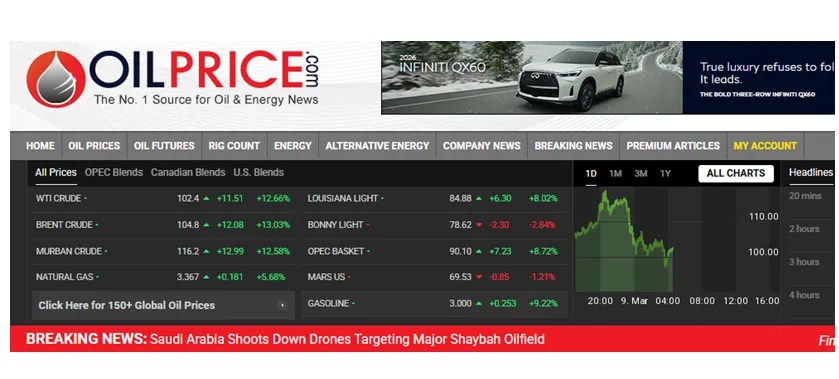
This is the chart of the year, courtesy of OilPrice.com. Brent at almost $105, WTI over $102, with nowhere to go but up so long as shipping traffic through the Strait of Hormuz remains at a standstill. At one point in overnight trading, both Brent and WTI approached the $120 mark. Expect both to do the same today unless something about current fundamentals changes for the better.
Over at Bloomberg, Javier Blas has a story up detailing the few alternate routes which exist to take crude out of the Persian Gulf region, but the pipelines he discusses can only move a fraction of the 20 million barrels of crude which normally transit the Strait each day.
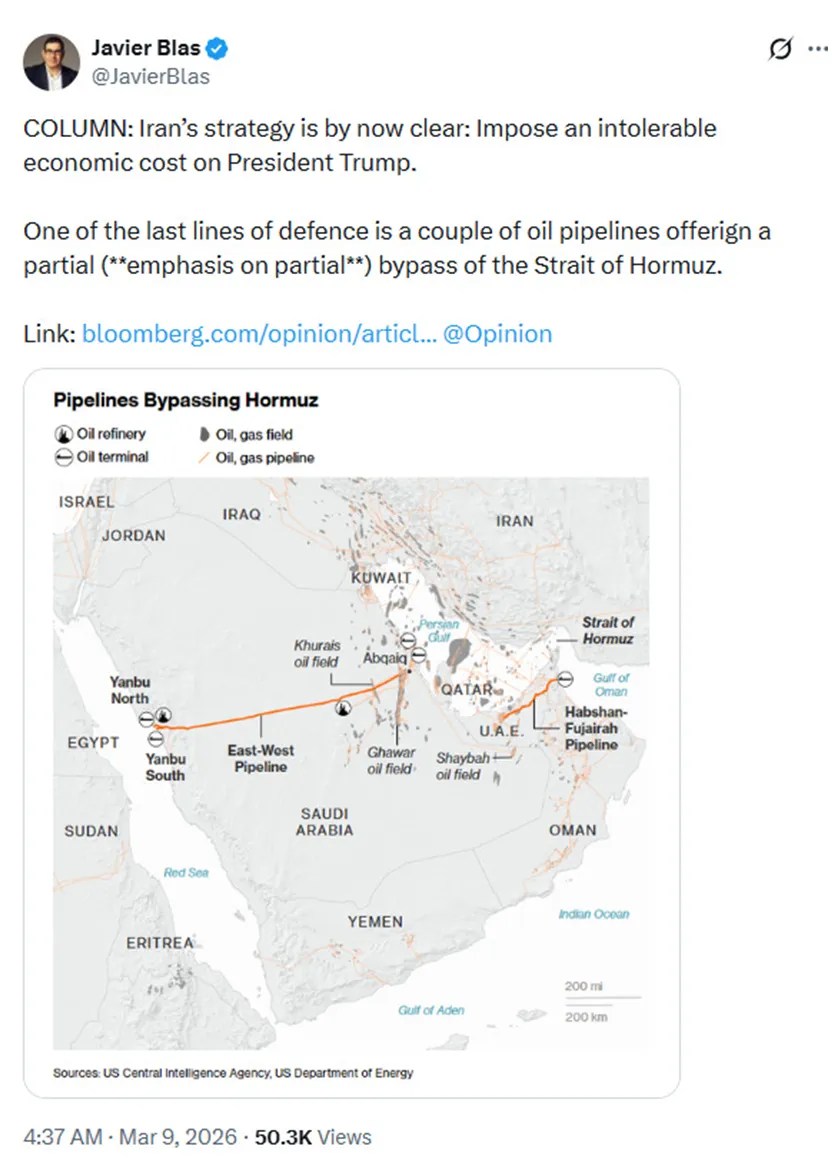
Key excerpt:
Washington: Iran’s strategy in its war with the US and Israel is by now clear: Impose an intolerable economic cost on President Donald Trump, forcing him to abandon his “war of choice” as American gasoline prices surge. Is there any way the Islamic Republic’s blueprint for survival can fail? Yes, if its old regional nemesis, Saudi Arabia, can cushion the oil market.
Enter the East-West pipeline, a 1,200-kilometer (746 mile) conduit crisscrossing the Arabian Peninsula from the Persian Gulf to the Red Sea. Its raison d’être is to meet this historic moment: Iran’s closure of the Strait of Hormuz. The Saudis built it 45 years ago thinking that one day, Tehran would manage to do what was then unthinkable and halt shipments through the narrow waterway.
Again, the pipelines he mentions are rated at about 8 million bpd, but real throughputs in the near term might be able to total around 6 mmbpd. Not enough to get prices moving in the other direction.