The proposed lease area includes 224 blocks stretching roughly from Kalgin Island in the north to Augustine Island in the south, the MMA statement revealed.
The Marine Minerals Administration (MMA) announced, in a statement posted on the Bureau of Ocean Energy Management’s (BOEM) website recently, the availability of a Proposed Notice of Sale for Big Beautiful Cook Inlet 2, or BBC2.
This is the second offshore oil and gas lease sale in Alaska’s Cook Inlet required by the Working Families Tax Cut Act of 2025, the statement noted, adding that the proposed sale would make approximately 1.05 million acres available for leasing in the northern portion of the Cook Inlet Planning Area. This is the same area offered in the Big Beautiful Cook Inlet 1 sale, held in March 2026, the statement pointed out.
The MMA outlined in its statement that, on Tuesday, it sent the Proposed Notice of Sale to the governor of Alaska and published a Notice of Availability in the Federal Register. This step began a 60-day regulatory review period for the state and affected local governments to submit comments and recommendations on the proposed sale’s size, timing, and location, the statement revealed, noting that the MMA will consider those comments and recommendations before issuing a Final Notice of Sale.
The Proposed Notice of Sale includes the proposed size, timing, and location of the sale, as well as lease stipulations, terms and conditions, minimum bids, royalty rates, and rental rates, the statement said.
“To encourage strong industry participation and support investment in domestic energy production, the proposed terms include a 12.5 percent royalty rate,” the MMA highlighted.
MMA will publish a Final Notice of Sale in the Federal Register at least 30 days before the scheduled bid opening, the statement said.
“Alaska remains central to America’s energy future, and Cook Inlet is an important part of that opportunity,” MMA Acting Director Mike Olsen noted in the statement.
President Donald Trump has announced that Taiwan will take roughly 30% of Alaska LNG output for two decades and contribute an additional $4.4 billion to the project, though Taipei has not yet locked in either commitment. Taiwan’s current plan is to buy about 6 million tons of LNG a year and join the development process, with the financial structure and ownership terms still to be negotiated. The potential deal could help ensure the development’s success while helping Taiwan broaden its fuel supply base, but commercial deliveries are not expected before 2032. API Smart Brief, October 14, 2026
A swing toward Democrats in Alaska’s major races continued Tuesday when the governor’s race was switched to “Lean Democrat” by The Cook Political Report, the third change by the ratings website since it classified the contest as “Likely Republican” a month ago.
An analysis at the election ratings website notes former state lawmaker Jonathan Kreiss-Tomkins, a Democrat, is polling far ahead of three Republican candidates — Bernadette Wilson, Dave Bronson and Treg Tayor — in the ranked choice contest.
“Other than Iowa, Alaska may be Democrats’ best opportunity to flip a governors’ mansion in a red state,” Jessica Taylor, an editor for the site, wrote in her analysis. “Former state Rep. Jonathan Kreiss-Tomkins (colloquially known as JKT) benefits from being the lone Democrat in the four-person field and is running comfortably ahead of conservative activist Bernadette Wilson and two other Republicans.”
“The concern for Republicans is that, amid a divided GOP field, Republican voters will only choose one of their candidates on their ranked-choice ballots rather than ranking multiple options, allowing Kreiss-Tomkins to consolidate a majority.”
The change is similar to rating shifts for the U.S. Senate, which have also shifted from favoring Republican incumbent Dan Sullivan at Cook Political Report as well as the election forecasting website Sabato’s Crystal Ball. The latter rates Sullivan’s race against Democrat Mary Peltola as “Leans Democratic,” having shifted it left twice since a “Leans Republican” rating in Juneau. The Cook Political Report rates the race a “Toss Up,” a shift made in June from “Lean Republican.”
Alaska last elected a Democratic governor in 1998 and a Democratic U.S. senator in 2008.
The shifts in Alaska also mirror forecasts and polling across the United States showing Republican candidates are struggling in areas that historically have been favorable toward the party.
Those struggles are widely attributed to President Donald Trump, whose approval ratings have plummeted due to cost-of-living and other concerns. He has responded with a series of campaign appearances in states that traditionally vote Republican, including a visit to Wasilla on Tuesday following a visit by Vice President JD Vance to Fairbanks last week.
Both ratings websites classify Alaska’s U.S. House race as likely Republican, with incumbent Rep. Nick Begich III polling well ahead of independent challenger Bill Hill.
The notice said the current project-by-project approach is inefficient, particularly in a region where seasonal limits and severe weather narrow the window for oil and gas work.
The Interior Department is exempting certain winter oil and natural gas drilling in Alaska’s National Petroleum Reserve from case-by-case environmental reviews, according to a notice to be published Friday in the Federal Register.
The change creates what is known as a categorical exclusion under the National Environmental Policy Act, allowing the Bureau of Land Management to approve certain projects without preparing a new environmental assessment for each one. It takes effect upon publication.
The exclusion covers bureau approval of seismic surveys, permits to drill and rights of way for wintertime exploration in the reserve, a roughly 23-million-acre area on Alaska’s North Slope.
Activities covered include seismic surveys using vibration-based equipment; temporary ice roads, snow routes and ice pads; camps and support equipment; water withdrawals; drilling and testing of appraisal wells, as well as suspending, plugging, or abandoning them; and helicopter-assisted cleanup the following summer.
The department said its finding is based on decades of experience with such projects. The Bureau of Land Management reviewed winter exploration projects approved over the past 28 years and found that all 47 environmental assessments resulted in findings of no significant impact.
The notice said the current project-by-project approach is inefficient, particularly in a region where seasonal limits and severe weather narrow the window for oil and gas work.
The exclusion does not apply automatically. The bureau must still confirm that each project fits the category and screen it for “extraordinary circumstances” that could cause significant environmental effects. If such circumstances exist, the agency must prepare a full environmental assessment or environmental impact statement
Also, we know Jonathan wants to raise taxes on oil companies structured as S-corps — specifically, on Hilcorp. But he’s also made clear that he thinks the oil industry shouldn’t be the only thing on the menu: He’s said that individual Alaskans should be part of the budget solution, too, likely through a sales or income tax.
Opinion: How pro-business Republicans see an impending ‘calamity’ in the November elections Anonymous, Anchorage Press, October 8, 2026 Say what you want about Republican Mike Dunleavy, Alaska’s governor for the past four years. I didn’t always agree with him. He picked some annoying social issues to take stands on, and he was obsessed with the Permanent Fund dividend.
But the guy was a great backstop to block bad ideas from the Legislature that would have hurt Alaska businesses.
And now, it looks like we’re in for a big change. A Democrat from Southeast Alaska, Jonathan Kreiss-Tomkins, is likely to be our next governor. Both the House and Senate look like they’re going to be led by mostly Democratic coalitions. Which means: Tax increases are definitely on the table, with the oil industry on the chopping block.
Calamity is the word many of the people in my conservative-leaning, pro-business world would use. Folks are already talking about how they’re going to try to protect themselves in Juneau; lobbyists who have good relationships with Democratic legislators are going to be in demand.
I want all Alaskans to know how people in the resource industries see this. And how annoyed I am at the Alaska Republican Party’s inability to develop a coherent strategy for the governor’s race, to recruit viable legislative candidates and to stand up a get-out-the-vote effort to help save U.S. Sen. Dan Sullivan. So, I’m writing this op-ed. It has to be anonymous, though — our companies don’t want the exposure or political risk that comes with speaking publicly, and official messaging would have to be formally approved and sanitized.
I can also offer some insight into why JKT is likely to win.
For one thing, everyone knows many conservatives aren’t going to rank all three GOP gubernatorial candidates, so votes are going to be wasted. But also, some of us can’t really get behind any of the Republicans — myself included.
I don’t care much about the social stuff, and I think if you’re out there promising a full Permanent Fund dividend, you can’t do basic algebra. So, I don’t have a home with Bernadette Wilson. Dave Bronson is a nice guy, and I respect his military service, but his time as mayor of Anchorage failed the governance test. Treg Taylor seems like a pro-business, relatively reasonable guy, but he’s also coming from fifth place in the primary and doesn’t seem to be moving the needle.
Jonathan makes me uneasy. He’s from Southeast Alaska, where people often take for granted the oil industry’s contribution to the state economy, and the contributions of other non-fishing resource industries. He and his running mate don’t have kids, and I’m worried that will make it hard for them to appreciate the needs of Alaska families. And while he seems like a pretty sincere guy and has picked up some business experience. READ MORE
The leading candidate for governor wants to “completely reassess” the Alaska Industrial Development and Export Authority and the projects it’s funding.
Some of Alaska’s most polarizing development projects — from oil drilling in the Arctic National Wildlife Refuge to a mining road in the Northwest Arctic — share a key feature.
They’re under the direction of the same state-owned corporation, one that’s been a lightning rod for diverging visions of Alaska’s economy and future.
In the past year, the board of the Alaska Industrial Development and Export Authority, or AIDEA, has approved some $250 million for Arctic oil exploration and two separatemining road proposals.
But only a fraction of that money has been spent. The projects haven’t been built.
And now, with Alaskans set to elect a new governor Nov. 3, AIDEA’s fate is in limbo.
If Democrat Jonathan Kreiss-Tomkins, the current frontrunner, wins the race to succeed outgoing Republican Gov. Mike Dunleavy, the export authority could be poised for a sharp change in direction.
In a recent interview, Kreiss-Tomkins said he’s been “frustrated” by the authority, citing concerns about a lack of transparency and a sense that it’s “rogue and off on its own.”
If elected, Kreiss-Tomkins said, he would “completely reassess everything that AIDEA is looking at.”
Following August meetings with energy, military, mining, and other industrial leaders in Alaska, U.S. Secretary of Energy Chris Wright has unveiled plans for the federal government to contribute up to $150 million in Defense Production Act funding toward a second high-voltage connection between Southcentral and Interior Alaska.
“Supporting improvements to Alaska’s transmission infrastructure with Defense Production Act funds reflects the Trump administration’s commitment to strengthening national security, improving grid reliability, and lowering electricity costs,” Wright said.
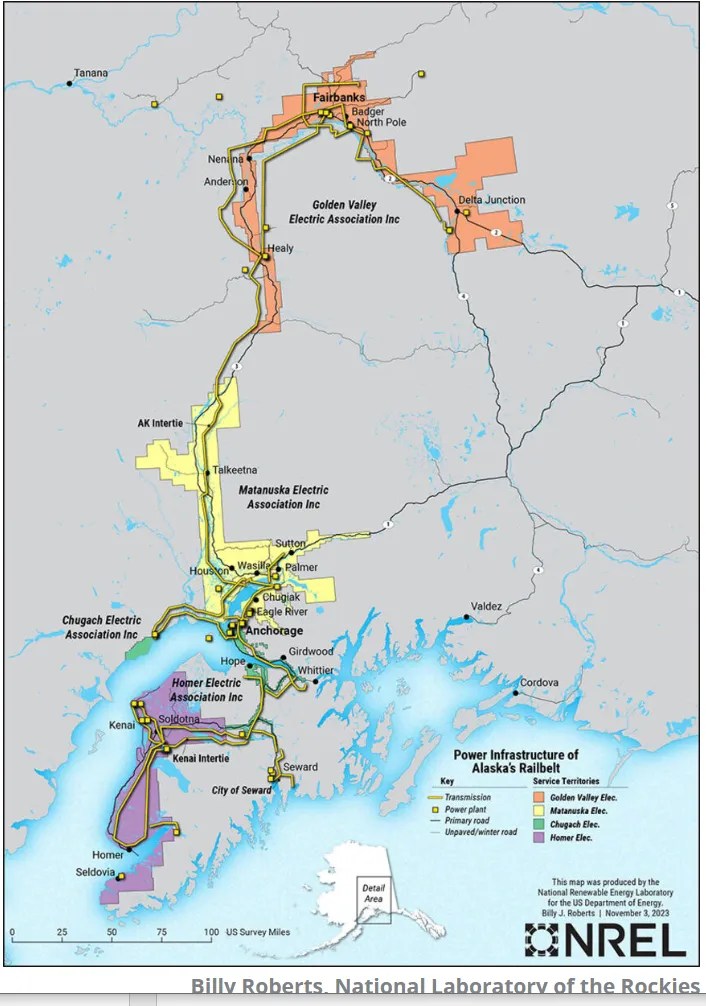
The approximately $418 million Beluga-Healy Transmission Project would involve the installation of roughly 223 miles of new 230-kilovolt transmission line between Beluga and Healy, providing a parallel pathway to move electricity along Alaska’s Railbelt.
The proposed line would run from the Beluga substation through West Susitna, where a new substation would be built, toward Willow and north to existing transmission infrastructure at Healy.
The project would also integrate with the Alaska Energy Authority’s Cook Inlet PowerLink project being developed to improve transmission between the Kenai Peninsula and Anchorage.
Together, the upgrades are aimed at increasing the capacity, reliability, and redundancy of a largely linear Railbelt electrical system that serves roughly 75% of Alaska’s population and five major military installations.
During Wright’s August visit to Alaska, industry and state leaders pointed to the need to upgrade and expand this transmission infrastructure as a top priority for lowering energy costs, increasing reliability, and accommodating major new electrical loads.
“It is true that the project had not moved forward in the past because its commercial viability was clearly low,” Kim said. “But following the war in the Middle East, it has clearly gained new strategic value.”
South Korea’s industry minister said Tuesday that a proposed Alaska liquefied natural gas project carried added strategic value for the country’s energy security, especially after the war in the Middle East, while reaffirming that any Korean participation would have to make economic sense.
Industry Minister Kim Jung-kwan made the remarks during a parliamentary audit of the Ministry of Trade, Industry and Resources, responding to a question from Rep. Choi Soo-jin of the ruling People Power Party over Seoul’s potential involvement in the massive US energy project.
London-listed junior 88 Energy has received “a number of bids” from player’s interested in farming into an exploration asset onshore Alaska.
The junior company said it plans to start drilling the Augusta-1 exploration well in the first quarter of 2027, targeting about 134 million barrels of unrisked resource potential.
This well is located in the South Prudhoe asset on Alaska’s North Slope for which 88 Energy is looking for partners.
The company said on Wednesday that the South Prudhoe farm-out process has progressed as planned, with detailed technical diligence completed by multiple counterparties which provides “strong validation” of the Augusta prospect and the South Prudhoe asset.
88 Energy said: “A number of bids have been received, with discussions and negotiations ongoing.” It aims to complete the proposed farm-out by the end of next month.
Drilling of Augusta-1 remains subject to completion of the farm-out and financing.
“The bottom line in this case is whether it’s…a public nuisance theory, whether it’s a consumer protection theory, what it really is an effort through litigation, backed by deep pocketed billionaires and a bunch of 1 percenters, to force their preferred lifestyle on the rest of the world.”
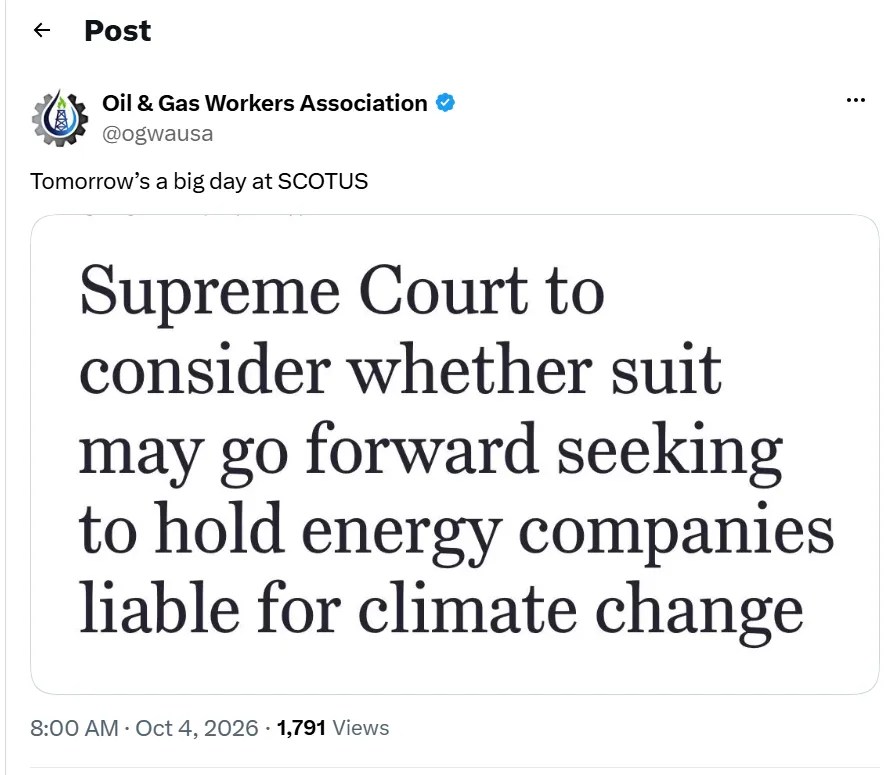
When the U.S. Supreme Court gavels in for its 2026-27 term on Monday, it will hear oral arguments in one of the key energy cases in recent years. It is no exaggeration to say that the Court’s ultimate ruling in the case styled Suncor Energy v. Boulder County could determine the success or failure of the American Energy Dominance agenda being pursued by President Donald Trump.
In a guest piece for the Wall Street Journal, former attorney general William Barr asserts that Boulder County should not be allowed to write American energy policy from a Colorado courtroom. Speaking to an audience in Texas this week, Barr said Boulder County’s case claims “interstate emissions have always been subject to regulation by the state. That’s not true.” He isn’t wrong.
Barr went on to add that “if Colorado doesn’t like what ExxonMobil is doing…they cannot sue ExxonMobil under their law for activities in Texas. That’s basic…and the plaintiffs’ theory ignores it.” There is no doubt the plaintiffs’ theory does ignore this basic facet of federal law – that the federal government has always held primacy when it comes to regulating air pollution under the Clean Air Act. That longstanding legal principle has led to a long series of similar cases brought by different plaintiffs using the same left-wing law firms being thrown out of courts all over the country over the last half decade.
The joint US-Ukrainian reconstruction investment fund has sealed its first critical minerals deal alongside four other new projects, one of its top US officials told Reuters.
The fund, established as part of the minerals pact the two countries signed in April last year following a push by US President Donald Trump, is focused on five strategic sectors from minerals and defense to energy and infrastructure.
Conor Coleman, head of investments at the US International Development Finance Corporation (DFC), said the fund’s projects now total around $70 million and showed Washington’s support for Kyiv in the long-running war with Russia.
“It’s absolutely imperative for the Ukrainian people that we’re investing now,” Coleman said in an interview, referring to the ongoing damage to Ukraine as it faces another winter.
The long-anticipated first minerals deal will inject roughly $30 million into a “joint investment platform” with BGV Group, a firm founded by Hennadii Butkevych, the billionaire co-owner of Ukraine’s largest supermarket chain ATB.
Coleman said it would initially focus on early-stage mining projects across Ukraine and target rare earths, uranium, beryllium and zirconium deposits.
“They are all on the US critical minerals list, so it ties in very well with what we’re looking to do from a (US) administration priority (standpoint),” Coleman said.
Power projects
Two of the other new projects announced on Friday aim to shore up Ukraine’s power and heating networks after a rise in Russian attacks on key infrastructure ahead of winter.
Coleman said one would add to the near $100 million the DFC has just agreed to lend Ukraine’s largest private energy company DTEK for a new battery system that will provide backup power to approximately 600,000 Ukrainian homes for up to two hours.
The project will also have “access to capital if damages arise.”
The fund will also take an equity stake in a combined heat and power co-generation platform designed to help build and run off a number of “energy hubs” aimed at restoring damaged electricity and heat supplies to households.
Coleman also said the fund was looking for more capital to increase its capacity.
The last time Alaska North Slope crude production averaged more than 550,000 barrels per day was March 2012, at about 558,000 bpd, according to US Energy Information Administration monthly data.
Alaska North Slope oil production has posted a daily reading of 551,247 barrels, an encouraging jump as new production from the Pikka oil field adds momentum to the state’s petroleum industry. That’s an amount not seen in 14 years.
The figure puts daily output well above the 500,000-barrel mark and substantially ahead of August’s average
“The North Slope renaissance is real, and we’re seeing it in the barrels flowing through TAPS. Stability matters—when Alaska provides a predictable investment climate, companies invest, projects move forward, and new production comes online. Our members are continuing the investment in Alaska’s future,” said Steve Wackowski, president and CEO of the Alaska Oil and Gas Association.
North Slope production had already crossed 500,000 barrels earlier in September. Alaska Department of Revenue daily reports showed production of 510,389 barrels on Sept. 2, when Alaska North Slope crude was priced at $93.60 per barrel.
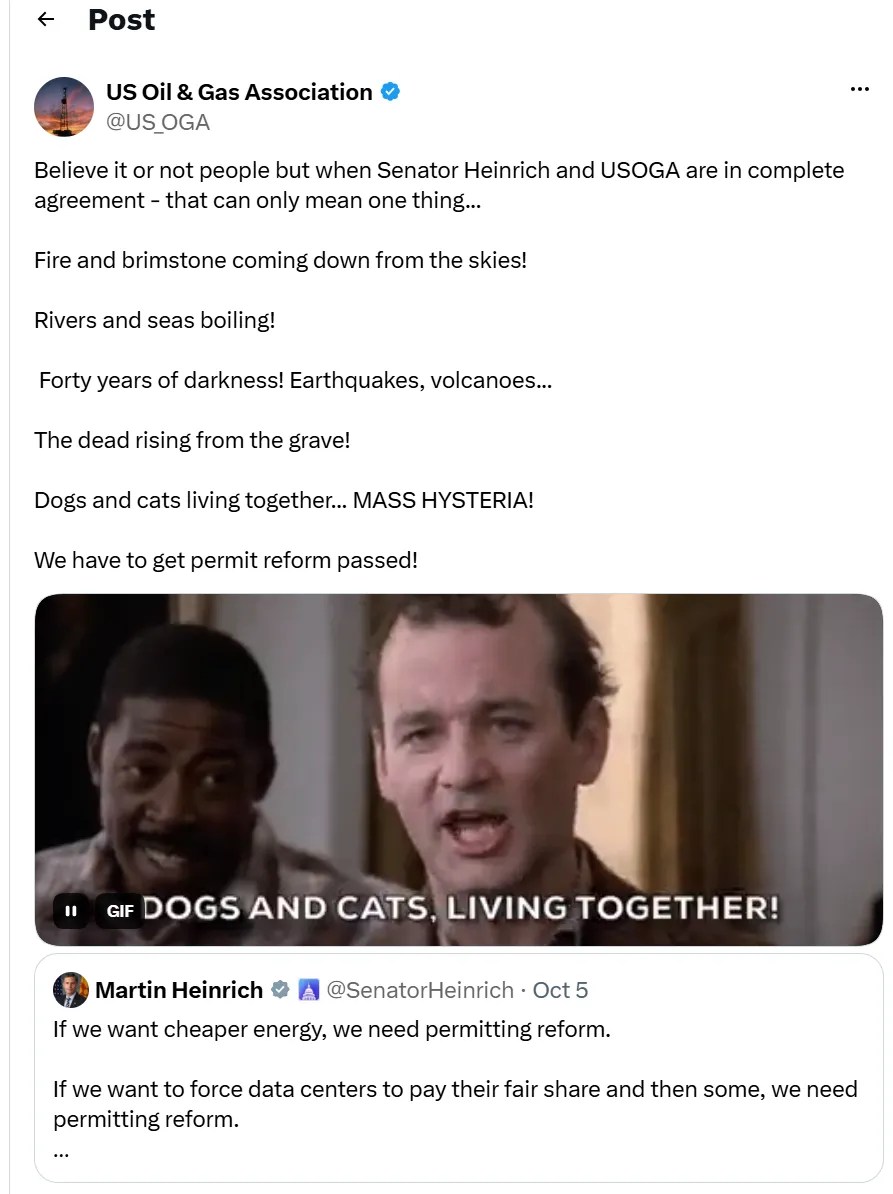
ENVIRONMENTAL GROUPS PLAN TO TANK PERMITTING BILL: Several major environmental organizations met this week to discuss how they could convince Democrats in Congress to tank the bipartisan permitting legislative package agreed to this week.
Not only does a transcript of the call reveal tactics they intend to use, but that the groups didn’t want key Democratic negotiators Sens. Martin Heinrich and Sheldon Whitehouse to find out.
The details: The call, reported by Daily on Energy alum Josh Siegel, featured about 89 people from groups like the Sierra Club, Center for Biological Diversity, Earthjustice, Defenders of Wildlife, Trust for Public Land, and more.
While the bipartisan permitting bill has been championed by both Republicans and Democrats, the environmental organizations say that the legislation includes cuts that go too far for the Endangered Species Act, the National Environmental Policy Act, and the Clean Water Act.
Participants on the call were candid that they wished to tank the bill, offering up tactics to do so.
“So, if we’re able to kill this bill, then I think that gives us good leverage to make the argument that this emerging alliance between the center and right all around tech finance and energy capital is not a good path forward, and that we need to rethink the political math underlying all of this movement,” Erik Schlenker-Goodrich with the Western Environmental Law Center said.
Other strategies floated included holding legal technical briefings for congressional staffers, educational briefings for reporters, and partnering with climate hawk members such as Sen. Ed Markey of Massachusetts.
One theme made clear throughout the call was that many of the organizations didn’t want key Democrats to find out.
“I think most of us are opposing it, but I just, you know, just to be totally candid, like if we really want to engage in tactics, I don’t want them getting back to Heinrich and Whitehouse,” Brett Hartl with the Center for Biological Diversity said.
By Friday morning, however, those tactics were made quite public through Siegel’s reporting.
Hartl later told him that he had no regrets for his remarks, and instead accused someone on the call of betraying “all of us.”
The bipartisan permitting package moving in the Senate – the American Affordability and Jobs Act, the “Freedom to Build” bill in plain English – is the first serious attempt in years to fix that.
Capito, Lee, Whitehouse, and Heinrich are not pretending the problem is a lack of studies. The problem is a system that treats delay as a virtue.
USOGA, API, IPAA, and the project developers who actually pour concrete are right. More than 650 major infrastructure projects are stuck in federal review, representing something on the order of $1.1 trillion to $1.5 trillion in investment.
McKinsey has estimated that construction costs rise 24 to 30 percent over long permitting timelines, mostly from materials, labor, and overhead while lawyers argue.
An ICF analysis commissioned by API finds comprehensive reform could cut residential electricity bills by a combined $55.6 billion from 2026 through 2035, support about 705,000 jobs, and generate nearly $24 billion in tax revenue by 2030.
That is the affordability case. It is math, not theory.
What the bill actually does:
Narrows NEPA so reviews cover impacts tied to the project, not every hypothetical downstream effect a litigant can invent.
Puts a 150-day clock on lawsuits and limits challenges to parties who commented and can show direct harm.
Stops courts from vacating a finished permit while an agency fixes a paperwork defect. Remand the document. Do not halt the job.
Keeps Clean Water Act Section 401 focused on water quality from a discharge, not a backdoor climate veto.
Makes statutory deadlines enforceable, including a path to court when agencies simply refuse to decide.
Environmental and safety standards stay. Endless process does not.
Senator Mike Lee put it cleanly: The bill makes it easier in America to build things.
Both parties claim they want lower power bills, more manufacturing, and data centers that do not stick households with the tab. None of that happens if every linear project spends a decade in review and another five years in court.
The Senate will need 60 votes after the midterms. Pass the bill. Finish the job this year. American energy should not have to wait in line for Washington’s bureaucracy.
As Tim Stewart, President of USOGA, said it all in a post Wednesday: “Pass the frickin’ bill so we can start building things again.”
Seven projects hold nearly 94B lb of copper; economics, infrastructure, policy, and courts will determine which reach production.
Alaska’s copper paradox is not rooted in a lack of metal.
Seven advanced exploration and development projects across the state contain nearly 94 billion pounds of copper in measured, indicated, and inferred resources, ranging from high-grade volcanogenic massive sulfide deposits in the Ambler District and Southeast Alaska to one of the world’s largest undeveloped porphyry systems.
What separates those resources from production varies sharply by project.
For some, road access remains the critical link. Others need additional drilling, engineering, capital, permits, or resolution of regulatory and legal barriers.
Together, Arctic, Bornite, Sun, Alaska Range, Palmer, Whistler, and Pebble provide a snapshot of Alaska’s copper pipeline at a time when record prices and expectations of tightening global supply are putting renewed attention on the state’s enormous endowment of the red metal.