If the United States institutes a ban on diesel fuel exports, Goldman Sachs analysts estimate it would initially push prices lower. The effect, however, would only continue until storage space fills up, the bank warned.
Amid reports on the possibility that Washington may suspend diesel fuel exports for a period of 90 days, the investment bank’s analysts calculated that the move, once in effect, could reduce diesel fuel prices by about $0.25 per gallon every week—until diesel storage capacity fills. Once that happens, prices at the pump will start climbing higher again, but this time for gasoline, Reuters reported, citing the bank.
“The longer a diesel export ban lasts, the more disruptive it would likely be by putting upward pressure on gasoline prices because diesel, gasoline, and jet fuel are largely produced together,” Goldman Sachs’ commodity analysts said in a note. According to them, once available storage space fills with gasoline, gasoline prices could add $0.30 per gallon per week.
Meanwhile, the diesel ban would also push up fuel prices in Europe as well, as the continent is the biggest buyer of U.S. energy commodities. Goldman estimates the price effect at $3 per barrel of diesel, equal to about 2% of current prices. An emergency inventory release could cushion the blow by about 50% of that price rise, according to the bank.
“Once a diesel ban is lifted, US diesel prices would likely reconnect with prices elsewhere, including Europe, putting upward pressure on US diesel prices and downward pressure on prices abroad,” the analysts also said.
This raises the question of whether there is even a point to a diesel export ban, if its immediate effect would be short-lived, would then turn adverse on gasoline prices, and eventually, once the ban is lifted, diesel prices would rebound.
Alex Metals Corp., a new discovery-driven exploration company focused on volcanogenic massive sulfide prospects in Southeast Alaska, has raised roughly C$16.1 million ($11.4 million) through financings tied to its public debut and is listed on the TSX Venture Exchange under the ticker symbol ALX.
“Alex Metals is coming to trade near the end of our first field season, during which we drilled four targets across two projects while completing significant geophysics, mapping, and sampling across our portfolio in Southeast Alaska,” said Alex Metals President and CEO Gwen Preston.
As a former journalist for the Northern Miner and founder of the Resource Maven newsletter, Preston is a familiar name to executives, investors, and others following mining and mineral exploration in North America.
She is joined by Chairman Darwin Green, a mining executive and exploration geologist with more than 25 years of experience in Alaska and Canada, including advancing exploration of the Niblack and Palmer VMS projects in Southeast Alaska.
Alex Metals’ geological team is led by Vice President of Exploration Nathan Steeves, who launched his career with research focused on the Palmer and Greens Creek VMS deposits in Southeast Alaska while earning his PhD from the Centre for Ore Deposit and Earth Sciences at the University of Tasmania.
Glenfarne’s Magnolia LNG has secured a five-year extension from the US FERC to complete construction and place into service its planned liquefaction and export plant in Louisiana.
In 2020, Magnolia LNG secured a five-year extension from FERC to complete the facility located near Lake Charles in Calcasieu Parish by April 15, 2026.
Magnolia filed a request with FERC in January this year, seeking an additional five-year extension until April 15, 2031, to complete construction and place the project in service.
The LNG terminal developer told FERC in that request that “good cause” exists to grant its requested extension of time, as Magnolia faced “substantial, unprecedented delays at DOE that could not have been foreseen and were completely outside Magnolia’s control.”
“Because we find that Magnolia has demonstrated good cause for its inability to meet the deadline for constructing and placing into service the Magnolia LNG project and has shown good faith efforts to complete the project, we will grant a five-year extension of time to complete construction of the project and place it into service,” FERC said in its order issued on Tuesday.
Magnolia LNG is granted a five-year extension of time, until April 15, 2031, to construct and make available for service the Magnolia LNG Project.
“Fully committed to realizing the project”
Magnolia said in the January request that regulatory delays at DOE naturally impacted the company’s ability to develop the project, hampering Magnolia’s efforts to secure offtake and advance commercial development.
At the time of DOE’s pause, Magnolia had already shortlisted two major engineering and procurement contractor (EPC) companies from a larger initial group of potential contractors, the firm said.
However, the negotiations as part of this EPC company selection process had to be ceased due to lack of clarity on the status of Magnolia’s non-FTA authorization.
“Notwithstanding these delays, Magnolia remains fully committed to realizing the project, with Magnolia incurring substantial expenditures to develop the project and maintain necessary permits,” it said.
Magnolia’s work has included expenditures for site acquisition, property taxes, facility engineering, technical consulting services, safety and marine consulting services, legal services, and community relations activities.
Moreover, Magnolia noted that it is also a core component of the LNG portfolio of its corporate parent, Glenfarne.
Glenfarne is actively engaged in developing the Texas LNG and Alaska LNG projects.
“Simply put, there is no question that Magnolia is and has remained fully committed to developing the project despite these delays, and an extension of time is necessary to ensure that Magnolia can reach FID and commence and complete construction under a valid authorization,” the company said.
The company recently also signed a long-term feed gas deal with Texas Eastern Transmission for its planned liquefaction and export plant in Louisiana.
Magnolia revealed the signing of the agreement in a letter to the US FERC dated August 10, supplementing its five-year extension request from January.
Despite the 10-point lead for Kreiss-Tomkins in the final round of the poll, it’s a much closer race than the headline numbers make it seem…That’s because nearly one in five voters — 18% — told the pollsters they were undecided, so they didn’t play a role in the final tabulation.
Republican Bernadette Wilson is again calling on fellow Republicans Dave Bronson and Treg Taylor to drop out of the race to be Alaska’s next governor. That’s after an AARP-sponsored poll showed Democrat Jonathan Kreiss-Tomkins winning the race by 10 percentage points after ranked choice tabulation.
“That poll issues a stark warning to Alaskans,” Wilson said in a social media video Friday. “It shows us that we are at risk of electing a Democrat to the governor’s race.”
The poll has fed Democrats’ optimism that they can take back the governor’s mansion for the first time since Tony Knowles left office in 2002.
It would be a startling turn in a state that reelected Republican Gov. Mike Dunleavy by a landslide in 2022 and voted for President Donald Trump by a 13-point margin just two years ago.
“Alaska hasn’t seen a gubernatorial campaign like this in a generation, and the polls are showing it,” Kreiss-Tomkins’ campaign said in a message to supporters Tuesday.
Forecasters are taking notice.
“It is a very strange race,” said Kyle Kondik, the managing editor of Sabato’s Crystal Ball, an election-forecasting outfit housed at the University of Virginia’s Center for Politics.
South Korea’s government briefs parliament on $350 billion US investment package
Lawmaker says Seoul picked Texas gas power plant as first potential project
President Lee has said commercial viability was a sticking point in project-level talks
South Korea confirmed its first project under a $350 billion US investment pact on Tuesday and said it is considering two others, moving ahead despite profitability concerns and criticism from President Donald Trump over the pace of implementation.
Seoul has selected a gas-fired power plant project in Texas, while also considering a proposal to invest in two South Korean-designed nuclear reactors as part of a broader nuclear investment initiative, lawmaker Chung Chin-ook said on the sidelines of a briefing by Industry Minister Kim Jung-kwan.
Judge Jane Beckering of the US District Court for the Western District of Michigan has dismissed Michigan’s antitrust lawsuit against BP, Chevron, ExxonMobil, Shell and the American Petroleum Institute, which accused them of suppressing competition from renewable energy and electric vehicles while driving up consumer energy costs. Beckering found that federal antitrust law offered no remedy for most of the alleged harms and that the claimed conspiracy was too remote from energy overcharges to establish causation. “Climate policy is a federal, not state, issue, and we are pleased with the court’s decision,” said API Senior Vice President and General Counsel Ryan Meyers.
Steel pilings hold every structure off the ground here, thermosyphons keeping the permafrost beneath them locked solid against the heat of the equipment above.
There are no roads in, no power grid to tap, and no room for error when the nearest warm building is a flight away.
This spring, crude from Pikka crossed more than a hundred miles of fresh pipeline and reached the Trans-Alaska Pipeline System for the first time.
The operator targets a production rate of 80,000 barrels per day for Pikka Phase 1, the ceiling the surface equipment was designed to handle as the well count grows.
What the industry had been watching was not simply whether the field would flow, but what the Arctic would cost the machine to keep it flowing.
Why the western North Slope presents a different engineering problem than anything to the east
The Pikka Unit sits within the Nanushuk Formation, a rock sequence known to geologists for years but long dismissed as too shallow and too tight to be commercially attractive. What changed was drilling technology: horizontal wells with long lateral reaches unlocked reservoirs that vertical drilling had left untouched, and the economics shifted fast.
Permafrost is the governing fact of construction here. Every surface structure must be elevated on thermosyphon cooled pilings that keep the ground frozen beneath them, because a warm foundation would soften the permafrost and sink. The gravel pads that underlie the drill sites required years of preparation, laid down during winter construction seasons when the tundra is solid enough to carry heavy loads without rutting.
So the field’s physical footprint was assembled piece by piece across four or five winter campaigns, with personnel and materials ferried in by ice road each season. That rhythm makes first oil a cumulative result of many cold-weather construction winters, not a single dramatic moment.
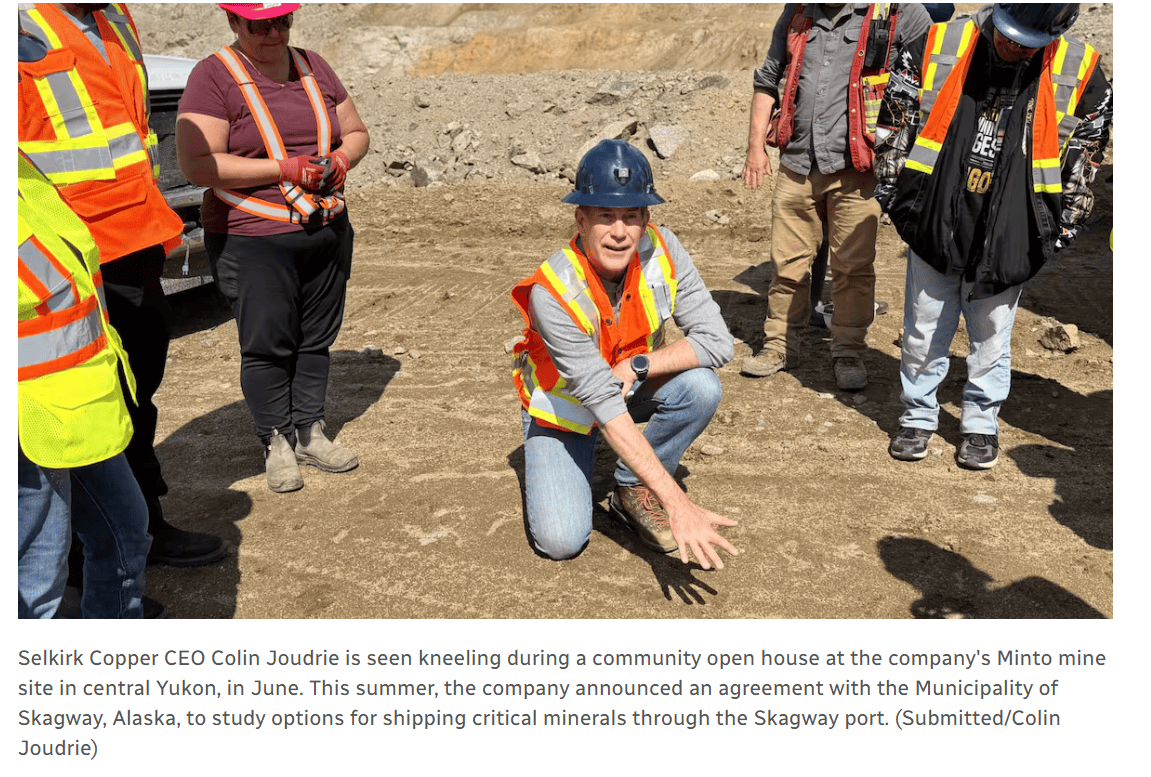
An Alaska port is getting its first swap of money from a Yukon mine to study options for shipping critical minerals to international markets.
Selkirk First Nation, based in Pelly Crossing, Yukon, has controlling interest in Selkirk Copper Mines Ltd., the proponent that’s looking to restart the former Minto copper-gold-silver mine. The mine, which is on the First Nation’s traditional territory, was abandoned by its previous owners in 2023.
Last month, Selkirk Copper announced an agreement with the Municipality of Skagway, Alaska, to finance a study “to evaluate options to safely, environmentally responsibly, and sustainably ship critical mineral concentrates” through the Skagway port.
Colin Joudrie, who heads Selkirk Copper, confirmed the $200,000 US from the mining company to Skagway marks the first exchange of funds between the parties to advance this work.
Joudrie said this particular relationship persists across the international border amid an escalating trade war between Canada and the U.S., initiated by President Donald Trump.
“The North is filled with people who want to do things and want to do things well. There’s a lot of community support both ways. I think there’s a long history here,” Joudrie said.
“I don’t think we should ever try to conflate things beyond what they actually are, in my view […] let’s focus on the task at hand and do our best. And if we can learn, and maybe other people can learn from it, then that’s a good thing.”
As Americans grow frustrated with artificial intelligence software and concerned about the side effects of data centers, they have become a major issue in this year’s midterm elections. Alaska’s gubernatorial race is no exception, particularly since the Alaska Industrial Development and Export Authority announced plans for a development that could include data centers in Southcentral Alaska.
All four candidates — Republicans Dave Bronson, Treg Taylor and Bernadette Wilson and the Democratic Kreiss-Tomkins — have staked out different policy positions before Alaskans vote this fall.
Data centers need reliable connections to the internet, cheap electricity and a cooling method. Currently, the North Slope is the most promising location for all three.
One of the GOP’s biggest worries is that their voters, who are skeptical of a ranked choice system that the party has relentlessly criticized, won’t rank candidates beyond their first choice.
Last week, we shifted the four-way Alaska gubernatorial race one step in Democrats’ direction into the Lean Republican column. But this week we have gotten further evidence that the lone Democrat in the race, former state Rep. Jonathan Kreiss-Tomkins, is opening up an advantage that merits putting the contest into Toss Up as the race continues to develop.
As we noted earlier, Republicans are rightly worried that their three candidates listed on the ballot are splitting the vote in the ranked-choice contest. A bipartisan AARP poll conducted by FabrizioWard/Impact Research shows Kreiss-Tomkins taking 40% in the first round of voting, followed by conservative activist Bernadette Wilson at 20%, former Anchorage Mayor Dave Bronson at 14% and former Attorney General Treg Taylor at 7%, with 18% undecided. In a ranked choice simulation, Kreiss-Tomkins eventually wins the contest 55%-45%. Private Democratic polling also tracks with the AARP poll results.
Eighty-seven percent of likely voters 50 and older rated their motivations to vote a 10 on a 10-point scale, compared with 62% of voters under 50. Among voters younger than 35, 43% gave themselves the highest rating.
Alaska voters 50 and older report much higher motivation to vote in November than younger voters, according to an AARP survey that also found groceries and gasoline dominate affordability concerns across age groups.
The poll’s likely-voter model puts Alaskans 50 and older at about 63% of the electorate, pollster Bob Ward of Fabrizio Ward said in an interview Thursday. The gap in self-reported motivation is one reason, he said, to pay attention to age when examining the results of Alaska’s statewide races.
#image_title
Republicans have been looking for every possible solution to bring down soaring diesel and gasoline prices, but there’s one the Trump administration still won’t go for: an export ban.
Secretary Wright shot down the possibility of the administration endorsing any type of ban on fuels this morning, saying that while the U.S. is a net exporter of products like diesel, the country does still import gasoline.
“We consume a larger percent of gasoline out of each barrel of oil than a barrel of oil yields,” Wright said.
He explained that if the U.S. were to stop exporting diesel, refineries would slow down their operations, as they would run out of places to sell that product. As a result, refineries would start producing less gasoline, leading to higher prices at the pump.
“It’s a globally interconnected system,” Wright said. “The thing we need when prices are high is more supply. We need to do everything we can to grow supply, and if you start putting barriers on flows, pretty quickly you will reduce the production, and you’ll have less supply.”
Senate Majority Leader John Thune expressed interest in a diesel export ban earlier in the week, saying that if it were to take pressure off prices, he was “open to exploring it.” The idea, however, has also been shot down by other administration officials, including Interior Secretary Doug Burgum.
Wright’s remarks come as experts warn gas and diesel prices will spike even higher in the coming days.
“This milestone reflects the hard work and commitment of our project team, investors, and partners as we continue building a first-of-its-kind facility for Alaska’s North Slope,” said JR Wilcox, CEO of Alyeschem. “By producing methanol and ultra-low sulfur diesel close to the resources and operations that need them, Alyeschem is helping create new value from Alaska’s natural gas while supporting a stronger, more resilient industrial supply chain.
Construction of Alyeschem’s North Slope chemical and fuels manufacturing facility continues to make steady progress, with project officials reporting that the final foundation pile was installed over the weekend, marking another key milestone in the buildout of the facility.
Located in Prudhoe Bay on an existing AIDEA-developed gravel pad, the Alyeschem facility is designed to produce methanol and ultra-low sulfur diesel (ULSD) using North Slope natural gas and captured carbon dioxide, with hydrogen used in the refining process. The project represents a significant opportunity to monetize stranded North Slope natural gas resources while expanding Alaska’s manufacturing capacity and strengthening the state’s energy infrastructure and inventory of Alaska’s diesel supply.
Alyeschem broke ground on the project earlier this year following AIDEA’s investment in the development. The facility is expected to support approximately 80 construction jobs and 15 permanent operations positions while generating new economic activity for the North Slope Borough and the State of Alaska.
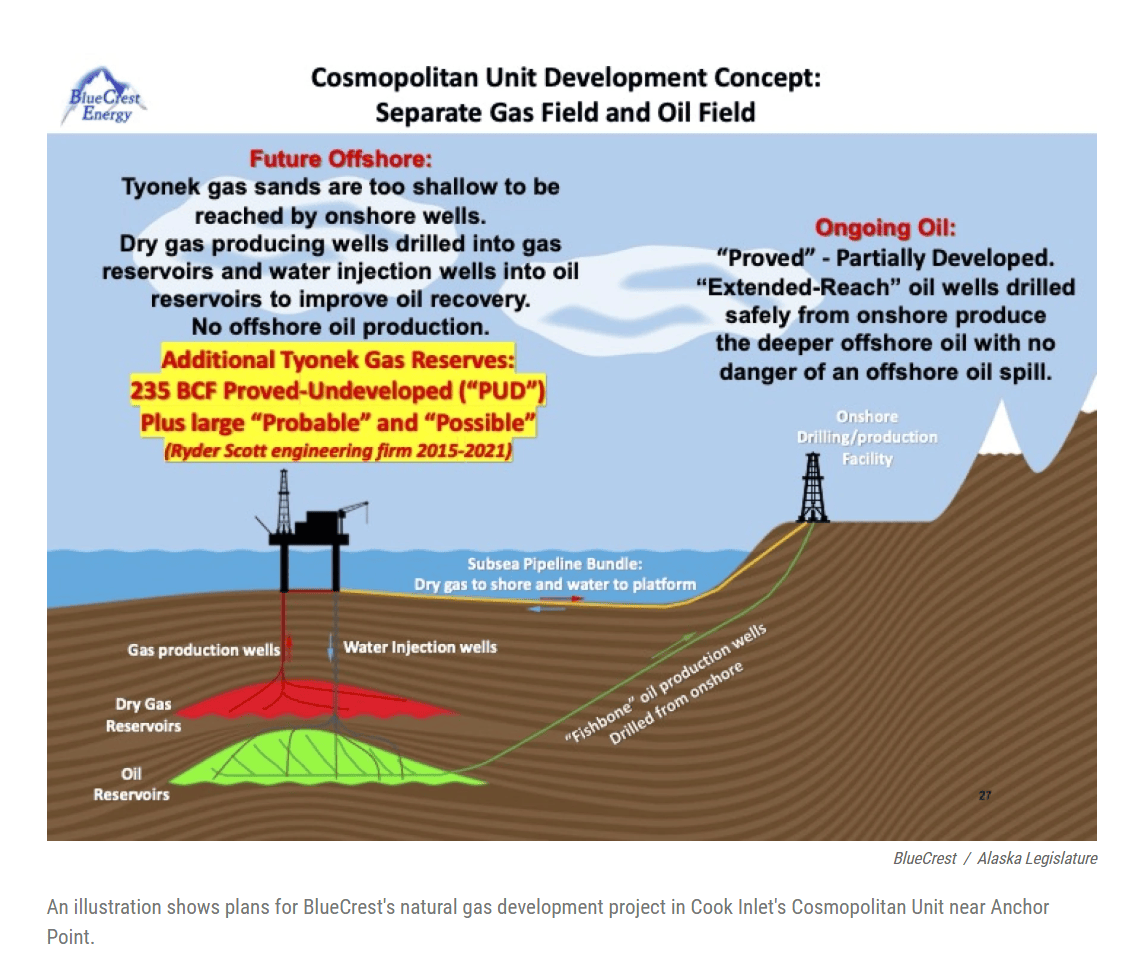
BlueCrest Energy Inc. estimates it can extract 25 million cubic feet of natural gas per day once the new well comes online. That amounts to about 13% of the annual demand for Cook Inlet gas.
BlueCrest says it will drill from an existing pad on the east side of Cook Inlet. The company owns all of the so-called Cosmopolitan Field near Anchor Point, which it has long said holds proven but undeveloped natural gas reserves.
“We know the gas is there,” BlueCrest CEO Benjamin Johnson told state lawmakers about the Cosmopolitan Unit in 2024. “There’s no question. It is a matter of getting the funding to develop that gas, and that’s what our main focus is.”
It’s been less than a month since the state Department of Natural Resources threatened to revoke the company’s leases. The department wrote the company a stern letter, giving BlueCrest 30 days to prove it could fund more development, or risk losing access to the unit.
In 2023, BlueCrest received a $30 million grant from Alaska’s state-run development agency to support its onshore drilling efforts in the Cosmopolitan Unit.
BlueCrest’s announcement comes as Southcentral Alaska’s largest natural gas utility says demand for gas could outpace supply as soon as this winter. ENSTAR Natural Gas says it could run 18 days short of supply if this winter follows typical temperature trends.
Cook Inlet’s largest developer, Hilcorp Alaska, has warned for years that it’s no longer economic to spend more money drilling for riskier gas in the state’s oldest basin. The advent of the Cook Inlet gas shortage has sent companies scrambling to secure enough resources for the region’s relatively small market.
With the new development, BlueCrest says it’s proud it will be part of the solution to that energy crisis. Johnson, the company CEO, declined to answer questions about the announcement, saying the company would prefer to let the news release speak for itself.
Australian LNG player Santos has signed two separate, non-binding LNG agreements that underscore the company’s growing global LNG portfolio position.
Santos entered into a non-binding heads of agreement to buy LNG from the Ksi Lisims LNG project in Canada and the company agreed key commercial terms with South Korea’s Posco Steel to supply the latter with LNG.
US energy firm and LNG terminal developer Glenfarne has promoted Texas LNG director Oliver Wood to global head of projects.
In this newly created role, Wood will guide all engineering and construction activities across Glenfarne’s North American LNG portfolio, according to a Glenfarne statement.
Wood will be part of Glenfarne’s executive team leading technical definition, development and contracting strategy, project execution and controls, safety, and operational readiness for the company’s LNG projects in Alaska, Texas, and Louisiana.
He brings 20 years of project experience in the oil and gas industry, including more than a decade in management positions.
Wood joined Glenfarne in May 2023 as construction and module director for Texas LNG and was appointed as project director of the planned 4 mtpa Texas LNG export project in the port of Brownsville last year.
“Oliver has been instrumental in successfully advancing our Texas LNG project and building our companywide project execution capabilities,” said Glenfarne CEO and Founder Brendan Duval.
“In his new role he will ensure that our projects are developed according to the strategic, commercial, and operational objectives that are central to Glenfarne’s long-term growth. His deep technical and commercial expertise and hands-on leadership make him the right choice to guide engineering and construction across our LNG projects,” Duval said.
Universities can receive up to $1M PROSPECT Prize to rapidly expand critical minerals education, training pathways
To help build the workforce needed to rebuild America’s critical mineral supply chains, the U.S. Department of Energy’s Office of Critical Minerals and Energy Innovation is inviting universities across the nation to receive up to $1 million to accelerate mining and minerals education and training.
DOE’s Office of Critical Minerals and Energy Innovation on Sept. 14 opened the $16 million PROSPECT Planning Prize, a competition aimed at developing implementation-ready programs that substantially increase the number of graduates and other credentialed professionals prepared to produce, process, recover, and recycle critical minerals in the United States.
“Mining and critical minerals professionals are essential to America’s success in manufacturing, AI, energy, and national security – but this country isn’t producing enough of them,” said Assistant Secretary of Energy Audrey Robertson.
DOE says America’s 14 accredited mining schools graduate only about 170 mining engineers per year, well short of the 6,000 new engineers forecast to be needed over the coming decade.
The need, however, extends well beyond mining engineers.
Rebuilding U.S. mineral supply chains will also require geologists, metallurgists, mineral processors, materials scientists, automation and data specialists, equipment operators, electricians, welders, and other skilled workers needed to build and operate mines, processing plants, refineries, and recycling facilities.
DOE began addressing this human infrastructure challenge in August with the launch of its $100 million Providing Opportunities for Specialized Education in Critical Technologies initiative.
Aptly shortened to PROSPECT, the initiative has a near-term goal of doubling the number of graduates earning mining, minerals, and associated supply chain credentials across the U.S.
That broader initiative is one piece of more than $180 million in mining education, workforce development, technology commercialization, and materials training investments unveiled during an Aug. 7 critical minerals roundtable at the White House.