Both Democrats told the petroleum industry audience that they favored changes that would bring the state more revenues from oil producers. Their plans include a statewide corporate income tax on oil producers that are S corporations, also known as pass-through corporations, that currently do not pay them.
At their first candidate forum since the Aug. 18 primary election, the four remaining gubernatorial hopefuls pitched visions for the state’s future that revealed sharp political divides.
Speaking at the event, held at the Alaska Oil and Gas Association’s annual conference in Anchorage, were Democrats Jonathan Kreiss-Tomkins and Tom Begich and Republicans Bernadette Wilson and Dave Bronson. Kreiss-Tomkins has been leading in the still-ongoing primary election vote count, with 22.2 %, followed by Begich at 20.5%, Wilson at 10.2% and Bronson at 8.2%.
The four emerged as the top vote-getters among 17 candidates for governor. Alaska’s election system uses open, non-partisan primaries and ranked choice voting in the general election.
Kreiss-Tomkins and Begich, both former state legislators, presented mostly similar positions. Wilson, a talk-show host, and Bronson, a former Anchorage mayor, also presented largely similar positions that contrasted with the Democrats’ views.
Oil and gas taxes figured prominently in the event.
The metal has hit record highs in 2026 and is currently up 15% since the start of the year, trading above $14,300 a ton on the London Metal Exchange.
Behind the recent price action is a powerful longer-term story. Copper is essential to everything from power grids and electric vehicles to renewable energy and the rapidly expanding network of data centers needed to support the boom in artificial intelligence.
And the world is going to need a lot more of it. Analysts at S&P Global project copper demand will rise 50% to 42 million metric tons by 2040 from 28 million tons last year. Supply is looking increasingly tight. The same study estimates a supply deficit of 10 million metric tons by 2040 due to soaring demand and mining constraints.
That supply-demand imbalance has strengthened the investment case for copper. Betting on copper doesn’t have to mean buying the metal itself or trying to identify the one mining company that will strike it rich. Jon Lapp, founder and financial planner of Haven Financial Advisors, recommends limiting a dedicated copper allocation to 1% to 3% of a portfolio, with 5% as an upper limit for someone with a high-risk tolerance.
QatarEnergy’s latest cancellations run into early November. Buyers in Europe and Asia are finding replacement cargoes, switching to other fuels, or using less gas, while no one knows when LNG shipping through the Strait of Hormuz will return to normal.
QatarEnergy has extended force majeure on liquefied natural gas (LNG) deliveries to customers in Europe and Asia as regular LNG shipping through the Strait of Hormuz remains largely halted.
Italian utility Edison said QatarEnergy would be unable to deliver another five LNG cargoes scheduled between late September and early November.
That brings the number of cargoes affected under Edison’s contract since April to 29, representing around 3.8 billion cubic metres of natural gas.
Edison said it had already replaced 21 of those cargoes, equivalent to about 2 billion cubic metres, and could continue meeting its commitments to customers.
QatarEnergy has reportedly told buyers in Pakistan that cancellations will continue into October, while supplies to Bangladesh will remain affected beyond September. Other European buyers have also begun receiving similar notices.
QatarEnergy first declared force majeure in March and has since renewed it month by month as the disruption has lasted longer than buyers initially expected.
“Absent any political resolution or one of the main stakeholders blinking first, we are still likely to be there for quite some time,” said Anne-Sophie Corbeau, a global research scholar at Columbia University’s Center on Global Energy Policy.
She said QatarEnergy was extending force majeure month by month because it still had no reliable date for normal exports to resume.
QatarEnergy did not respond to Euronews’ request for comment.
Nearly 50 years later, the Trans-Alaska Pipeline isn’t just Alaska history—it’s Alaska’s future. Keeping TAPS full and flowing will be critical to unlocking new North Slope resources and strengthening Alaska’s economy for decades to come.
Forty-nine years after it began transporting crude oil from Prudhoe Bay, the Trans Alaska Pipeline System is due for a regulatory renewal that will allow it to keep operating on federal lands into future decades.
The U.S. Bureau of Land Management has kicked off the process to renew the right-of-way agreement for the pipeline.
About half of the territory that the 800-mile pipeline system crosses is federal land, so a federal authorization is required. The rest of the territory is state or Native-owned land; the state is also due to issue its own right-of-way renewal.
In a statement, Kevin Pendergast, the BLM’s Alaska state director, predicted a robust future for operations of the pipeline system. It will carry new oil from federal land units, including the Arctic National Wildlife Refuge, where the Trump administration has pushed for oil drilling, he said.
“Nearly 50 years after its construction, the Trans Alaska Pipeline is still an engineering marvel and only growing in its importance to Alaska’s economy and global energy markets,” Pendergast said in the statement. “We are acting now to secure the pipeline’s future as we work to unlock the energy resources of the National Petroleum Reserve in Alaska and the Coastal Plain of Arctic National Wildlife Refuge.”
The Trans Alaska Pipeline System was first authorized in 1974. It was built over the following three years.
Nova says the antimony development is fully funded by a US$43.4 million ($60.26 million) US Department of War award under the Defense Production Act Title III program.
Nova Minerals (ASX:NVA) has shipped approximately 454 tons of processing and refining equipment to Alaska, US, ahead of planned construction of its Port MacKenzie antimony plant.
The barge departed Seattle on 26 August and is expected to arrive in early September, allowing construction of the processing facilities to begin.
The shipment comprises more than 40 containers and multiple oversized loads of crushing, ore sorting, milling, flotation, and refining equipment.
Nova says the antimony development is fully funded by a US$43.4 million ($60.26 million) US Department of War award under the Defense Production Act Title III program.
The company acquired a recently decommissioned processing facility in North America and sourced additional equipment across the continent before consolidating the cargo in Seattle.
CEO Christopher Gerteisen says repurposing existing equipment has helped reduce costs and accelerate the development schedule.
“That decision allowed us to move faster and more cost-effectively as we construct our processing plant at Port MacKenzie and work toward first antimony production in 2027,” Gerteisen says.
The plant is designed to process stibnite-bearing material, initially producing antimony trisulphide under the government-funded project.
Nova says the modular design would allow future expansion into other refined products, including antimony metal and antimony trioxide.
The company also envisages the refinery providing toll-treatment services after completion of the funded project, processing material for defense, industrial, and critical technology supply chains.
Port MacKenzie provides access to deepwater port infrastructure, supporting the delivery of equipment for the planned processing operation.
Nova is advancing the Estelle Gold and Critical Minerals Project in Alaska’s Tintina Gold Belt. Estelle hosts two defined multimillion-ounce gold resources and more than 20 prospects along a 35km mineralized trend.
Geotechnical drilling program is the critical next step toward final design of the proposed
access road
AIDEA Board Unanimously Approves $25 Million to Advance the West Susitna Access Project
Yesterday, the Board of Directors of the Alaska Industrial Development and Export Authority (AIDEA) voted unanimously, 7-0, to adopt Resolution No. G26-09, authorizing up to $25 million to fund the geotechnical drilling program for the
West Susitna Access Project and the permitting, hydrologic, engineering, and access work that directly supports it.
Geotechnical data is the gating input for final design of the proposed road. The information gathered through this program will drive bridge foundation design, material site development, culvert sizing, and refinement of the road alignment. Without it, the project cannot advance to a constructible design package.
“This is the work that turns a route on a map into a road that can actually be built,” said AIDEA Deputy Executive Director Brandon Brefczynski. “The Board’s unanimous action keeps the project on schedule for the upcoming field seasons and moves us another step closer to unlocking one of the most promising resource corridors in the state,” said AIDEA Board Chairman Bill Kendig.
The drilling program was developed by AIDEA staff working with the Alaska Department of Transportation and Public Facilities, Northern Region Materials Section, and the Authority’s engineering and permitting consultants. The investigation covers proposed bridge crossings along the alignment — including major crossings of the Skwentna River, with seismic velocity geophysical surveys at each bridge site — as well as material sites that will supply gravel and fill for construction, trail overcrossings, and large culvert locations.
The program will take place during the 2026–2027 field seasons, with crews and drill rigs moved between remote sites by helicopter. The authorization also funds the hydrologic and hydraulic field investigations and the preparation of state and federal permit applications — including U.S. Army Corps of Engineers, Alaska Department of Natural Resources, and Alaska Department of Fish and Game authorizations — required before drilling can begin.
The sudden collapse of U.S.-Canada trade talks late last week represents far more than another diplomatic snarl in the ongoing tariff spat between Washington and Ottawa. It strikes at the heart of America’s energy security in ways that too many in the political class are reluctant to acknowledge.
Upwards of 4 million barrels of Canadian crude oil flow into the United States every single day. Far from some marginal trade flow that can be casually disrupted without consequence, those Canadian barrels make up the single largest source of foreign crude for American refiners, and the overwhelming majority of it is the heavy, sour grades produced from Alberta’s oil sands.
Those heavy barrels are not interchangeable commodities that refiners could simply swap out for lighter grades from the Permian or the Gulf of Mexico. U.S. refining infrastructure – particularly the complex facilities in the Midwest and along the Gulf Coast – was deliberately configured over decades to process exactly this type of crude. These volumes of heavy crude, blended with lighter domestic grades, yield the gasoline, diesel, jet fuel, and petrochemical feedstocks that keep the American economy moving.
Without reliable access to Canadian heavy oil, utilization rates at those plants would drop, product yields would suffer, and prices at the pump and for trucking diesel would spike. The current tight global supply situation only compounds the problem. Spare capacity is limited, alternative heavy crude sources from places like Venezuela or the Middle East face their own geopolitical and logistical hurdles, and shipping longer distances across oceans would add both cost and vulnerability. Replacing lost Canadian volumes on short notice would be near-impossible for U.S. refiners operating at high rates to capture strong diesel margins.
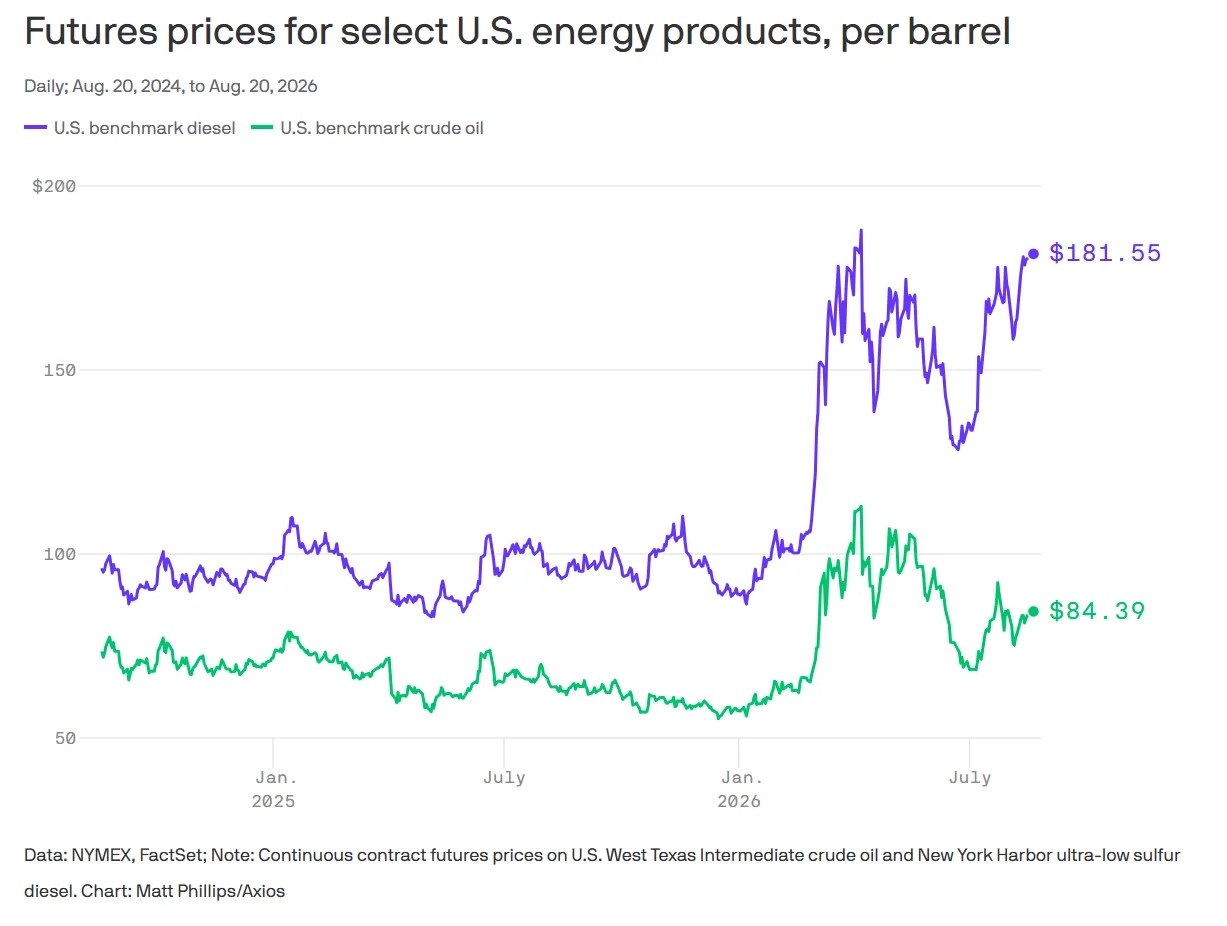
Futures prices for diesel have soared to roughly $100 above those of crude oil, the divergence between prices for the two products reflecting a dearth of diesel refinery capacity worldwide.
A long-predicted energy shock is finally showing up in sky-high prices for diesel fuel.
Why it matters: Diesel fuel is a key input for virtually anything grown or transported throughout the U.S., making it a potentially inflationary force.
Between the lines: It means the market’s relief over crude oil’s relatively muted reaction to the Iran war could be misplaced.
“The market is out to lunch, looking at crude oil prices,” Jeff Currie, a former commodities analyst with Goldman Sachs and Carlyle, tells Axios. “Look at diesel prices.”
The latest: Futures prices for diesel have soared to roughly $100 above those of crude oil, the divergence between prices for the two products reflecting a dearth of diesel refinery capacity worldwide.
This refinery shortage has been a growing issue since Ukraine launched a highly effective drone campaign targeting Russian refineries, resulting in a collapse of Russian production of refined product, shortages and a government ban on exports.
That’s a big deal because Russia is one of the world’s largest exporters of diesel.
The closure of the Strait of Hormuz has also curtailed global supplies of refined products previously exported by Gulf states.
Zoom in: This isn’t just a story of abstract geopolitical choke points. The cost of diesel will likely filter down to everyday life.
The cost of diesel accounts for between 3% to 5% of production costs for major U.S. crops like wheat, soybeans and corn, Axios’ Ben Geman recently wrote, putting upward pressure on prices for those items as well as other agricultural products that use them as feedstock.
Diesel is the key fuel for trucking, and its surge has already raised the costs of truck transportation for goods throughout the economy, which is gradually getting passed down the food chain.
Case in point: Performance Food Group, a distributor of food products to restaurants and convenience stores, said on a recent earnings call that it faced some $16 million in additional costs related to diesel prices during its recently completed quarter, telling analysts its “team worked to manage the increase in diesel prices through our surcharge program.”
TL;DR: In other words, price increases.
The bottom line: “Diesel is the cost base of everything. Every container, every tractor, every locomotive, every mine truck – you get the idea,” Currie wrote on X last week, adding: “That pass-through will reach into trucking, food and producer prices, and it is barely getting started.”
#image_title
When it takes a peer reviewed study to explain why the strongest candidate lost, we have made voting harder than it needs to be.
Seventeen people ran for governor of Alaska last Tuesday.
Four of them will be on your ballot in November. Two Democrats and two Republicans.
Supporters of ranked choice voting and the jungle primary told us this system would give voters more choice and clearer results. Let’s look at what it actually gave us.
This system does not produce clarity. It produces arithmetic.
Most Alaskans remember the 2022 special election for Congress. Mary Peltola beat Sarah Palin after Nick Begich was eliminated in the first round.
Then mathematicians went back and studied the actual ballots. Begich would have beaten both of them.
Jeanne Clelland, a professor of mathematics at the University of Colorado Boulder, ran the numbers from the ballots Alaskans marked. Against Peltola one on one, Begich wins with about 52 percent. Against Palin one on one, he wins with about 61 percent. He beat every opponent head-to-head, yet he was the first of the final three eliminated.
The simplest way to say it is this. Among voters who marked a second choice, Begich won an overwhelming share. The system threw those votes out before counting them.
Mathematicians call a candidate who beats every opponent one on one the “Condorcet winner.” Clelland found Begich was the Condorcet winner in 2022, and Palin the Condorcet loser. The candidate who could beat either opponent was eliminated first. The one who could beat neither made the final round.
That was not voters filling out ballots wrong. Those ballots did exactly what voters told them to do. The result came from the counting method itself.
Alaska’s two leading Democratic candidates for governor have quietly been discussing whether one of them should quit the race if both are among the top four vote-getters in Tuesday’s primary election.
Jonathan Kreiss-Tomkins and Tom Begich each said by phone on Thursday that they’ve been discussing different scenarios about what could happen when the final votes are counted.
Republicans have been talking about similar maneuvers for months, with one prominent Republican group going so far as to run ads urging lower-finishing candidates to withdraw in order to consolidate the vote in November.
“Both sides are trying to figure out: What does the top four look like? And how are we best positioned for success?” said Bernadette Wilson, one of the leading Republican candidates for governor in Alaska’s 17-person race.
Under Alaska’s election system, the top four vote-getters — regardless of political party — advance to the November general election. That may mean multiple Republicans or Democrats on the same ballot, competing for the same votes.
In November, voters in the general election will be asked to rank those four candidates in order of preference.
After all the votes are in, the candidate with the fewest number of first-choice preferences is eliminated. Any voters who ranked that candidate first will have their votes go to their second choice.
The process repeats until only two candidates are left.
In theory, that means no vote splitting. Anyone whose favorite candidate is eliminated can instead vote for someone else.
In practice, some Alaska voters ranked only one or two candidates in the 2022 and 2024 statewide elections, leading to an unusual number of “exhausted” ballots whose votes went to neither of the final two candidates.
“For the time being there is enough crude oil in the market preventing crude oil stocks from falling sharply and preventing Brent crude from rallying higher,”
In a crude oil report sent to Rigzone on Monday, Bjarne Schieldrop, Chief Commodities Analyst at Skandinaviska Enskilda Banken AB (SEB), explained why Brent hasn’t rallied to $150 per barrel or higher.
“For the time being there is enough crude oil in the market preventing crude oil stocks from falling sharply and preventing Brent crude from rallying higher,” Schieldrop stated in the report, which included “back of the envelope” calculations of how the loss of crude normally passing through the Strait of Hormuz is currently being compensated “by different elements.”
According to these calculations, the loss of crude supply if the Strait is fully closed is 14 million barrels per day. These calculations see a “crude escape” of five million barrels per day from the Strait, an increase of three million barrels per day in Yanbu crude exports, reduced Chinese crude imports of three million barrels per day, an OECD SPR crude discharge of one million barrels per day, reduced Russian refinery runs of 1.5 million barrels per day, and an increased flow of 0.6 million barrels per day from the Abu Dhabi pipeline. Taking all these “elements” into account, the net balance is a positive 0.1 million barrels per day, the calculations outline.
In June, Glenfarne indicated that energy companies are ready to commit to buying $115 billion worth of LNG from Alaska once the project is completed, with as many as 50 companies expressing formal interest.
A bill aimed at advancing the construction of a liquefied natural gas pipeline in Alaska has failed to secure enough votes in the state legislature, drawing a sharp response from Governor Mike Dunleavy, who had championed the measure. T
The governor expressed deep disappointment over the legislature’s decision not to reconvene in Juneau to address a proposed property tax change that was needed to move the project forward, warning that the consequences extend beyond the current session.
According to the governor, Alaska is running out of affordable and reliable natural gas, a long-standing issue that has become more urgent after decades of inaction. He cautioned that delaying action only increases risk, raises costs, and limits future options.
The Alaska House Majority Coalition announced late Wednesday that they had gathered enough votes to approve the project, but the bill ultimately did not pass.
The Alaska LNG pipeline is a key component of the broader liquefied natural gas production project, designed to deliver North Slope natural gas to Alaskans and export LNG to U.S. allies across the Pacific. The planned 800-mile pipeline would transport gas from production centers on the North Slope to south-central Alaska for exports, with multiple interconnection points to meet in-state demand.
The project is a joint venture between U.S. energy developer Glenfarne Group and the Alaska Gasline Development Corporation, a state-owned company. In June, Glenfarne indicated that energy companies are ready to commit to buying $115 billion worth of LNG from Alaska once the project is completed, with as many as 50 companies expressing formal interest.
Governor Dunleavy noted that the legislature’s failure to move the pipeline forward would send a negative signal to investors and potential partners in Alaska, the nation, and around the world, emphasizing that large infrastructure projects require certainty and sustained commitment.
SCOOP – REPUBLICAN AND DEMOCRATIC VOTERS SUPPORT EXPANDING FOSSIL FUELS TO MEET ENERGY DEMANDS, NEW POLL SHOWS:
The demand for power across the country is surging, driven by the development of artificial intelligence, data centers, increased manufacturing, and electrification. And for many voters across the political spectrum, oil and gas could be the solution to meet those needs.
Polling set to be released by the American Exploration and Production Council this week shows that both Democrat and Republican voters are acknowledging the need for oil and gas to meet rising demand, and keep energy costs affordable to American consumers.
Some numbers: In fact, roughly 79% of voters said they believed oil and natural gas are important for keeping costs affordable, according to the poll first obtained by Daily on Energy. This view was shared by 51% of voters who identified as very liberal, and 70% of those who identified as a Democratic voter.
As a result, most voters polled (63%) said they would support expanding oil and gas production to meet surging demands. Unsurprisingly, very liberal voters were the least likely to support this view, with only 26% saying they would support expanding fossil fuel production and 70% saying they would oppose. However, a plurality of Democratic voters, around 47%, said they would support, and only 43% said they were in opposition.
Republican voters voiced the strongest support for expanding oil and gas production at 90%, with 97% of MAGA-identifying voters also backing the move.
“Voters across the political spectrum agree that supporting oil and natural gas production is key to making life in America more affordable,” Anne Bradbury, CEO of AXPC, said in a statement. “It’s time to break the cycle of policy uncertainty that delays and derails critical energy investments, and passing durable, source-neutral permitting reform will provide a pathway to lower costs for struggling families.”
From the Washington Examiner, Daily on Energy, August 14, 2026
There is a critical need for additional gas this winter—
On August 20 at 2 p.m., the House and Senate Resources Committees will meet jointly at the Anchorage LIO to discuss Alaska’s winter energy supply. ENSTAR, the Alaska Energy Authority, the Regulatory Commission of Alaska and the Department of Natural Resources have been invited to answer questions about gas storage, Cook Inlet production, hydroelectric power and transmission.
Those are important questions. But here’s the problem: We already have many of the answers.
And before this hearing becomes an exercise for Senator Giessel, Senator Wielechowski, Senator Dunbar and Senator Kawasaki to point fingers at the Governor, ENSTAR, regulators, producers or anyone else for a problem that has been building for years under their lack of leadership, Alaskans deserve the facts and the context.
The Senate Resources Committee and the Senate Majority had an opportunity to do their job and pursue these issues before we reached the point of an urgent winter gas shortage. Instead, we are now heading into a hearing where there is a risk that the discussion will focus on what someone else should do to solve a problem they ignored.
So, before the finger-pointing begins, we’re going to give you the answers (the questions were publicized in a recent campaign newsletter from Senator Giessel and in a statement from the Senate Majority).
1. Why was expanded gas storage denied?
What happened
On July 8, 2026, the Regulatory Commission of Alaska (RCA) denied ENSTAR’s request for an advance determination that its proposed Kenai Loop Pool gas-storage project was prudent.
Importantly, this was not a finding that gas storage is unnecessary or that the project could never proceed.
ENSTAR proposed developing the depleted Kenai Loop Pool, currently associated with AIX Energy, as a seasonal gas-storage facility. The project would provide approximately 25 Bcf of storage capacity at an estimated cost of $240 million. ENSTAR argued that the facility is critical to meeting winter gas demand.
The RCA’s concern was essentially that it did not have sufficient information to make the extraordinary advance prudency determination ENSTAR was requesting. The Commission specifically questioned:
The timing and magnitude of the need for additional storage;
The proposed facility’s injection and withdrawal capabilities;
Whether the reservoir is technically capable of functioning as a storage facility; and
The fact that DNR had not yet made a final determination regarding the reservoir’s technical suitability for storage.
Important current development
ENSTAR has already petitioned the RCA for reconsideration of the decision. The RCA has 30 days to act on that petition.
That means this issue is not over. The reconsideration process is already underway, and any new information regarding the need for storage, the reservoir’s capabilities or the competing applications could be relevant to the Commission’s review.
2. Can the Governor instruct the RCA to reverse itself?
No.
The Governor cannot simply instruct the RCA to reverse its decision. The RCA is established by statute as an independent agency. Its five commissioners are appointed by the Governor and confirmed by the Legislature, but the Governor cannot lawfully order the Commission to reach a particular regulatory decision.
That does not mean the Governor is powerless.
The Governor can:
Direct his administration to make the gas-storage issue an urgent priority;
Direct DNR to promptly resolve the technical and leasing questions surrounding the Kenai Loop Pool;
Publicly urge the RCA to give ENSTAR’s reconsideration petition expedited consideration based on new or additional information; and
Coordinate the state agencies involved to ensure that regulatory and technical questions are addressed as quickly as possible.
The distinction is important: the Governor can prioritize and facilitate action, but cannot dictate the RCA’s regulatory outcome.
3. Where is the gas going this summer?
With ENSTAR warning of a potential winter gas shortfall, one of the most immediate questions is:
What is being done right now to ensure that every available molecule of Cook Inlet gas that can be economically produced is available to Alaska consumers and, where possible, stored for winter?
This is not simply a question about future development.
ENSTAR is currently disputing with HEX over discretionary gas that ENSTAR says it needs to refill storage before winter. ENSTAR has initiated arbitration and sought emergency relief, arguing that gas that is not stored during the summer injection period cannot simply be recovered later when winter demand arrives.
That issue may be more immediate to the coming winter than the long-term storage question.
4. HEX Energy has doubled its gas production. How much more exploration and development is planned?
HEX has demonstrated that additional Cook Inlet gas can be brought online.
The important questions now are:
How much additional exploration and development is planned for the Kitchen Lights Unit?
What additional production is expected from that program?
What regulatory, permitting or infrastructure obstacles could prevent that gas from reaching Alaska consumers?
How quickly can additional production actually be brought online?
A better question for DNR and HEX may be:
What would it take to accelerate development of the remaining resource, and how long would it take to have additional gas available and under contract?
That gets beyond simply asking whether additional gas exists. The issue is how quickly it can become deliverable gas for Alaska consumers.
5. BlueCrest Energy has the Cosmopolitan Unit lease, with approximately 250 Bcf of gas reported in legislative hearings. Why hasn’t that gas been developed? What is the holdup? Why hasn’t DNR made them produce?
There is a much stronger and more complicated story here than simply asking, “Why hasn’t DNR made them produce?”
AIDEA documents show that BlueCrest Energy has been seeking investment to develop the offshore gas resource. Its 2023 board materials stated that the company was seeking financing for offshore gas development and that development was contingent on obtaining funding.
BlueCrest was denied nearly $100 million in cashable tax credits for initial investments in Cosmopolitan and has struggled to secure financial backing for the drilling commitment contained in its 12th Plan of Operations filed with DNR.
But financing is not the only issue.
The limited and tenuous nature of the Southcentral Alaska natural gas market also makes significant investment in exploration and development more difficult. With the Railbelt consuming approximately 70 Bcf of gas per year, the market is operating on a relatively tight supply-and-demand balance. Plans to import LNG from Canada or potentially deliver North Slope natural gas to Southcentral Alaska create additional uncertainty for companies considering major investments in Cook Inlet exploration and development.
In other words, there is a resource, but developing it requires capital, infrastructure, a market and confidence that the investment can be recovered.
There are also significant regulatory issues.
In January 2026, DNR Commissioner-designee John Crowther told the House Resources Committee that BlueCrest was in default and that DNR was examining options to bring the resource into production. He also said the operator has an obligation to develop the leases and that DNR had been working to encourage BlueCrest to bring in investment to enable production.
In August 2025, DNR placed BlueCrest’ s 13th Plan of Development into abeyance because the company was in default under its 12th POD, while the Commissioner’s office reviewed BlueCrest’ s request for reconsideration.
So the picture is this:
DNR believes BlueCrest has a development obligation. BlueCrest has struggled to finance the development. The company is in regulatory default, and its development plan is in abeyance.
That leads to a much better question for DNR:
Is taking action to place the resource in the hands of an operator capable of developing it a viable option? If so, what would the timeline be for doing so, and when would DNR expect to see first production?
6. Can the Governor order DNR to enforce the lease?
Again, not simply by issuing an order to “enforce the duty to produce.”
The Governor has substantial authority over DNR and appoints the Commissioner. But the Governor cannot simply dictate a particular enforcement action or regulatory outcome.
The Governor can, however:
Direct DNR to make development of stranded Cook Inlet gas a priority;
Require the department to publicly report on the operator’s lease obligations and defaults;
Require DNR to identify available enforcement options;
Establish a clear timeline for decisions; and
Require the department to report on what would be necessary to bring the resource into production.
The real question should therefore be:
What authority does DNR have today, what actions can it take, and what is the fastest realistic path to getting this resource into production?
7. How is Dixon Diversion progressing toward the 2030–2031 completion date?
Bradley Lake currently produces approximately 10% of Railbelt annual electricity. The Dixon Diversion project is expected to increase Bradley Lake’s energy production by as much as 50%.
AEA’s current materials estimate that the project could produce approximately 180,000 MWh annually, resulting in roughly 1.5 Bcf per year of natural gas displacement.
That is a positive step, but it is important to put the number in perspective.
The estimated natural gas displacement represents only about 2.14% of annual Railbelt gas demand. It is therefore helpful to the overall energy picture, but it is not large enough to solve the projected gas shortfall—and it will not be available for the 2026–27 winter.
AEA filed the Final License Amendment Application with FERC on June 30, 2026.
The project is targeting completion around 2031, with an estimated construction cost of approximately $342 million.
A better question for AEA and Bradley Lake is:
AEA has now filed the Final License Amendment Application for Dixon Diversion. What are the remaining FERC, financing, permitting and construction milestones, and is the project still on schedule for commercial operation in 2030–2031? What could cause that schedule to slip?
That is the information Alaskans need—not simply assurances that a project is underway.
The bigger issue: What can actually help this winter?
These questions matter because Alaska has both an immediate problem and a long-term energy problem.
Dixon Diversion will help—but not this winter. New Cook Inlet exploration can help—but it takes time. Cosmopolitan could potentially provide a significant resource—but it is not currently producing. New gas storage could provide important winter reliability—but the regulatory process is still underway. And the state needs to understand what gas is available right now and whether it is being properly positioned for the coming winter.
There is no single switch the Governor can flip to solve this.
But there are actions that can be taken now, and Alaskans deserve to know what they are, who has the authority to take them, and how quickly they can produce results.
That is the context that should frame the August 20 hearing.