Interior Transfers 1.4 Million Acres in Dalton Utility Corridor to State of Alaska BLM Alaska Press Release, May 6, 2026
ANCHORAGE, Alaska – Today, the Department of the Interior announced a major Alaska statehood land transfer to convey approximately 1.4 million acres of land along the Dalton Utility Corridor to the State of Alaska. With conveyance of these lands north of the Yukon River, the Bureau of Land Management has fulfilled more than 96% of the state’s entitlement under the Alaska Statehood Act, expanding Alaska’s opportunities for resource development, strengthening local economies, and enhancing the state’s control of its own economic destiny.
“This decisive action puts Alaska at the forefront of American Energy Dominance,” said Secretary of the Interior Doug Burgum. “President Trump is delivering on his commitment to unleash Alaska’s vast resources—advancing the Alaska Liquefied Natural Gas project, the Ambler Road, and the Trans-Alaska Pipeline—to strengthen our economy, bolster national security, and drive down costs for American families.”
This transfer comes after Public Land Order No. 7966 opened approximately 2.1 million acres of lands within the corridor for selection under the Alaska Statehood Act and to location and entry under public land and mining laws. That February 2026 opening order allowed “top filed” land (i.e., land previously unavailable for state selection but which Alaska sought to acquire) to become valid state selections available for conveyance.
“On behalf of the State of Alaska, I want to thank Interior Secretary Burgum and his dedicated staff for completing the transfer of the Dalton Utility Corridor to state ownership,” said Alaska Governor Mike Dunleavy. “This milestone represents a leap forward in advancing Alaska’s ability to responsibly develop its resources and advance economic opportunity across Alaska. We appreciate our partnership and collaboration with President Trump that made this transfer possible, and we look forward to putting this corridor to work for the benefit of all Alaskans. President Trump delivered when other presidents did not.”
This transfer marks significant progress on fulfilling Alaska’s statehood entitlements, a responsibility of the BLM Alaska Land Transfer Program. With this conveyance, the state has 3.8 million acres remaining of their 105-million-acre entitlement under the Alaska Statehood Act.
“For far too long, we have been at a relative standstill on statehood entitlements because these critically important lands were off the table,” said BLM Alaska State Director Kevin Pendergast. “We are proud to make this unprecedented progress with the State of Alaska and look forward to continued partnership ahead.”
As Alaska takes control of these lands, the Alaska Department of Natural Resources continues its public process to identify and address potential impacts to public access in the area.
“This transfer is the result of extraordinary work by dedicated Department of Natural Resources staff to secure these long-promised critical infrastructure lands,” said Alaska Department of Natural Resources Commissioner-designee John Crowther. “Thanks for our federal partners for effectuating this transfer, and we look forward to stewarding these lands while ensuring Alaskans continue to have access to adjacent federal lands.”
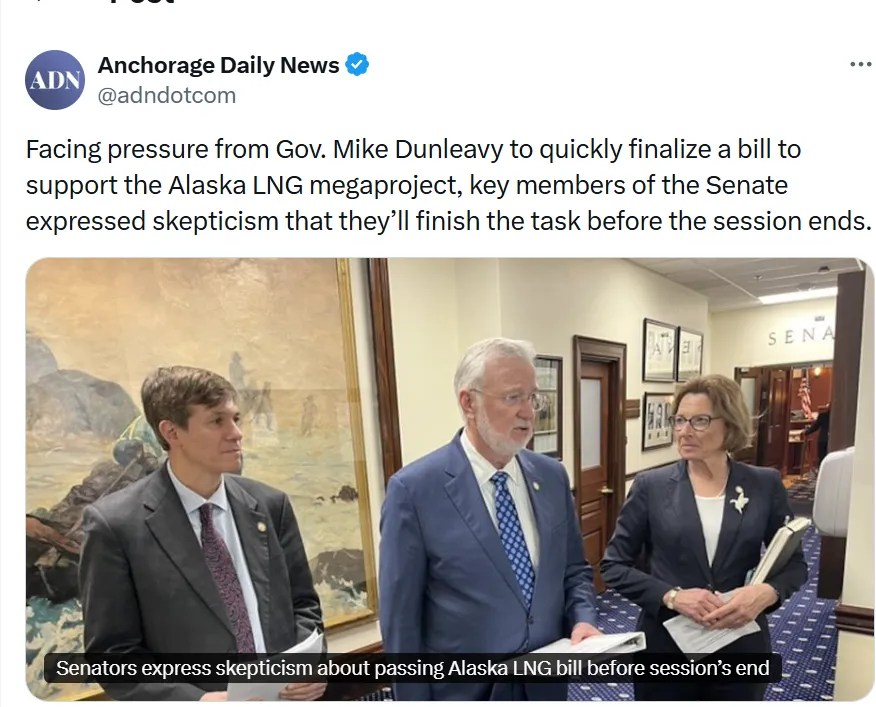
The White House has lent its support to Alaska legislation aimed at advancing the long-delayed Alaska LNG project, urging state lawmakers to consider tax reforms that could incentivize the massive export facility.
The number of active hardrock exploration permits in Alaska swelled by 100% between 2018 and 2025, according to state data. And regulators are anticipating 20 entirely new early-stage mining projects this year.
For years, some of Alaska’s largest mining proposals inched along, unable to attract big investment. Then the price of gold took off.
A massive gold mining project north of Fairbanks treaded water for years, without an investor willing to pour billions of dollars into construction.
Now, it’s getting a fresh look.
The owners of the Livengood project recently raised more than $100 million to push it forward, and they’re now planning new drilling and an updated economic study. Like mining companies across Alaska, they’re eager to capitalize on soaring gold prices.
“I joined this project in 2010 to build another mine, and it’s just exhilarating now to start taking the steps that can actually realize that dream,” said Karl Hanneman, chief executive of International Tower Hill Mines, the publicly traded company that owns the project.
The new momentum behind Livengood is just one example of how record mineral prices are drawing new interest and investment into Alaska’s mining industry.
The price of gold has quadrupled in the past decade, and now hovers above $4,500 an ounce. Other minerals, like silver and copper, also have been trading at historically high prices, making once-marginal developments increasingly attractive to investors.
“Whenever there’s a bull market, people come rushing in, and then a lot of projects that have been sitting on the sidelines because they couldn’t get financing all of a sudden qualify, simply because the pool of money is larger,” said Douglas Silver, a Colorado-based mineral economist and financier with decades of industry experience.
Bad Bill of the Week: SB 286 – Two Miles, One Target: The Dalton Highway Toll That Misses the Mark
The latest version of the proposed toll on a short stretch of the James Dalton Highway doesn’t just raise concerns—it sharpens them.
This bill carefully carves out who pays and who doesn’t. Vehicles tied to oil and gas activity are tolled. Others are not. That means within the same two-mile segment of public road, the state is picking winners and losers based not on impact, but on affiliation.
The bill then goes a step further by mandating that operators—truckers and contractors—front the cost and seek reimbursement from oil and gas companies within 30 days. If payment doesn’t come, they’re expected to take legal action to recover it, with the promise of attorney’s fees if they win. In effect, the state inserts a new layer of administrative burden and potential litigation into everyday commerce, shifting enforcement from government to private parties.
That’s not efficient policy—it’s a workaround.
If the goal is to fund maintenance, Alaska already has tools to do that broadly and transparently. Instead, this approach isolates a narrow slice of road, targets a single industry, and relies on a reimbursement scheme that invites disputes.
And the precedent matters. Today it’s two miles near Deadhorse. Tomorrow, it could be any stretch of road tied to a specific user group. Once the state starts segmenting public infrastructure and assigning costs based on who it thinks should pay, the line between user fee and selective taxation begins to blur.
Alaska’s infrastructure has long been built on shared benefit and shared responsibility. This bill moves in the opposite direction—toward fragmentation, complexity, and unequal treatment under the law.
For a policy that covers just two miles, the implications travel much farther.
From the newsletters of Senator James Kaufman:
What’s not being talked about in Juneau:
There’s a few critical things that I believe that the legislature is falling behind on, such as taking meaningful, proactive steps to assure affordable energy for Alaska. We face a dwindling supply of natural gas in Cook Inlet. Potential refined petroleum product shortages increase prices on Alaskans in Anchorage and even more so in rural Alaska.
The conflict in Iran and neighboring countries has brought higher oil prices which brings more revenue to the state, but comes with raised costs for families, businesses, schools, and local governments across Alaska.
In rural communities, where fuel is already much more expensive and is barged or flown in, price spikes can have an incredible impact. A significant amount of the refined products delivered to much of rural Alaska come from east Asia refineries that are experiencing reduced supplies of crude oil which is affecting their ability to produce and export refined products. Thankfully, this is happening at a time where we are going into the summer months, but I believe that this will become a huge issue going forward that we will have to address at the state level.
Meanwhile, closer to home, there has been endless debate and numerous committee hearings about the prospect of building the gas pipeline, which I hope will result in enabling real progress on moving the project forward.
Somewhat lost in the shuffle is a growing need to address what the railbelt will do for natural gas in the near term, as we still have the looming issue of waning gas supply in Cook Inlet. We’re getting to a point where, at least in its current state of production, our railbelt gas supply may not meet the needs of the next long deepfreeze middle of winter event.
I feel that the legislature and executive branch should be working together much more cooperatively to hammer out a realistic energy management plan that can get everyone pulling in the same direction in pursuit of reliable and affordable energy for the near, mid, and long-term timeframe.
While there are a lot of legitimate questions and issues surrounding the gas line, what has stunned me in the last year has been the attitude that I’ve seen from some people in the legislature that all they care about is how much money the state will get from the gas line. These people don’t care about lowering energy costs for households, the potential expansion of mining and other industries that can happen with lower cost energy, or the wider economic development that surrounds a project of this magnitude.
For the 2025-26 Legislature, I’ve been serving on the Senate Natural Resources Committee. The committee has spent a significant amount of time collecting information and weighing various proposals regarding the gas line. I’ve spent a significant amount of my own time reading to prepare for those hearings and to gather my own information on the project.
While there are a lot of legitimate questions and issues surrounding the gas line, what has stunned me in the last year has been the attitude that I’ve seen from some people in the legislature that all they care about is how much money the state will get from the gas line. These people don’t care about lowering energy costs for households, the potential expansion of mining and other industries that can happen with lower cost energy, or the wider economic development that surrounds a project of this magnitude. The bottom line to the state treasury is the only thing that matters. It’s not every legislator or probably even a majority, but it is a large portion. Let me explain why that attitude exists.
People care more about something when it is where their livelihood comes from. It’s a cynical take, but government is the same way: it cares about where its money comes from. The gas line is projected to bring is serious money, with estimates being somewhere in the $800 million per year range. But that compares to the $4 billion that we will bring in from the Permanent Fund draw this year. To the state, that seems small enough that we can live without it. And that is not factoring in the costs that come with it.
For every other state, that would not be the calculation. While any state would love the gas royalties and taxes, the calculation would be primarily aimed at that larger economic growth that comes from the gas use in state. Every other state has some kind of broad-based tax (sales, income, property) that relies on that wider economic activity to generate revenue. Our municipalities do that and are more supportive of the project as a result, but our state does not.
To make it worse, all of that potential revenue growth is years away. We hope to get gas to Alaskans by 2029, but the real money for the state won’t kick in until the export portion starts up about 2031. Politicians already have an incentive to think in the short term because of election cycles, and construction of this project will go over at least two if not three cycles. Most politicians are focused on the short-term impacts that will happen during that time period.
At a time when conversations about energy are often shaped far from the places that produce it, it’s worth pausing to recognize a voice that carries both credibility and lived experience. Born and raised in Anchorage, Drake Ward brings something increasingly rare to the national dialogue: firsthand understanding of the people, infrastructure, and industries that power not just Alaska, but much of the nation.
His perspective isn’t theoretical—it’s grounded in a childhood shaped by the realities of Alaska’s resource economy, where energy production isn’t an abstract concept but a daily livelihood. In his recent opinion piece, Ward articulates a growing disconnect between energy consumption and energy understanding, particularly among younger generations. But more importantly, he does so with a clarity and authenticity that reflects Alaska’s unique role in the conversation.
Alaska should take pride in voices like Ward’s—thoughtful, informed, and willing to engage in complex debates without losing sight of the real people behind the policies. At a moment when energy literacy matters more than ever, his words serve as both a reminder and a call to action: that Alaska’s story is best told by those who have lived it.
Growing up in Anchorage, I never had to think twice about where energy came from. The people around me worked to provide it — winters on the Slope, on the pipeline, in the support industries that keep extraction running. Energy was never abstract; it was someone’s job, someone’s livelihood, the backbone of the state’s economy that guided the everyday lives of thousands.
Then I left for university out of state, and I started hearing things that genuinely stopped me mid conversation.
A professor described drilling in the Arctic as destructive and “uniquely evil.” A university administrator, when I mentioned I wanted to work in Alaska resource development law, immediately began preaching about the dangers of resource development, assuming I wanted Alaska to remain a snow globe for the rest of the country to look upon and smile at: beautiful, fragile and untouched.
This is the energy literacy crisis of my generation. It is costing real people real things.
My peers and I are the most energy-consuming generation in history. We stream constantly, charge devices that never leave our hands and have transitioned to a more online world. Yet we also register the highest opposition to offshore oil and gas drilling of any demographic group in modern polling. This isn’t hypocritical; it’s what happens when a generation grows up never asking where power comes from.
When my classmates plug in their laptops, they aren’t questioning what made that simple action possible. They aren’t thinking about the natural gas plant that generated the electricity, or about the pipeline that delivered the fuel, or about the federal permitting process that took years to approve. To them, electricity comes from the wall. The physical infrastructure that converts raw resources into usable energy is invisible to the people consuming it most, and in a democracy, the people who don’t think about how something works still get to vote on whether it continues.
Alaska is where that abstraction has the sharpest consequences. Oil and gas revenues have made up considerable portions of Alaska’s budget for decades. The men and women I grew up around worked long days in difficult conditions in one of the harshest environments on Earth. When someone who has never been to Alaska decides it should be preserved like a decorative object on the mantle, they are making a fiscal and economic argument on behalf of people they have never met, with consequences they will never experience.