Santos said Tuesday that its recently launched Barossa LNG project and Pikka oil development in Alaska are expected to drive a major increase in free cash flow as the company pivots toward large-scale LNG and oil basins across Australia, Papua New Guinea, and Alaska.
At its 2026 Investor Briefing Day in Sydney, Santos unveiled a strategy focused on “tier-1 basins,” targeting production growth, lower costs, and increased shareholder payouts as geopolitical instability tightens global LNG and oil markets.
The company said Barossa is already operating at 70%–75% of planned production rates and is targeting full plateau production by mid-2026, with unit production costs below $7 per barrel of oil equivalent. Meanwhile, Alaska’s Pikka Phase 1 project has achieved first oil and is expected to reach a gross production plateau of 80,000 barrels per day in the third quarter of 2026 at costs below $8/boe.
Santos said the two projects mark a “cash flow inflection point,” estimating that every $10 increase in realized oil prices above its free cash flow breakeven level could generate an additional $550 million to $600 million annually once both assets reach plateau production.
CEO Kevin Gallagher said the company intends to focus future investment on LNG and oil production hubs in Alaska and Papua New Guinea while continuing appraisal work in Australia’s Beetaloo and Bedout basins.
State and national lab signs MOU on research, advancing the state and nation’s resource and energy priorities.
Alaska Gov. Mike Dunleavy May 19 announced that the state has signed a memorandum of understanding with the U.S. Department of Energy’s National Laboratory of the Rockies (NLR) to work more closely together on advancing Alaska as a leader in critical minerals development, energy system innovation, and Arctic infrastructure.
NLR was established as the Solar Energy Research Institute in response to the oil crisis in the 1970s, before being rebranded as the National Renewable Energy Laboratory in 1991. Last December, the Colorado-based national lab was rebranded to reflect a wider energy focus.
“The energy crisis we face today is unlike the crisis that gave rise to NREL,” Assistant Secretary of Energy Audrey Robertson said at the time of the rebranding. “We are no longer picking and choosing energy sources. Our highest priority is to invest in the scientific capabilities that will restore American manufacturing, drive down costs, and help this country meet its soaring energy demand.”
“This new name embraces a broader applied energy mission entrusted to us by the Department of Energy to deliver a more affordable and secure energy future for all,” added NLR Director Jud Virden.
Robertson said Alaska’s unique energy needs, along with its unmatched energy and mineral resources, make the state a top priority for the work the Office of Critical Minerals and Energy Innovation does on both fronts.
“Alaska has 95% of critical minerals designated by the Department of the Interior,” she noted during her panel discussion with Gov. Dunleavy.
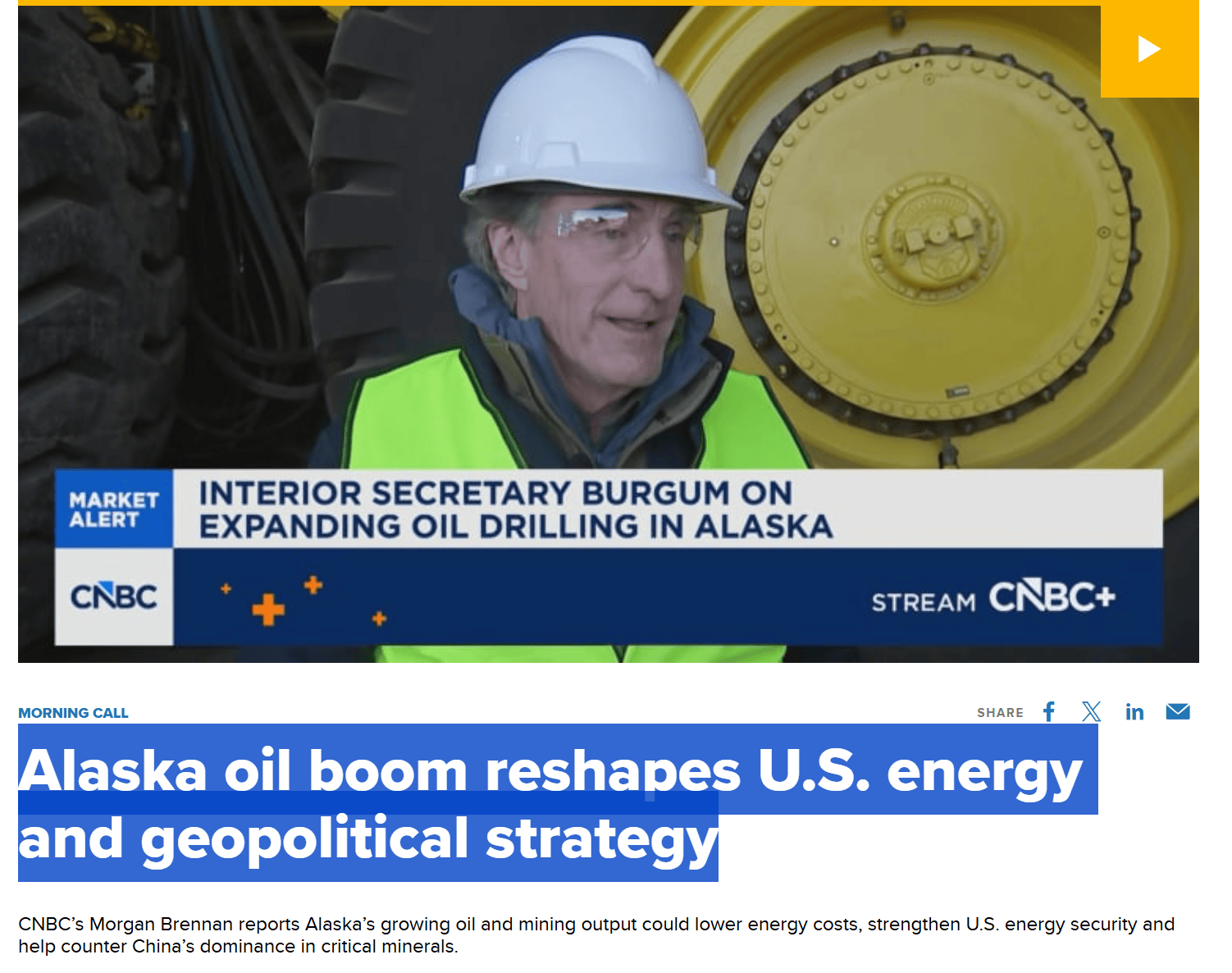
As major oil companies eye new drilling on Alaska’s North Slope, the Trump administration is now working to accelerate their projects by streamlining environmental reviews on federal land.
The new proposal was announced May 15 by Interior Secretary Doug Burgum on a visit to Alaska.
It would change how regulators review and approve new oil projects in the National Petroleum Reserve – Alaska, a federally managed area that’s roughly the size of the state of Indiana and encompasses tundra, wetlands and expansive caribou and bird habitat.
Historically, federal land managers have required companies to go through lengthy environmental reviews each time they propose a new project. The Trump administration now aims to create a blanket environmental approval to expedite projects.
The proposal comes at a time when the Trump administration is under pressure from spiking fuel prices and looking for ways to boost U.S. energy production.
The proposed change comes as the North Slope’s oil industry is picking up steam.
The state’s biggest new oil field in years — located on state and Alaska Native corporation land to the east of the federal petroleum reserve — just started commercial production. Another major project, ConocoPhillips’ Willow development, is set to come online in a few years.
And the industry is poised to expand west: Several of the world’s largest oil corporations, including ConocoPhillips, Shell and ExxonMobil, bid on new territory in the federal reserve in a huge lease sale earlier this yea
Alaska LNG Draws Top Energy, Infrastructure, and Shipping Leaders to Nikiski
#image_title
On Monday, May 18, Glenfarne hosted more than 50 business leaders and Alaska stakeholders at its Nikiski site, bringing together an impressive cross-section of global energy, infrastructure, shipping, and Alaska industry leaders connected to the Alaska LNG project.
The meeting highlighted the caliber of companies and organizations actively engaged in advancing the project. Representatives included major international firms such as Danaos — one of the world’s largest independent owners of modern containerships — which has committed a $50 million development capital equity investment in Glenfarne Alaska Partners LLC and is expected to serve as the preferred provider for the construction and operation of at least six LNG carriers serving global markets.
Attendees also included leading pipeline construction and supply companies involved in Phase One planning and execution, including SICIM, MasTec, Quanta Services, Houston Contracting, Associated Pipeline, Corinth Pipeworks, Barnard Pipeline, and US Pipeline. These companies are expected to play key roles in pipeline construction, technical execution, and line-pipe supply for the project.
International participation underscored the project’s growing global significance. POSCO International, affiliated with Korea’s largest steel producer, is engaged through agreements involving steel supply, LNG offtake, and project investment. TotalEnergies, one of the world’s leading integrated energy companies, also participated following its LNG offtake agreement with Glenfarne.
The gathering also featured strong participation from Alaska stakeholders and industry leaders, including Donlin Gold, Pantheon Resources, ConocoPhillips, ExxonMobil, Enstar, Worley, the Alaska Support Industry Alliance, and the Municipality of Anchorage. Together, the group reflected the broad alignment of industry expertise, investment interest, and local engagement supporting Alaska LNG’s continued momentum.
To stay on development timelines, company selects a site with power and transportation infrastructure in place.
To begin delivering graphite into North American battery supply chains by the end of 2027, Graphite One Inc. has secured a new industrial site in Conneaut, Ohio, to build its active anode materials plant.
Located on the southern shores of Lake Erie, about 65 miles northeast of Cleveland, the new site, to be leased from the Bessemer and Lake Erie Railroad Company, a subsidiary of Canadian National Railway, offers several advantages over the previously proposed location near Warren, Ohio. These advantages include:
Direct access to Lake Erie and the Great Lakes shipping corridor.
• Multi-line rail connectivity through Canadian National Railway.
• Existing power infrastructure, including an on-site substation.
• Capacity for future expansion and scaling.
“This site provides the infrastructure, logistics access, and scalability required to support long-term growth,” said Graphite One COO Mike Schaffner. “It positions the company to efficiently move material and expand production capacity as market demand develops.”
Existing power infrastructure was the primary impetus for the move. Challenges with the timeline for upgrading power infrastructure at the Warren site to meet the needs of its three-phase graphite anode material processing and finishing would have slowed development and operations.
Alaska’s energy future is entering a new era of opportunity and momentum. With first oil now flowing from the Pikka development on the North Slope and major progress advancing the Alaska LNG project, the state is once again demonstrating its role as a global energy leader. These milestones represent more than infrastructure and investment — they reflect thousands of jobs for Alaskans, new opportunities for local businesses, stronger energy security for communities, and long-term revenue that supports schools, public services, and future generations.
From responsible North Slope oil production to the promise of delivering Alaska natural gas to homes, businesses and international markets, Alaska is building an energy future rooted in innovation, reliability, and economic growth. Companies including Santos, ConocoPhillips, ExxonMobil, and Glenfarne Group are making long-term commitments that reinforce confidence in Alaska’s vast resource potential. As new projects move forward, Alaska has the chance to strengthen its economy, create high-paying careers, and continue supplying the world with energy produced under some of the highest environmental and operational standards anywhere.
Santos announced yesterday that first oil has officially been achieved at the Pikka Phase 1 development on Alaska’s North Slope, marking a major milestone for one of the state’s most significant new oil projects in decades. Operated by Santos with partner Repsol, the project has begun flowing oil into the sales pipeline system as start-up and commissioning activities continue. Production is expected to ramp up from an initial 20,000 barrels per day to a planned plateau of 80,000 barrels per day later this year. Company leaders highlighted Pikka as a world-class asset within Alaska’s Nanushuk formation and pointed to additional long-term growth opportunities across the North Slope, including future development potential at the Quokka and Horseshoe discoveries.
Glenfarne Group and ConocoPhillips Alaska announced a major milestone this morning for the Alaska LNG project with the signing of a long-term gas sales precedent agreement to supply North Slope natural gas for Phase One of the project. The 30-year agreement secures enough gas commitments to support a final investment decision for the first phase, which includes construction of a 739-mile pipeline designed to deliver natural gas to Alaskan communities and address declining Cook Inlet supplies. Glenfarne noted that Alaska LNG now has agreements in place with all major North Slope producers, including ExxonMobil, Hilcorp Alaska and Pantheon Resources, positioning the project as a major step toward long-term energy security and future LNG exports from Alaska.
AKLNG Legislative Update: With 10 days left in session, AKLNG bills are getting daily hearings. After fast, thorough work by the House Resources Committee, HB 381 has emerged as the clearest path forward and will be worked on in House Finance this week. Meanwhile, SB 280 remains stuck in Senate Resources — caught in a cycle of hearings, revisions, and more hearings.
Alaska’s economic development agency, AIDEA, wants to conduct geologic testing on its existing oil leases — and to bid on new ones — in the Arctic National Wildlife Refuge.
Alaska’s industrial development agency this week is set to vote on spending $190 million on controversial plans for oil exploration in the Arctic National Wildlife Refuge.
The budget, drafted by staff and still pending approval by the agency’s governor-appointed board, includes up to $175 million for advanced geologic testing, plus as much as $15 million to bid on new areas of the refuge in an upcoming federal lease sale.
If approved, the plans from the Alaska Industrial Development and Export Authority, or AIDEA, could represent a major step toward development in the refuge. They could also represent a massive expenditure, as $190 million exceeds the yearly general fund budgets of more than half of Alaska’s executive branch agencies.
AIDEA’s proposed spending is outlined in a resolution that the authority’s board is set to discuss at a meeting Wednesday. The state published a notice about the meeting on Sunday.
The geologic work, known as seismic testing, involves searching for oil deep underground by using sound waves — a technique that geologists liken to an ultrasound of the earth.
The first month of the American war against Iran caused crude oil prices to skyrocket around the world, and the price of Alaska’s oil has risen particularly far.
That rise is making extra millions of dollars available for state services and the Permanent Fund dividend, even as it squeezes the finances of individual Alaskans.
In figures newly compiled by the Alaska Department of Revenue, the average price of a barrel of Alaska North Slope crude was $111.17 in April.
That’s $8.70 higher than the average price of a barrel of Brent crude, a standard based on oil extracted from Europe’s North Sea. It was also $13.11 per barrel higher than the average price of West Texas Intermediate, a standard based on oil from America’s second-largest state.
“The differential is the largest monthly value since the year 2000 and may be the highest value in history,” said the Department of Revenue, referring to the gap between Brent and North Slope crude.
“The large premium is due to a tightness in the Pacific basin oil market, where ANS is traded. “Most mid-east crude oil is supply constrained and cannot reach major importers like China, Japan, India, and South Korea,” the department said by email. “Uncertainty about shipping and delivery is incentivizing refiners to pay a premium for available crude that does not transit areas with substantial security risks. Crude grades from the Americas are the safest option. Brent primarily trades in the Atlantic basin, where the impacts from the Iran war are not quite as pronounced on a barrel for barrel basis.”
The premium now being paid for Alaska crude will have a significant impact if it continues for months.
Each dollar increase in the average annual price of a barrel of ANS crude is worth roughly $30 million. The exact value varies because the state collects different amounts of money at different price levels.
With permits for the Ambler Road reinstated, the Alaska Industrial Development and Export Authority (AIDEA) has launched a 2026 field program to advance design and construction planning for the proposed 211-mile access to one of the richest undeveloped copper districts.
Fieldwork along the corridor will be carried out by crews from the Alaska Department of Fish & Game, HDR Engineering Inc., and Qayaq Construction LLC, an Alaska Native-owned company that specializes in building roads, airports, and other infrastructure.
According to AIDEA, geotechnical, hydrological, permafrost, and fish habitat data collected during the program will help refine engineering design, environmental review, and overall project planning.
“This work is critical to reducing uncertainty around major cost drivers and advancing design toward construction-ready plans,” said Jeff San Juan, infrastructure development program manager at AIDEA. “Each field data point improves our understanding of the corridor and helps reduce data gaps, and uncertainty.”
This mine depends on the Ambler Road to transport concentrates to market, while those shipments are expected to underpin the road’s economic viability.
Development of the road and Arctic mine is expected to help unlock the broader district, which hosts more than 30 known deposits enriched in copper, zinc, silver, germanium, and other critical minerals.
AIDEA emphasized the importance of local hire during the 2026 Ambler Road corridor data collection program. PJ Simon, the first chief of Allakaket, a village about 45 miles south of the Ambler Road corridor, says the job opportunities offered by this program, and the future development of the road and mines in the district, are unmatched.
“Above all else, standing on your own two feet to succeed and having gainful employment builds character, confidence, disposable income, and future retirement,” he said. “Qayak Construction has taken the opportunity to provide gainful employment with Allakaket Tribal members. This is the direct benefit of responsible resource development and extraction for Ambler Access Project.”
The oil market faces a shortage of nearly 1 billion barrels that will only get worse every day the conflict in the Middle East drags on, Shell CEO Wael Sawan told investors Thursday.
“The hard facts are we have dug ourselves a hole of close to a billion barrels of crude shortage at the moment, either because of locked in barrels or unproduced barrels,” Sawan said during the London-headquartered oil producer’s first-quarter earnings call.
“And of course, that hole is deepening every single day, so the journey back will be a long one,” Sawan said.
To put that number in context, the entire world consumes about 100 million barrels of oil every day, according to data from OPEC.
Halliburton also estimates that oil production lost due to the war is trending toward a billion barrels, CEO Jeffrey Miller said on the oil field service company’s April 21 earnings call.
“Recovery of oil and gas production and inventories will not be a quick or simple process,” Miller said.
From David Blackmon’s 4 Big Energy Stories, May 8, 2029