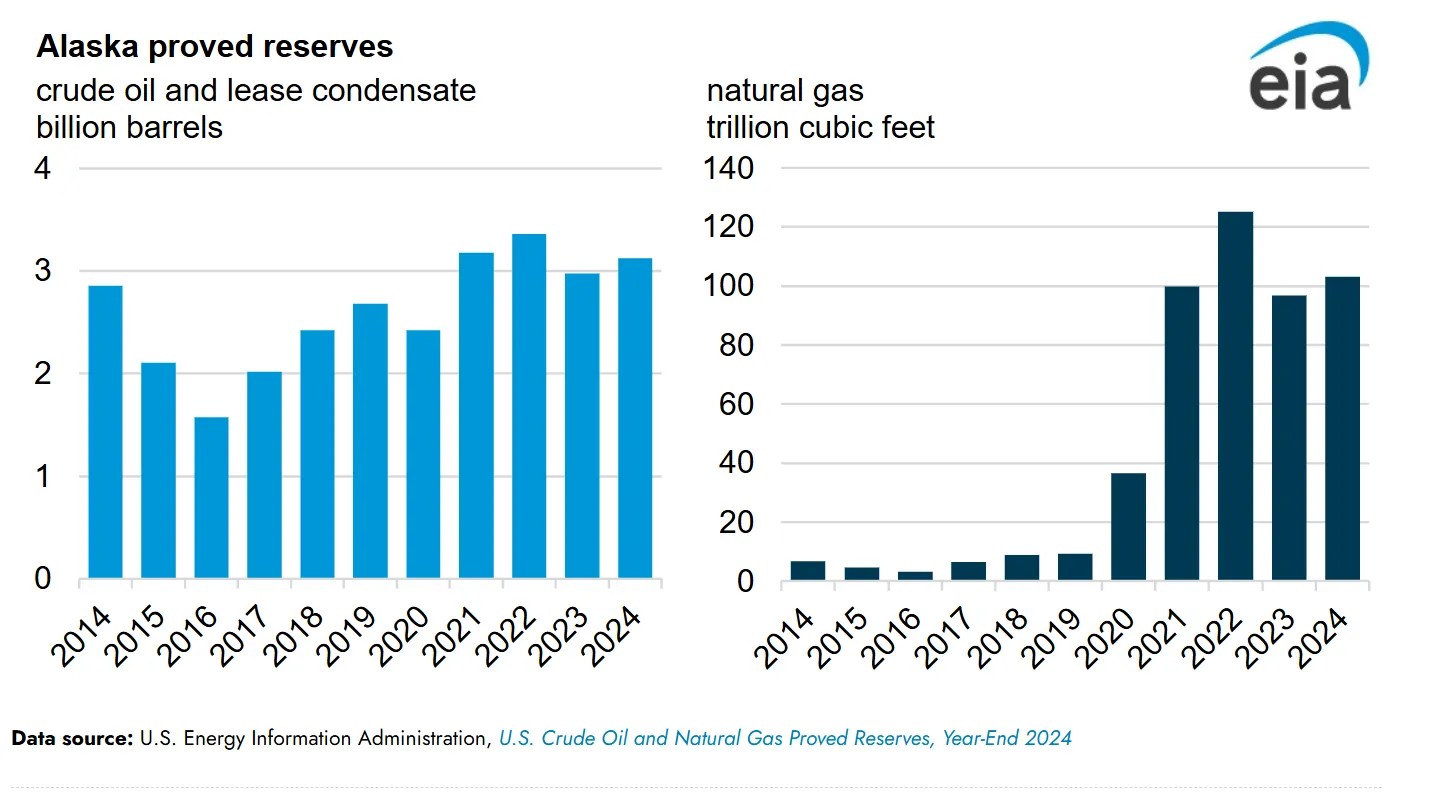
Oil and gas producers operating in Alaska reported increases in proved reserves in 2024 at a time when low prices triggered a decrease in nationwide proved reserves, according to our recently released
Oil and gas producers operating in Alaska reported increases in proved reserves in 2024 at a time when low prices triggered a decrease in nationwide proved reserves, according to our recently released U.S. Crude Oil and Natural Gas Proved Reserves, Year-End 2024 report. Alaska’s crude oil and lease condensate proved reserves increased 5%, and natural gas proved reserves increased nearly 7% in 2024.
U.S. proved reserves of crude oil and lease condensate totaled about 46 billion barrels at year-end 2024, a 1% decline from 2023. U.S. proved reserves of natural gas also fell, decreasing 3% to 584 trillion cubic feet (Tcf) at year-end 2024.
Proved reserves are operator estimates of oil and natural gas volumes that geological and engineering data demonstrate with reasonable certainty are recoverable under existing economic and operating conditions.
Exploration and development in Alaska in 2024 increased, supporting upward revisions in reserves there despite the lower prices. Natural gas reserves increased from 97 Tcf in 2023 to 103 Tcf in 2024, and crude oil reserves increased from 3.0 billion barrels in 2023 to 3.1 billion barrels in 2024. During 2024, Conoco Phillips’ Nuna project became operational and contributed to higher oil proved reserves in Alaska. Planned projects, including new wells at Prudhoe Bay in Alaska’s North Slope and new infrastructure to bring North Slope production to market, such as the Alaska LNG Project, could contribute to increasing proved reserves in the future.
More recently, changes in federal policies are aimed at increasing Alaskan production. On January 20, 2025, President Donald J. Trump issued an Executive Order, Unleashing Alaska’s Extraordinary Resource Potential, which expedites the permitting and leasing of energy and natural resource projects in Alaska and prioritizes the development of Alaska’s liquefied natural gas (LNG) potential. The order highlights the sale and transportation of Alaska’s LNG to other regions of the United States and allied nations within the Pacific region. On March 18, 2026, the Bureau of Land Management awarded 1.3 million acres in a National Petroleum Reserve lease sale.
Last week I wrote about two AKLNG bills and two ways of thinking about resource development. SB 280, the Governor’s bill, was written to help a project get built. SB 275, out of Senate Resources, was written to maximize the state’s take whether the project gets built or not. I closed that piece by saying we needed a House Resources committee substitute that pulled the few good accountability pieces out of SB 275 and folded them into SB 280.
The Committee Substitute to HB 381 came out this week. That’s closer to what we need, and the House Resources Chair and the committee have done a pretty good job.
The CS keeps the core trade the Governor put on the table. No property tax during construction. A low volumetric tax once gas is moving. That is the whole reason this approach can work, and the House did not touch it.
The numbers did move. SB 280 set abatement at up to ten years or until the line hit one billion cubic feet per day, then six cents per Mcf escalating one percent a year. The CS for HB 381 sets it at six years or 250 million cubic feet per day, then five cents on the pipeline and ten cents at the LNG plant, escalating with the five-year CPI for urban Alaska.
That is a shorter, tighter abatement window and a split rate that charges more at liquefaction. House Resources is basically saying we will do the Governor’s deal, but on a faster clock, and we will charge more where the margin is. Whether that still works for Glenfarne is a question DOR and the developer have to answer. It is not a hostile rewrite. But it is a tougher one.
As I wrote last week, the Gulf Coast terminals all got ten-year exemptions, so six years with a hard throughput trigger is tighter than what those states offered, and Alaska is the higher-cost build.
The Bureau of Land Management will convey more than 1,085 acres of land to an Alaska Native Corporation that intends to mine it, the agency announced on April 1. The parcel is near Flat, a ghost town in Western Alaska, and lies just north of the proposed Donlin Gold project.
Doyon, Limited spokesperson Cheyenna Kuplack said in an email that the corporation started exploring the land’s mineral potential in the 1970s and is now working with Canadian Mining company Tectonic Metals.
The corporation plans to begin a large exploration drilling program this year.
Environmental groups say they’re monitoring the situation. In an emailed statement, Northern Alaska Environmental Center president Krystal Lapp encouraged transparency for such projects and said it was “important for the public to understand how land ownership changes can shape long-term decisions about development, conservation, and subsistence resources.”
Federal officials say the land transfer was a legal obligation under the Alaska Native Claims Settlement Act, which gives Alaska Native corporations the right to select millions of acres of federal land — and that it was not related to recent executive orders seeking to advance mining and oil development in Alaska.
Doyon is still entitled to over 200,000 acres of untransferred land under the Alaska Native Claims Settlement Act.
“FAST-41 has delivered exactly what it was designed to do — improved timeliness, predictability, and accountability across multiple federal agencies without changing any environmental or regulatory standards,” said Anthony Huston, president and CEO of Graphite One.
Graphite One (TSXV: GPH) says its flagship project in Alaska remains on track for a September permitting decision as it continues to undergo federal review under the FAST-41 program.
In June, the Graphite Creek project — considered the largest graphite resource in the US — was selected for inclusion in the FAST-41 framework, a federal government initiative designed to streamline the permitting process for what it deems to be major infrastructure projects.
At the time, Graphite Creek was the first project in Alaska to be added to the FAST-41 permitting dashboard.
Following a 60-day coordinated project plan (CPP) process, the FAST-41 website published a detailed permitting timetable, giving the project an approximate 13.5-month environmental review period. That places the projected completion date at September 29, 2026.
In an update on Monday, Graphite One said the project remains “in progress” under the leadership of the U.S. Army Corps of Engineers, and it continues to advance all required federal reviews on schedule, with full transparency provided to the public via the federal permitting dashboard.
Shares of Graphite One jumped nearly 9% to a two-week high of C$1.27 on the update, with a market capitalization of C$258.1 million ($189.6 million).
Markets are sending a clear signal: energy security risks are no longer theoretical—they’re pricing in, and the consequences are already rippling through the global economy.
Goldman Sachs once again raised its outlook for oil prices, now seeing Brent crude at an average of $90 per barrel in the fourth quarter of the year, and West Texas Intermediate at $83 per barrel.
At the time of writing, Brent crude was trading at $106.68 per barrel, and WTI was changing hands at $95.35 per barrel as negotiations between Iran and the United States remain on hold, with the restart uncertain.
“The economic risks are larger than our crude base case alone suggests because of the net upside risks to oil prices, unusually high refined product prices, products shortages risks, and the unprecedented scale of the shock,” the bank’s analysts said in a note over the weekend.
This shock will start destroying demand for oil and, indeed, it already is, according to Goldman Sachs. The team expects global demand for oil to decline by 1.7 million barrels daily over the current quarter and by some 100,000 barrels daily over 2026 compared to 2025.
“Because extreme inventory draws are not sustainable, even sharper demand losses could be required if the supply shock persists longer,” the Goldman team wrote. The bank has estimated lost production in the Middle East at 14.5 million barrels daily as of this month.
Meanwhile, ING commodity analysts wrote earlier today that “The lack of progress [on peace talks] means the market is tightening every day, requiring oil prices to reprice at higher levels. There’s little alternative to fill a roughly 13m b/d shortfall.”
Given the tightening of supply, prices will inevitably go higher, dampening demand prospects, Warren Patterson and Ewa Manthey also wrote. “In the short term, inventories help to fill the gap, whether commercial or strategic reserves. Clearly, the longer this persists, the more demand destruction we will need to see. To see further demand destruction, prices will need to move higher,” they noted.”
Shell is doubling down on North American gas in a major bet on long-term LNG demand, agreeing to buy Canada’s ARC Resources in a $16.4-billion deal that will add roughly 370,000 barrels of oil equivalent per day to production and strengthen the supermajor’s position in one of the continent’s most strategic gas corridors.
The acquisition gives Shell access to roughly 2 billion barrels of reserves while bolstering supply feeding LNG Canada, the export project Shell operates with a 40% stake and increasingly views as a cornerstone of its Asia growth strategy. With ARC’s assets adjoining Shell’s Canadian operations that feed LNG Canada, the deal boosts Shell’s LNG supply position while also replenishing reserves.
The move also addresses a growing concern hanging over Shell’s long-term production outlook. Analysts had warned earlier this year that the company faced a potential production gap of 350,000 to 800,000 boed by the middle of the next decade as mature fields decline. ARC’s output, which averaged a record 374,000 boed last year, effectively plugs much of that hole while allowing Shell to lift its compound annual production growth target for the decade to 4% from 1%.
Shell said the transaction, structured as roughly 25% cash and 75% shares, values ARC at a 20% premium to its 30-day average share price. Including assumed debt, Shell will take on an enterprise value of $16.4 billion, one of the biggest upstream deals since Chevron Corporation acquired Hess Corporation.
Beyond adding volumes, the deal deepens Shell’s tilt toward gas at a time LNG is emerging as one of the sector’s tightest long-term growth markets. Canadian gas has become especially attractive because Pacific Coast exports can reach Asian buyers faster than U.S. Gulf Coast cargoes while avoiding some shipping chokepoints.
The acquisition also extends Shell’s reserve life, which had fallen below eight years at the end of 2025, and is expected to boost free cash flow per share from 2027 without changing the company’s $20 billion to $22 billion investment budget through 2028.
Our bad bill of the week is the Senate Resources committee substitute for SB 280 – “An Act relating to the taxation of certain natural gas pipeline property; relating to municipal taxation limitations; establishing an alternative volumetric tax on natural gas throughput; relating to the allocation of revenue from the alternative volumetric tax; and providing for an effective date.”
We should all agree on the goal: getting the Alaska LNG project built.
Not because it’s easy. Not because it’s quick. But because it is, quite simply, a game-changer for Alaska’s future—on three fronts that matter to every family and every community in this state:
Jobs. Energy security. Long-term revenue.
Proponents of the committee substitute for SB280 claim to support the project, Yet listening to committee hearings, hours of testimony, one thing has become clear: the conversation has drifted. The focus has shifted almost entirely to hypothetical downsides—what might go wrong if we build this project—while losing sight of what is guaranteed if we don’t.
So let’s reset the conversation.
This project unlocks stranded North Slope gas—an asset that has sat dormant for decades—and turns it into thousands of jobs and billions in economic activity.
It delivers reliable, affordable energy to Alaskans, helping stabilize costs and prevent the very real supply challenges looming in Southcentral.
And it generates long-term state revenue—without raising taxes—by finally putting a resource we already own to work.
Beyond that, it positions Alaska as a strategic energy supplier to Asia, strengthens U.S. energy leadership, and lays the groundwork for future industrial development.
Bottom line: this isn’t just a pipeline.
It’s Alaska’s best shot at turning resource potential into real, durable economic security.
And we are not alone in recognizing that.
Just days ago, the U.S. Secretary of Energy, acknowledging the hurdles it must overcome, called this his top infrastructure priority. Earlier this week, President Trump invoked the Defense Production Act to accelerate investment in natural gas infrastructure, including LNG capacity.
The momentum is real.
But momentum alone doesn’t build projects.
Policy does—or stops them.
And that brings us to the version of the bill in front of the Senate Resources committee – our bad bill of the week.
Because despite all the stated support for Alaska LNG, this version does not move the project forward.
It moves it backward.
The original proposal understood a basic truth: this project only happens if the economics work. That’s not speculation—that’s what the legislatures own consultants have told them for over a decade.
So the original framework reduced early risk, aligned state revenue with project success, and gave the project a fighting chance to compete for global investment.
This Committee Substitute does the opposite.
It raises costs. It accelerates taxes. It adds constraints. And it injects uncertainty.
In the LNG world, that’s not a policy tweak.
It’s a deal breaker.
Let’s be clear about what changed:
The ramp up period was eliminated —meaning taxes begin before the project is even generating revenue. That directly undermines the most financially fragile phase of development.
The committee didn’t just increase the tax —they multiplied it. From six cents per Mcf to potentially fifty-five cents when stacked across the system. That puts Alaska at a clear competitive disadvantage globally.
They added more than $800 million in upfront construction costs—before a single dollar of revenue is earned.
They imposed price caps that limit the project’s ability to respond to global markets—on this project alone, even after hearing from the President of Enstar that this is the ONLY project that will lower energy costs.
They compressed the timeline for construction and operations, increasing financing risk on one of the most complex energy projects in the world.
They layered on mandates that increase costs and reduce flexibility.
And they added additional political and regulatory hurdles—the very uncertainty that drives investors away.
Step back and look at that full picture.
Less flexibility. Higher costs. More risk. Lower potential return.
That is not how you attract capital.
That is how you lose it.
And if we lose the investment, we lose everything that comes with it—jobs, energy stability, long-term revenue.
That’s the part that’s getting lost in this conversation.
If this project doesn’t get built, there are no benefits to debate.
No revenue to allocate.
No energy relief for Alaskans.
No economic boost.
Just another missed opportunity.
That’s why we urge the committee to reconsider these changes and return to a structure that actually makes this project buildable.
If Alaska is serious about getting this project built, then the policy framework needs to reflect that seriousness.
Right now, it doesn’t.
And until it does, the biggest risk isn’t what happens if we build the project.
ConocoPhillips is pushing to explore for more oil near its Willow project in Alaska, filing applications Monday with U.S. regulators asking to drill four new test wells and undertake seismic studies to search for additional oil in the National Petroleum Reserve-Alaska, in what would be the company’s largest proposed exploration campaign since 2020, Bloomberg reported Monday.
Alaska offers Conoco an opportunity to leverage an infrastructure network that includes both decades-old processing facilities and Willow, which is still under construction and already projected to produce 600M barrels over 30 years.
“As we look out in the future, that’s an investment we want to keep full,” and is a matter of “going out and exploring now to ensure that we continue to have this pipeline of opportunities that we’re looking at to backfill our infrastructure in the future,” Erec Isaacson, president of ConocoPhillips Alaska, told Bloomberg in an interview.
The proposed wells include three near ConocoPhillips’ Bear Tooth Unit site, with one 11 miles from Willow, and a fourth well would be drilled further east in the company’s Greater Mooses Tooth Unit site.
At the same time, ConocoPhillips wants to conduct high-quality three-dimensional seismic surveys across 300 square miles to the south, mapping underground formations to identify pockets of oil and gas, updating antiquated two-dimensional studies conducted in the 1980s.
ConocoPhillips did not provide a cost estimate for the proposed exploration program, but Bloomberg said it overlaps with the company’s pattern of devoting $1B-$1.2B annually in the state for new capital development, wells and drilling pads.
News of the application comes as Ambler prepares to start geotechnical and exploration drilling next month. Its fully financed field campaign, part of a $35 million annual budget, is expected to include 40 to 45 drill holes over at least 5,650 meters aimed at advancing final engineering plans for the development of a mine.
Trilogy Metals (TSX: TMQ; NYSE-A: TMQ) said its Ambler Metals joint venture will seek inclusion under the FAST-41 speedy permits program for its Arctic copper-zinc-lead-gold-silver project in Alaska after kicking off the federal approvals process.
Ambler has filed an application for a Clean Water Act (CWA) Section 404 permit with the US Army Corps of Engineers, a move that initiates federal permitting for mine development and operations at Arctic, Trilogy said late Tuesday in a statement. CWA 404 is the only critical permit required by the Federal government, while all other key permits are issued at the state and local levels.
Located in northwestern Alaska’s Ambler mining district, Arctic ranks among the highest-grade undeveloped polymetallic deposits on earth. It’s one of two key assets, along with the Bornite copper deposit, that Ambler is advancing as part of a long-term strategy to develop a new US domestic source of critical minerals.
“While the commencement of federal permitting is largely expected by the market, we believe it represents a meaningful milestone for the Arctic project,” TD Cowen Securities analyst Craig Hutchison said Wednesday in a note. I
Wright, testifying at a Senate hearing, said the project to build a pipeline and an export terminal for North Slope natural gas is his No. 1 infrastructure priority.
“Not a week goes by that I don’t have multiple meetings or dialogues about it,” he said, in response to Sen. Lisa Murkowski’s questions.
But, he said, it’s “tricky” to finance construction of the 800-mile pipeline.
“And you have to build the pipeline first,” he said. “The LNG export terminal is not hard to finance, but we can’t finance that without financing the pipeline. So, we are just working every avenue we can.”
Officials from Alaska government and industry have tried for years to figure out how to bring North Slope gas to market. Natural gas is a byproduct of oil extraction and has been pumped back into the ground. In 2020, the Alaska Gasline Development Corp. estimated the cost of the project to be $38.7. Other estimates run to nearly double that figure, raising doubts that it will ever make economic sense.
Wright, though, said Alaska LNG could solve a natural gas shortfall in Alaska cities and help U.S. allies in Asia who usually rely on tankers that have to transit the Strait of Hormuz.
Murkowski raised a selling point for the Alaska project: “No choke point.”
Wright agreed.
“It’s a short run (from Alaska) to all the major LNG consumers in East Asia,” he said.
Wright supplied enthusiasm but did not detail any possible solutions to the financing hurdle.
Throughout this entire session, I have not heard a single legislator ask: “What can we do to clear the path for this project to happen?”
Alaskans often ask me what the greatest risk is to the Final Investment Decision and the ultimate construction of the Alaska LNG Project.
My answer has always been clear: the Alaska State Legislature. Recent behavior from our legislators has only confirmed this, as they appear to be positioning themselves to kill the project — and with it, Alaska’s future.
In the Senate Resources Committee hearings, the motivations are on full display. Some legislators view maximizing the state “take” and the funding of budget deficits as the only metrics of success.
Others harbor a fundamental disdain for private-sector capital, specifically targeting those in the oil, gas, and energy infrastructure industries.
Finally, some are simply obsessed with petty political grudges; for instance, Chair Cathy Giessel’s apparent fixation on settling a perceived score with Gov. Mike Dunleavy by opposing any initiative he supports.
This political theater is dangerous, works against the interests of all Alaskans, and puts this transformational project in jeopardy. Legislators routinely use the phrase, “Of course we all support a gas pipeline …” as a convenient escape from accountability. This disingenuous opening is almost always a precursor to spiteful attacks on the oil and gas industry, the Alaska LNG Project, the private-sector developer Glenfarne, and the state corporation empowered to oversee the state’s interest.
As the source of their power, legislators often cite Article VIII, Section 2 of the Alaska Constitution: “The legislature shall provide for the utilization, development, and conservation of all natural resources belonging to the State … for the maximum benefit of its people.”
While this is a foundational mandate, the Legislature’s interpretation seems narrowed to a single focus: generating maximum revenue for the Legislature to spend. One member of the Senate Resources Committee recently had the gall to imply that because the project doesn’t generate $3 billion annually to cover the state’s budget deficit, he cannot support it.
Throughout this entire session, I have not heard a single legislator ask: “What can we do to clear the path for this project to happen?”
Our state is facing a slow decline: an energy crisis, a steady outflow of population, an ever-increasing government budget, and stagnating private-sector activity.
Legislators often claim the solution is more spending on a failing education system and state entitlements. Yet, what specific solutions has the Legislature offered to provide long-term energy security?
Solving this foundational issue by supporting the Alaska LNG Project clearly meets the threshold of “maximum benefit” for the people.
The real danger of the Legislature’s adversarial approach is the lost opportunity cost.
When career politicians shun private investment, projects don’t get built and the economy stalls. Rather than obsessing over how to “cut a fat hog” (extracting every possible penny before a project even begins), Alaska’s legislators need to get out of the way and let the capitalist system work.
Most Alaskans go about their days ignoring or tolerating the antics in Juneau.
But make no mistake: the Legislature is about to blow your future. It is time for Alaskans to get engaged.
President Trump has appointed Alaska Gov. Mike Dunleavy to a seat on the U.S. Arctic Research Commission.
The commission promotes Arctic science and establishes priorities for funding research projects in Alaska and the international Arctic.
This is the first time a sitting governor has served on the commission, according to USARC Executive Director John Farrell, and the appointment takes effect immediately.
Dunleavy’s spokesman did not answer questions about how much time or travel he expected the position to take.
Mead Treadwell, who chaired the commission before he was elected lieutenant governor of Alaska, said the position is important, especially since the U.S. gained a lot of Arctic territory in 2023 by laying claim to the extended outer continental shelf.
“We just got two Californias worth of land north of Alaska, and … you get that much land, you kind of need a Lewis and Clark program to figure out what we got,” Treadwell said.
The position will also allow Dunleavy to press the Interior Department to advance energy and critical minerals projects in the Arctic, Treadwell said. Another priority, he said, might be to resolve questions about Alaska’s fishery disasters.
The governor issued a statement saying it was an honor and listed priorities he intends to pursue only in general terms, such as “strengthening America’s leadership in the Arctic.” Dunleavy’s term as governor ends in early December.
Commissioners are not granted salaries but can be compensated for travel and receive per-diem pay for a maximum of 90 days per year.
The Trump administration has reoriented Arctic policy, shifting money away from climate research and the National Science Foundation while emphasizing national security, icebreakers and resource development.
While the appointment of a sitting state governor is new for the USARC, it’s not new for the Trump administration: Trump named Louisiana Gov. Jeff Landry as his special envoy to Greenland in December 2025.
Despite hours of impassioned arguments from Sen. Tina Smith, the U.S. Senate ended a Biden-era moratorium on mining in the Boundary Waters Canoe Area Wilderness watershed.
The vote on Thursday removed a major hurdle for Twin Metals, which has battled to extract nickel, copper and other metals in Superior National Forest.
Twin Metals, which has tried to establish a mine in that area since 2019, will soon be able to request federal permits to restart work on that project after President Donald Trump, as expected, signs into law the resolution that would lift the 20-year moratorium.
In a statement, MiningMinnesota said, “We don’t need a mining ban for the entire watershed to protect the Boundary Waters. They are already protected by strict federal and Minnesota laws that require environmental review and permitting processes for any proposed mine. Those processes are designed to rely on science, ask hard questions, protect our environment, and support Minnesota’s communities and its economy. This vote does not open a mine. It opens the door for a transparent, science-based review. Mining and environmental protections can co-exist, and our industry is committed to making sure that happens.”
Ryan Sistad, executive director of Better In Our Back Yard, told KARE 11, “This is a huge win for northeastern Minnesota and communities up on the Iron Range. There’s cities like Ely, Minnesota and Babbitt that have experienced population drops in excess of 30% in the last 40 years, while the rest of the state of Minnesota has grown by 25%.”
Sistad said the Twin Metals mine would create over 750 permanent jobs and more than 1,500 spin-off jobs.