Daniel Yergin – Pulitzer Prize-winning energy historian, S&P Global vice chairman, and author of the definitive book on oil – issues a stark warning in this interview with Fox’s Maria Bartiromo. He calls Iran’s closure of the Strait of Hormuz “the biggest energy disruption that really has ever happened in history.”
Here are Yergin’s key points:
Asia is already rationing: 80% of the oil and 90% of the natural gas that normally flowed through the Strait went east to Asia. Countries there are now rationing fuel, ordering workers to stay home 2–3 days a week, and desperately shifting back to coal for power generation.
Short-term pain is manageable — longer term is catastrophic: A couple of weeks might be absorbed, but any extension “is a big hit to the global economy, including here in the United States.”
Helium supply disruptions hit critical tech: Iran isn’t stopping at oil and gas. They’re choking off fertilizer shipments and nearly half the world’s helium supply – the gas essential for cooling superconductors in semiconductor manufacturing, MRI machines, and high-tech research.
Yergin’s blunt assessment: “What the Iranians are really doing is waging war on the world economy.”
Tehran’s power play: Iran is trying to convert an international waterway into “an Iranian basically canal that they can control and extract money from” — already charging Chinese shippers.
California is ground zero for America: The state slashed its domestic oil production by two-thirds over the last 25 years, now imports roughly 70% of its oil (much of it routed through Asia from the Middle East), and is “the part of the country that is most vulnerable directly, physically to the disruption.”
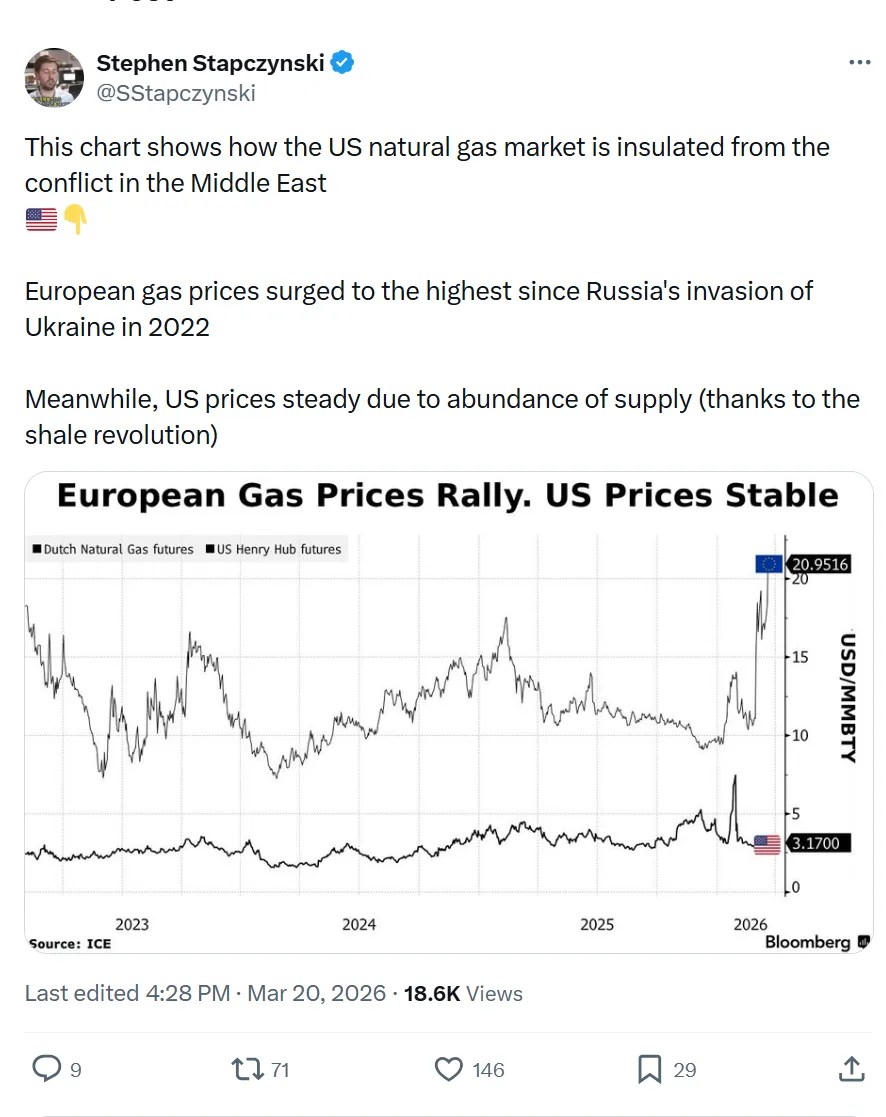
The only reason the rest of the U.S. mainland isn’t suffering alongside Asia is the shale revolution — the very energy breakthrough environmentalists fought tooth-and-nail for a decade.
That revolution flipped America from the world’s biggest oil importer (dangerously dependent on Middle East supply) into the world’s biggest producer of oil and natural gas. It created a domestic energy shield that is now protecting the American economy from this man-made crisis.
From David Blackmon’s Energy Additions, March 30, 2026 (subscription required)
It’s a special kind of logic to sound the alarm about declining revenue—while simultaneously putting one of the state’s reliable, long-standing revenue streams on the chopping block.
Wasted Days and Wasted Nights: When a Simple Bill Goes to Vegas and Loses
Somewhere between a routine floor session and a full-blown policy brawl, the Alaska Senate managed to turn a straightforward, noncontroversial bill into a procedural mess that would make even a seasoned card dealer shake their head.
House Bill 194 was supposed to be easy. Boring, even. The kind of bill that quietly does its job—ratifying the State of Alaska’s long-standing royalty oil sale contract with Marathon Petroleum, a reliable revenue stream. No drama. No intrigue. Just governance.
And then… Wednesday happened.
In what can only be described as a legislative plot twist, an amendment was introduced on the Senate floor that transformed the bill from a simple contract ratification into a sweeping tax policy debate. Suddenly, the focus shifted to new tax language aimed at certain privately held oil and gas companies, with implications that could stretch far beyond just a few companies.
Meanwhile, the clock is ticking.
And that’s where the “wasted days and wasted nights” really start to add up.
Because while lawmakers debate process and policy, the practical consequences stack up:
A critical contract remains in limbo
A reliable revenue stream is put at risk
Energy security questions go unanswered
And the Senate Majority burns valuable time untangling a situation of its own making.
Nothing says “open for business” quite like celebrating a successful lease sale in NPR-A—then immediately following it up with a tax grab that practically dares investment to take a seat on the bench.
How did we get from routine business to legislative roulette?
In Alaska’s Capitol this week, the answer seems clear: sometimes, the biggest gamble isn’t placed in a casino—it’s placed on the Senate floor.
Energy Secretary Chris Wright calls AKLNG “probably single most important energy infrastructure project of this whole administration.”
Alaska LNG back in focus: The state of Alaska has been thrust to the center of the Trump administration’s energy policy, as officials look to increase oil and gas production up North. This is all tied to a long-awaited, and controversial, liquefied natural gas pipeline that would stretch the length of the state.
Energy Secretary Chris Wright has called the LNG project “probably our single most important energy infrastructure project of this whole administration,” Axiosreported this morning.
In order to finance the project, Wright said, the administration is working to help the pipeline developer finalize commercial offtake and equity financing agreements, but the Energy Department’s loan office could also support the construction.
If you forgot, the 800-mile pipeline is intended to start in Prudhoe Bay, along the Arctic Ocean, where the existing Trans-Alaska Pipeline System, also around 800 miles long, begins. The project will also include the construction of a liquefaction facility to cool and condense the gas for exporting. Permitting for the project first started in 2014 and was finally completed in December.
Cold water on increased production: While the administration is using CERAWeek to encourage domestic oil and gas producers to ramp up their operations amid high prices, the largest fossil fuel trade group is doubtful that will happen.
“No one is going to be making significant investments in production when they don’t know what the duration of this is going to be,” Mike Sommers, president of the American Petroleum Institute, toldBloomberg . “Right now, we have a supply disruption, not a demand increase.”
From the Washington Examiner, Daily on Energy, March 24, 2026
Resource development provides over 95% of the North Slope’s tax revenue, which supports essential services in the remote region, including schools, health clinics, water and sewer systems, and wildlife management.
The Department of Interior held an oil and gas lease sale this week for the National Petroleum Reserve Alaska (NPR-A). It was by every measure a huge success. The sale resulted in 187 leases and generated $163 million.
The sale brought in some of the big players in oil and gas, including Shell, Exxon, and ConocoPhillips. It signaled a lot of interest from the industry in oil and gas development on Alaska’s North Slope.
It was a big win for Trump’s unleashing American energy policy, but it’s also a win for the North Slope Iñupiat Alaska natives.
Consistent advocacy and messaging
Resource development provides over 95% of the North Slope’s tax revenue, which supports essential services in the remote region, including schools, health clinics, water and sewer systems, and wildlife management.
The Biden administration would often say it was listening to indigenous voices, but when those voices collided with the administration’s climate goals, Native Americans took a back seat. Former President Joe Biden passed regulation after regulation restricting resource development, including oil, gas, and mining.
The Voice of the Arctic Iñupiat (VOICE), a 501(c)(4) nonprofit that advocates for the Arctic Slope communities, spent years trying to get a meeting with Deb Haaland, Biden’s interior secretary. She finally sat down with them in the summer of 2024.
“Things have changed quite a bit. And I think it’s a testament to our membership, our advocacy and our constant, consistent messaging, no matter who’s in office,” since the VOICE was founded in 2015, Nagruk Harcharek, president of VOICE, told Just the News.
Larry Fink, who leads the world’s largest asset manager, says the US “overdid” the focus on young people going to university and idolizing jobs careers in banking while undervaluing skilled trades.
Society should respect plumbing and electrician careers as artificial intelligence (AI) replaces some office jobs, the boss of US financial giant BlackRock has told the BBC.
Larry Fink, who leads the world’s largest asset manager, says the US “overdid” the focus on young people going to university and idolizing jobs careers in banking while undervaluing skilled trades.
In a wide-ranging exclusive interview, he also warned if the price of oil hits $150 (£122) a barrel it will trigger a global recession.
BlackRock is a financial colossus, controlling assets worth $14 trillion, and is one of the biggest investors in many of the world’s largest companies.
Its size and spread gives Fink, who is one of the eight co-founders of the business, which started in 1988, a unique insight into the health of the global economy.
Earlier this week, in his annual letter to shareholders, Fink said the AI boom would create an enormous amount of jobs “related to electricians and welders and plumbers”.
In contrast, there might not be as much demand for some office jobs and this could lead to a rethink about what roles are needed as “society is changing and evolving”.
He said this meant we needed to change our perception of skilled trades.
The Alaska Department of Natural Resources has tentatively decided that oil and gas exploration should be allowed on state land in the vicinity of the Yukon River.
In a public notice published March 4, the agency said its determination for the Yukon Flats “comports with constitutional direction to encourage the development of the state’s resources, and with the legislature’s direction that it is in the state’s interest to develop the state’s oil and gas resources.”
The flats are a large area of wetlands and lowlands at the confluence of the Yukon and Porcupine rivers in Interior Alaska.
DNR’s preliminary approval is subject to a public notice process, and public comments on the agency’s position are due by April 6. They may be emailed to dog.bif@alaska.gov.
This month’s public notice comes as the oil and gas firm Hilcorp enters another year of operations in the area with Doyon Ltd., the regional Alaska Native Corp. for Interior Alaska.
Last summer, Hilcorp drilled for oil on land leased from Doyon near the village of Birch Creek, south of Fort Yukon. Doyon’s subsidiary, Doyon Drilling, conducted much of the work.
Governor Mike Dunleavy has sent legislation to the Alaska State Legislature proposing a new tax structure for the Alaska Liquefied Natural Gas Project.
Under the plan, taxes would be based on the volume of gas flowing through the pipeline instead of the assessed value of the infrastructure. Officials say the current property tax creates a heavy cost during the early years of the project when construction expenses are high and revenue is low.
The proposal exempts the project from property taxes during construction and a ramp-up period after commercial operations begin. Once full operations start, a volumetric tax of six cents per thousand cubic feet would be applied, increasing one percent annually.
Revenue from the project would be shared between the state and local municipalities based on the location of the pipeline. State officials estimate the legislation could generate more than 26 billion dollars over 30 years.
Governor Dunleavy says the plan reduces risk for investors, creates a more predictable revenue stream, and benefits Alaskans by supporting affordable energy, new jobs, and long-term economic growth.
“The Alaska LNG Project is one of the most significant economic opportunities in our state’s history. This legislation removes a structural barrier that was standing between Alaska and decades of energy security, jobs, and revenue,” said Governor Dunleavy.
The latest data from the Energy Information Administration (EIA) on electricity prices and sales contradict the narrative that data centers are driving up electricity prices. That may change in the future, but the most recent data shows that data centers are not responsible for higher electricity rates.
The massive growth in AI-electricity demand at data centers has sparked growing concern about rising electricity demand and prices. Commentators increasingly argue that the rapid expansion of data-center infrastructure is pushing up electricity prices and imposing hidden costs on households. It is an intuitive narrative as data centers consume large amounts of electricity, demand is rising quickly, and prices in some regions have increased much faster than inflation in recent years. As a result, some politicians and activist groups have rallied around the idea that data centers are driving up electricity prices. Some are even calling for a moratorium on new data centers. But does the data support this intuition? The answer is no. Although data center growth is helping to drive demand higher, it does not explain why electricity prices have risen significantly in some parts of the country.
There is no statistically significant correlation between the number of data centers in a state and its current electricity prices. In fact, prices in the top ten data center states are virtually identical to the average across other states. Furthermore, there is no statistically significant relationship between data center concentration and faster increases in electricity rates.
Japan will purchase the additional crude oil produced in Alaska as part of its effort to reduce its heavy dependence on Middle East oil. Currently about 90 percent of Japan’s crude oil imports comes from that region.
Japan will invest to increase crude oil production in Alaska as part of the $550 billion (87 trillion yen) tariff agreement with the United States and also stockpile the reserves produced in the U.S. state.
Sources said Prime Minister Sanae Takaichi and U.S. President Donald Trump will announce the plan when they meet in Washington, D.C., on March 19.
Japan will purchase the additional crude oil produced in Alaska as part of its effort to reduce its heavy dependence on Middle East oil. Currently about 90 percent of Japan’s crude oil imports comes from that region.
The worsening situation in the Middle East has affected crude oil shipments through the Strait of Hormuz, which has been effectively blockaded by Iran. Subsequently, the volume of crude oil reaching Japan will decrease greatly from around March 20, according to the economy ministry.
Economist Brett Watson said the level of competition was novel. “Many tracts received multiple bids,” said Watson, who works at the Institute of Social and Economic Research at the University of Alaska Anchorage. “That hasn’t been true in a number of years in the NPR-A.”
An auction of drilling rights in the National Petroleum Reserve-Alaska broke records Wednesday, suggesting that the oil and gas industry is keenly interested in expanding in the U.S. Arctic.
Kevin Pendergast, Alaska director of the Bureau of Land Management, announced that the winning bids totaled nearly $164 million, half of which will go to the state of Alaska.
“This is the strongest sale we have ever had in the National Petroleum Reserve in Alaska, by nearly every measure,” he said on a live cast after all 430 bids were unsealed and read out loud.
The federal lease sale adds meat to the Trump administration’s framing of Alaska as an energy beast that just needs to be “unleashed” from prior conservation restrictions.
Eleven companies placed bids on more than 1.3 million acres in the western Arctic reserve. Much of the industry’s focus was on tracts near Willow, the ConocoPhillips project already underway.
As expected, ConocoPhillips was a big bidder, but other major and minor companies participated, too. The Spanish company Repsol won 42 leases, with partners that include energy giant Shell. At least half of its bids were more than $2 million.
While Trump’s efforts to revive coal in his first term had little impact, he’s having more success since returning to the White House last year. The US Energy Department has also ordered five coal plants that were set to retire to remain in service and has indicated that it may issue similar orders to other sites that are preparing to shut down.
Terra Energy Center is pouring $1 billion into a deal for a planned coal project in Alaska, marking the first investment in new US coal power in more than a decade.
The in-principal agreement with Hyundai Heavy Industries Power Systems for an order of power-plant boilers was described in a US Interior Department fact sheet Monday. The transaction is one of several that advanced during talks at the Indo-Pacific Energy Security Ministerial and Business Forum in Tokyo this weekend.
Terra Energy Center’s plan represents a striking reversal for the US coal industry. Coal once supplied more than half of the nation’s electricity, but that figure has been steadily declining and now stands at about 16%. The shift came as utilities turned to cheaper and cleaner power sources, including natural gas and renewables, in an effort to rein in climate change. Environmental groups have been pushing to eliminate coal power completely and questioned the economics of developing new projects.