Today’s Key Takeaways: Supreme Court gives permission to build! JERA submits expression of interest in AKLNG. Major infrastructure win for Alaska mining. Two prominent AK provisions stripped from big, beautiful bill.
Here are three takeaways from Thursday’s Supreme Court ruling that put new limits on federal reviews of infrastructure and energy projects.
Why it matters: Narrowing the National Environmental Policy Act’s scope has giant implications for President Trump’s pro-fossil “energy dominance” agenda.
1.This case is sneakily a huge deal. It wasn’t among the highest-profile SCOTUS battles that touch environmental policy, like the “Chevron deference” and “major questions” rulings.
But a spin through the docket shows that powerful K Street lobbies, environmentalists, and senior members of Congress all took keen interest. Names of note include Sen. John Barrasso, the Interstate Natural Gas Association of America and U.S. Chamber of Commerce.
2.It could have long-term climate policy effects. One thing to watch over the horizon is how much it curtails future presidents from stitching carbon emissions into project decisions.
Biden-era officials were taking steps in that direction, though Trump 2.0 has been reversing them, such as this week’s formal withdrawal of 2023 Council on Environmental Quality guidance.
3.It could have unpredictable effects. A hot center-left view these days is that NEPA (and other review layers) make it too hard to build anything — including low-carbon infrastructure.
Aidan Mackenzie of the Institute for Progress, writing on X, shouts out Justice Brett Kavanaugh for being “full abundance-pilled.”
The Kavanaugh-written decision says NEPA thwarts all kinds of projects — including transmission and wind turbines.
Check out Mackenzie’s entire thread, which delves into what discretion agencies will and won’t have under the ruling.
Catch up quick: The case centered on federal approval of an 88-mile railway to carry oil from Utah’s Uinta basin to larger rail networks and Gulf Coast refineries.
It reverses an appellate ruling that regulators needed to weigh matters beyond the railway’s direct effects, such as drilling impacts, refining pollution and climate change.
“NEPA does not allow courts, ‘under the guise of judicial review’ of agency compliance with NEPA, to delay or block agency projects based on the environmental effects of other projects separate from the project at hand,” the 8-0 decision states.
The court’s three liberals issued a concurrence on the fresh limits on NEPA reviews weighing upstream and downstream project effects.
But they ding the majority for “unnecessarily grounding its analysis largely in matters of policy.”
What they’re saying: The American Petroleum Institute applauded the court’s “long overdue steps to restore NEPA to its original intent.” But API said “common-sense permitting reform” is still needed.
On the flip side, the Center for Biological Diversity said the ruling “guarantees that bureaucrats can put their heads in the sand” on how projects affect ecosystems, wildlife and the climate.
What we’re watching: How the ruling starts filtering down to specific project reviews on LNG terminals, oil and gas development and more.
Japan’s largest liquefied natural gas importer, JERA Co., signaled it would consider buying the fuel from an export project in Alaska that has been championed by US President Donald Trump, as companies and government officials travel to the northern state for a week of negotiations and deals.
JERA, which is also the Asian nation’s largest power producer, submitted its expression of interest ahead of a summit next week, said people with knowledge of the matter. JERA did not specify how much LNG the company would potentially buy, said the people, who asked not to be identified because the talks are private.
JERA declined to comment regarding the expression of interest.
The move is a small step forward for the $44 billion Alaska LNG export project, which has been proposed in various forms for decades but has so far struggled to secure binding long-term contracts and investments. It comes as Japan’s government is seeking to smooth the path to a tariff deal with the US.
The Alaska Sustainable Energy Conference is not centered on the LNG project alone, but US proponents are using the gathering as a timely opportunity to gather support — while Asian gas buyers are seizing the moment to gain favor with Washington at a critical juncture in trade talks.
Takehiko Matsuo, vice minister for international affairs at Japan’s Trade Ministry, will attend the gathering, Japanese Trade Minister Yoji Muto said to media on Friday.
Taiwan will also send a delegation to the conference. South Korea’s energy ministry and Korea Gas Corp. are expected to attend the same discussions, the Herald Business Newspaper reported earlier this week.
VANCOUVER, BC / ACCESS Newswire / May 29, 2025 / Grande Portage Resources Ltd. (TSXV:GPG)(OTCQB:GPTRF)(FSE:GPB) (“Grande Portage” or the “Company”) is pleased to announce that the Alaska Department of Transportation & Public Facilities (DOT&PF) is advancing infrastructure development at Cascade Point, the site of the company’s proposed ore shipping terminal as well as a proposed passenger ferry terminal.
The Cascade Point property is owned by Goldbelt Inc, an Alaska Native corporation based in Juneau. Goldbelt and Grande Portage have an existing Letter of Intent to cooperate on advancing a freight barge terminal facility at the site, which would be utilized for transportation of ore from the company’s New Amalga Gold Project to a third-party processing facility. (See Grande Portage press release dated September 10, 2024)
Goldbelt also has an existing Memorandum of Understanding with the Alaska DOT&PF for advancing development of an Alaska Marine Highway System (AMHS) passenger ferry terminal at the site, which would significantly shorten the ferry route between Juneau and nearby communities.
Last week, the Alaska DOT&PF announced that it is initiating a design-build contracting process for Phase 1 of the Cascade Point Passenger Ferry Terminal. The scope of work includes all earthworks and site preparation for the uplands area, procurement of materials for development of the marine area, construction of a replacement bridge to enable heavy equipment access to the site, and construction of a new access road suitable for year-round use. Total value for this contract is estimated at $20-30 million USD.
Development of the ore terminal is not contingent on development of the passenger ferry terminal – it can be developed prior to (and independently of) the passenger ferry facility. However, having the ferry terminal proceed first is highly advantageous as it would result in the development of infrastructure that will also be necessary for the ore terminal, particularly the new access road and bridge. This reduces the time and cost required for future ore terminal development.
Ian Klassen, President and CEO comments: “We are extremely pleased to see the State of Alaska advancing the Cascade Point Passenger Ferry Terminal towards construction. In the future, Grande Portage and Goldbelt intend to further develop the site by adding a freight barge terminal for transportation of ore from the New Amalga Gold Project to a third-party processing facility. This dual-use of the site will maximize the benefits to the local economy and create long-term job opportunities for the community of Juneau”.
House Republicans sacked two prominent Alaska drilling and mining provisions from their tax, energy and national security megabill just hours before it cleared the chamber, but a top GOP lawmakers has hopes the Senate will add them back in.
The two provisions cut from H.R. 1, the “One Big Beautiful Bill Act,” would have facilitated approval of the Ambler mining access road and ramped up drilling in Alaska’s National Petroleum Reserve. They are long-sought priorities for Republicans, and their fate on the cutting room floor came as a surprise.
House Natural Resources Chair Bruce Westerman (R-Ark.), however, said the provisions were removed over procedural concerns relating to the budget reconciliation process.
“These provisions were addressed in the manager’s amendment out of an abundance of caution as part of the nuanced reconciliation process,” Westerman said in an email.
Any day the Center For Biological Diversity gets slapped around by the Supreme Court is a good day.
8-0.
"NEPA is a procedural cross-check, not a substantive roadblock. The goal of the law is to inform agency decision-making, not to paralyze it," Kavanaugh wrote." https://t.co/7o2SKwhjEr
Today’s Key Takeaways: Oil up with different supply options. Worley begins work to finalize cost estimate for AKLNG. More success for U.S. Gold at Alaska’s Whistler project. Big, beautiful bill and battery production decline.
Oil picks up from the previous day’s selling with the market juggling opposing geopolitical and supply scenarios. Recent sideways trading reflects changing expectations around supply and demand, George Pavel of Naga.com Middle East says in a note. The U.S. blocking Chevron from exporting Venezuelan crude has tightened supply, and the prospect of further U.S. sanctions on Russian energy exports reinforces the potential for a rebound. That’s offset by expectations of another large OPEC+ output increase for July and U.S.-Iran nuclear talks that hold potential for a return of Iranian barrels, he adds. “Production increases over recent months, combined with a build-up in U.S. crude inventories, indicate a market increasingly leaning toward surplus.” WTI is up 1.4% at $61.75 a barrel and Brent gains 1.3% to $64.
By putting Australia’s Worley in charge of the final engineering works, Glenfarne Alaska LNG, a subsidiary of Glenfarne Group, is edging closer to a final investment decision (FID) for a liquefied natural gas (LNG) export project in Alaska, as a majority owner and lead developer together with its joint venture partner, the State of Alaska’s Alaska Gasline Development Corporation.
Glenfarne has disclosed that Worley, tasked with undertaking additional engineering and preparing a final cost estimate for the Alaska LNG pipeline in sufficient detail to achieve FID for the project, has begun its assignment. The firm will use and supplement the package of previously completed engineering work and update the cost of the pipeline.
In addition, the company has been selected as the preferred engineering firm for the Cook Inlet Gateway LNG import terminal and project delivery advisor to Glenfarne across the Alaska LNG projects. The lead developer of this LNG project has launched a strategic partner selection process to team up with companies that support its execution efforts and have complementary expertise to help bring this development to life.
U.S. GoldMining Inc. (NASDAQ: USGO) (“U.S. GoldMining” or the Company“) is pleased to provide further detail regarding its high priority exploration targets for the northern part of its Whistler Gold-Copper Project (the “Whistler Project” or the “Project“) in Alaska, U.S.A.
Highlights:
TheWhistler – Raintree mineral system, also referred to as the ‘Whistler Orbit‘, comprises a classic ‘porphyry cluster’ spread over an area of approximately 5 x 5 km, containing multiple mapped and interpreted porphyry intrusions and including the established Whistler and Raintree West mineral resource deposits. Porphyry deposits are the primary source of copper globally and can also contain significant other metals such as gold, silver, and molybdenum.1 Whistler represents a gold-rich variant of the porphyry family.
Over 25 individual exploration targets are identified within the Whistler Orbit area, comprising a mix of mapped diorite porphyry rocks and/or surface geochemical anomalies, and interpreted diorite porphyry stocks and dykes from 3D magnetic modelling.
The potential for new discoveries within the Whistler Orbit was exemplified by the recently announced drilling results south of Raintree West deposit (see news release dated February 10, 2025) which included 138.0 m at 0.99 g/t AuEq (comprised of 0.89 g/t Au and 0.05% Cu) plus 17.57 g/t Ag, 0.44% Pb and 0.95% Zn, located 500 meters south of the Raintree West deposit in an area with no previous drilling.
The Company’s 100% owned Whistler Project, which lies within the emerging West Susitna Mineral District located just 100 miles west of Anchorage, Alaska, encompasses a contiguous land package of 53,700 acres of State mining claims. The footprint of the existing gold-copper deposits makes up <1% of the total Project area.
The Company is currently planning for potential future exploration programs to test the highest-ranking gold ± copper ± silver targets identified to date and to develop phased exploration programs which could commence this coming summer.
Tim Smith, Chief Executive Officer of U.S. GoldMining, commented: “The Whistler Gold-Copper Project is located within the West Susitna Mineral District, which contains established gold, copper and silver mineral resources, plus potential for other critical metals such as antimony and tungsten. The Whistler Project located just 105 miles from Anchorage, Alaska, encompasses three known mineral systems containing existing gold-copper-silver deposits and numerous additional potential exploration targets. Located in the north of the claim group, the Whistler-Raintree Mineral System already contains two of the three deposits delineated to date and over 25 additional individual potential exploration targets identified over an area of approximately 5 x 5 km. Also known as the Whistler Orbit, this area is underlain by a large causative batholith which has spawned a ‘porphyry cluster’ of multiple high-level intrusive bodies prospective for porphyry-style gold-copper-silver mineralization. We have an established exploration methodology, including the ability to directly image the intrusive bodies by inversion modeling of magnetic survey data coupled with geochemical and alteration data that is helping to vector exploration towards the highest priority targets. We are excited about the potential for systematic exploration to unlock additional resource growth at Whistler.”
Council on Clean Transportation: Trump’s big, beautiful bill could slash U.S. battery production by ~75% by 2030 to 250 GWh from the previously projected 1,050 gigawatt-hours, and EV sales by 40%.
The bill would eliminate 130,000 potential jobs in the EV sector by 2030.
Red and purple states including Texas, Michigan, Nevada, Tennessee, Kentucky and Georgia, would be the most adversely impacted if the bill were to become law.
Last week, the U.S. House of Representatives narrowly passed what’s been dubbed the “big, beautiful bill”, with the legislation designed to leverage deep cuts to the Inflation Reduction Act (IRA) credits to pay for tax cuts, immigration enforcement and extra spending on defense. The contentious bill is now headed for the Senate, where it faces its final test, with all Democrats but only a handful of GOP lawmakers critical of the huge increase it will bring to the national debt. According to a recent analysis by the International Council on Clean Transportation, the bill, coupled with cuts to other climate policies, could slash U.S. battery production by ~75% by 2030 to 250 GWh from the previously projected 1,050 gigawatt-hours, and EV sales by 40%.
The finding paves the way for the Trump administration to issue new US LNG export permits for the first time in almost a year.
The US Department of Energy (DOE) released its response to comments on a Biden administration LNG study May 19, finding that increasing US LNG exports is in the nation’s best interest.
The finding paves the way for the Trump administration to issue new US LNG export permits for the first time in almost a year.
President Joe Biden in January 2024 ordered DOE to halt new LNG export authorizations pending the results of the study gauging the effects of greater US LNG export capacity on the environment and natural gas prices (OGJ Online, Jan. 26, 2024).
The study, released in December 2024, found that expanded US LNG exports would harm the public and the environment by increasing domestic natural gas prices, electricity prices and worldwide greenhouse gas emissions (OGJ Online, Dec. 17, 2024).
Instead of simply declaring the LNG pause over as he had vowed in the run-up to the election, Trump at the urging of the LNG industry extended the study’s comment deadline to Mar. 25, 2025, from Feb. 18, 2025, to allow for additional comments building the rationale for LNG exports. Completing the administrative process should bolster the chance that new export permits survive potential court challenges (OGJ Online, Jan. 21, 2025; Feb. 19, 2025).
In its response to comments, DOE found that that greater LNG exports would have “no discernable impact to global greenhouse gas emissions,” would help grow the US economy, and shrink the US’ trade imbalance. DOE said its findings, based on the 2024 Biden administration study and all the public comments, support the proposition that exports of LNG from the US are in the best interest of the American public.
DOE’s recent finding could spur it to grant export authority to about a dozen LNG plants awaiting approval and help already approved LNG projects tied up in courts.
There’s a strong chance the Alaska Legislature will adjourn today, a day ahead of Wednesday’s deadline, according to lawmakers and staff. Key votes are a veto override on an education bill at 9 a.m., the compromise budget with a $1,000 PFD and potentially elections reform. pic.twitter.com/6B1biOu1Am
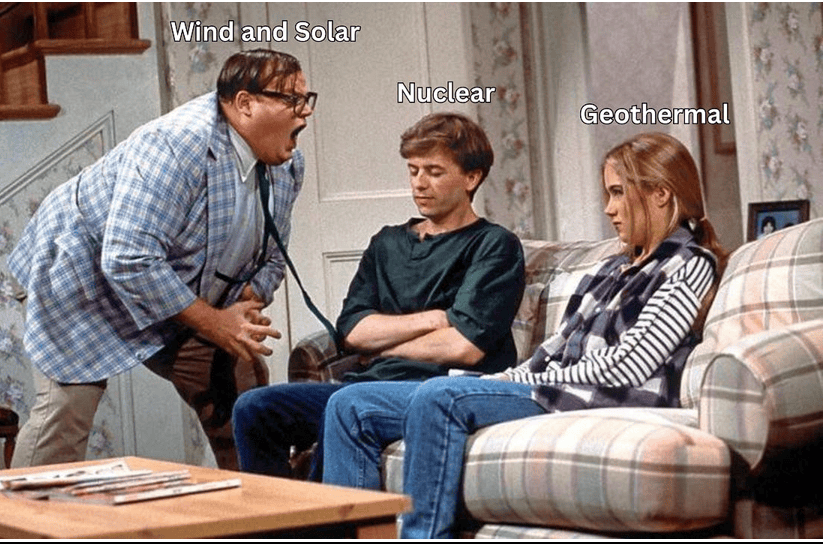
Without your money, wind and solar would be living in a van down by the river
This week, the House Republicans released their initial draft reconciliation package for the energy subsidies in the so-called Inflation Reduction Act (IRA). Unfortunately, it appears they are not working to immediately eliminate the IRA subsidies for wind and solar, but are instead looking to “phase them out” starting in 2028 and completely eliminating them by 2032.
This is simply not good enough because we’ve seen this movie too many times already, and it’s a bad one. It goes like this: Since the original Production Tax Credit (PTC) passed in 1992, when Isaac’s favorite show was Sesame Street and Mitch was a mere twinkle in his father’s eye, Republican lawmakers have been promising to “phase out” these subsidies in the future. However, when it comes time for the subsidies to actually go away, they are extended (often retroactively), and we continue the system of wealth transfers from hardworking Americans to unreliable energy producers.
The problem with “phase-outs” is that they never come to fruition. In the past, the renewal of the wind and solar subsidies has not been a major issue for grid reliability, but those days are over. In the next five to ten years, the grid will face a growing risk of widespread rolling blackouts due to surging power demand, federal regulations incentivizing the retirement of reliable coal and natural gas power plants, and a proliferation of unreliable wind and solar resources that are a direct result of the federal subsidies.
The main problem with the proposal by House Republicans is that they appear to view the wind and solar subsidies as a budgetary issue, and not a grid reliability issue. If we are going to subsidize any sources of energy, they should be dispatchable resources with the potential to outgrow the helping hand of government subsidization. Wind and solar have proven unable to do either. PTC “Phase Outs” If the history of the PTC—and many other “temporary” government programs—teaches us anything, it’s that you can’t trust a politician unless their mouth is closed.
As we wrote in Grassley v. The Grid, when the first PTC was implemented in 1992, Senator Chuck Grassley, the “Father of the PTC,” noted that the intent of the subsidy was to be a temporary “jump start” to a fledgling wind industry in it’s “infancy,” reflected in the fact that it ended eligibility in December 1999.
While not a “phase out,” the intent was clear: the subsidies weren’t supposed to last forever. Looking back, we wonder how many people understood “temporary” to mean over 40 years, or possibly forever, which it will hit according to the IRA. A History of Extensions The PTC has been extended 11 times since its inception in 1999, 2002, 2004, 2005, 2006, 2009, 2013, 2014, 2015, 2020, and 2021. The graph below shows when the PTC was enacted and extended, and for how long each time. While the original purpose involved “jump-starting” the industry to compete with other resources, it didn’t take long for the goalposts to move.
As Tom Pyle argued in an excellent piece, lawmakers have since argued for PTC extensions using any excuse they can imagine: to artificially prop up jobs, aid in economic recoveries, create certainty for green investors and uncertainty for fossil fuel investors, and so on. It’s interesting to note that none of these are the proper roles of the energy industry, which is to provide a quality and affordable product to consumers,but once a government program, always a government program. Senator Grassley was a key figure in arguing for almost every PTC extension. In 2002, he argued for an extension, saying, “Extending the wind energy tax credit is vital to keep this clean energy source growing and creating jobs, especially in rural areas hit hard by economic challenges.” In 2004, he promoted another extension, saying, “Without the production tax credit, wind energy projects would grind to a halt. This extension keeps the industry moving forward and supports thousands of jobs.” Over 20 years later, and he’s still not wrong: even today, wind projects would plummet without subsidies. In 2009, he again called for another extension, this time using the Great Recession as justification, asserting that, “Extending it through 2012 ensures we keep building this industry, especially when our economy needs every job we can get.” In 2012—the twentieth anniversary of the PTC—the subsidy officially ended with no phase out… until it was resurrected and extended once again, thanks in part to Grassley, who argued, “If we let the wind tax credit expire, we’ll lose thousands of jobs and billions in investment. This extension is critical to keep the industry alive.”
While some Republicans had been calling for a phase-out of the subsidies as early as 2005, the first official phase-out wasn’t implemented until 2015. This phase-out was canceled in 2020, however, using the economic turmoil from COVID as a reason to extend the subsidies again (similar to the Great Recession). As Travis Fisher noted in his excellent report on the cost of the IRA for the Cato Institute, the IRA extended the subsidies for wind and solar projects out to 2032 or when U.S. power sector greenhouse gas emissions decline to 25 percent of 2022 levels, whichever is later.
Fisher notes the electricity sector is highly unlikely to reduce the GHG emissions by 75 percent from 2022 levels in the next 10 years, especially if electricity demand continues to grow, meaning the subsidies are likely to be a permanent fixture of the energy landscape.
Where Republicans Stand on IRA Subsidies Now
The Republicans in Congress have now proposed to phase the IRA subsidies sooner, starting in 2029 and ending in 2032, in addition to ending the ability to sell the credits to third parties and requiring projects to be “placed in service” as opposed to simply commencing construction (which is how the credit was applied prior to the 2013 extension).
However, there appears to be some disagreement regarding these subsidies in the House and Senate. According to Politico, Republican Senator Kevin Cramer of North Dakota recently stated that the House plan to phase out the technology-neutral clean electricity tax credits beginning in 2029 would kneecap newer technologies that Republicans favor, like advanced nuclear reactors and geothermal, which are not ready to be deployed at a large scale. “They definitely need more time than that,” Cramer said. “It’s too short for truly new technologies. We’ll have to change that. I don’t think it’s fair to treat an emerging technology the same as a 30-year-old technology.” Cramer has issued his own proposal to phase out the credits only for wind and solar, arguing these technologies no longer need the tax credits.
This is the correct tactic, but instead of a phase-out, the wind and solar tax credits should be cut cold turkey, yesterday.
End Wind and Solar Subsidies, Yesterday The issues stemming from wind and solar subsidization are many. For one, they cost the American taxpayer $30 billion in 2023 and are expected to reach over $40 billion per year if the IRA subsidies continue.
At a time when the Trump administration is looking to enact massive tax cuts, one of the best ways to succeed in this would be by ending the most expensive energy subsidies in history. Second, and even more damning, is the negative impact wind and solar subsidies have on grid reliability. These subsidies give Investor-Owned Utilities, like Arizona Public Service, cover for prematurely shutting down their reliable, low-cost coal plants and replacing them with billions of dollars in wind turbines, solar panels, and battery storage facilities. The subsidies also distort the energy markets to the point that reliable and affordable power plants are shutting down and threatening the reliability of the grid.
These are facilities that even wind and solar rely on for resiliency and reliability attributes, like inertia, as demonstrated in the recent Iberian Blackout. The reliability threat to our grid is one of the most important issues facing the country, as it involves the foundation of our entire society. All lawmakers, especially Republicans, should be taking this extremely seriously.
As seriously as Democrats take climate change.
The Democrats play for keeps on energy. They use every regulatory lever of government at their disposal to punish energy sources they don’t like while propping up their preferred unreliable energy sources (wind and solar).
Their strategy is simple: introduce as much Fear, Uncertainty, and Doubt (FUD) for coal, natural gas, or nuclear investments, while pearl-clutching about the need for financial and regulatory “certainty” for wind and solar.
Republicans need to match this energy in the opposite direction. After Democratic administrations abused the EPA in an attempt to regulate coal plants out of existence and chill investment in new natural gas plants, all the while lavishing their preferred energy sources (wind and solar) with hundreds of billions of dollars in subsidies in perpetuity, the Republicans answer with a proposed “phase out” of the subsidies, which we know will never happen.
As Tom Pyle from the Institute of Energy Research (IER) stated: History shows there is no such thing as a ‘phase down’ of these policies because they will inevitably be resurrected. If the goal is to protect taxpayers from never-ending subsidies and protect the electric grid from the destabilizing influence of the Production Tax Credit (PTC) and Investment Tax Credit (ITC), these tax credits need to be ended now. We don’t have time to simply “phase out” these subsidies. Every year they remain is another year the grid becomes less reliable and more expensive. READ MORE
Today’s Key Takeaways: Cutting review times for oil and gas leasing in half? Pebble lawsuit stays on hold. UAE energy investments in US will rise five-fold.
The Interior Department announced a new policy Tuesday designed to speed up and expand oil and gas leasing on public land.
The plan shortens lease parcel reviews by Interior’s Bureau of Land Management to six months — a timeline that could cut review times in half from what they were during the last two years of the Biden administration.
BLM manages 245 million acres of federal land and 700 million acres of subsurface mineral estate, making its decisions closely watched by the energy industry as well as conservation groups. In a news release, Interior pointed to President Donald Trump’s push to open up more land for development while cutting review times.
“Under President Trump’s leadership, we are ending the unnecessary delays and bureaucratic roadblocks that have held back American energy production for too long,” Adam Suess, acting assistant secretary for land and minerals management at Interior, said in a statement.
Pebble lawsuit stays on hold as key federal positions remain unfilled.
Northern Dynasty Minerals Ltd. May 14 announced that it has consented to a request by the Environmental Protection Agency and U.S. Army Corps of Engineers to extend the current abeyance in ongoing litigation over the Pebble project by an additional 30 days, allowing more time for the new administration to review the case.
In the wake of ongoing changes in the new administration, EPA and USACE initially requested a 90-day pause in February to allow the agencies time to fill key roles and to familiarize themselves with the case surrounding Pebble.
Given the procedural history and regulatory scope of the matter, the agencies have now requested an additional 30-day extension, citing the continued absence of key appointments as personnel transitions remain underway.
According to Northern Dynasty, one of the primary factors in the request is the continued vacancy in the position of Assistant Attorney General for the Environment and Natural Resources Division of the U.S. Department of Justice – a role central to federal litigation strategy and agency coordination.
“We have not objected to the request for this additional and shorter abeyance because there still is not a confirmed Assistant Attorney General for the Environment and Natural Resources Division of the Justice Department in place,” said Northern Dynasty President and CEO Ron Thiessen. “This is an important position in any negotiation between a project proponent and a regulator, and for a process that could, hopefully, remove the veto and re-start the permitting process.”
The current pause is now scheduled to expire in mid-June unless the court approves a further extension or proceedings resume.
UAE says value of energy investments in US to rise five-fold
US firms to invest $60 billion in UAE energy projects
Trump says there is progress on UAE’s $1.4 trillion pledge
DUBAI, May 16 (Reuters) – The United Arab Emirates plans to raise its energy investments in the United States to $440 billion in the next decade, it said on Friday, boosting U.S. President Donald Trump’s efforts to secure major business deals on a Gulf tour.
The wealthy oil power’s strategy – which aligns with global growth ambitions for its companies – was announced during a presentation by Abu Dhabi oil giant ADNOC’s CEO Sultan Al Jaber to Trump during the last stage of the president’s regional trip.
Geothermal energy is clean, abundant, scalable and always on. Our members saw this firsthand in Utah this week at Fervo Energy’s Cape Station geothermal development, which has the potential to produce enough electricity to power half a million homes! Members followed up the site… pic.twitter.com/9cTGngmCUy
— House Committee on Natural Resources (@NatResources) May 16, 2025