Today’s Key Takeaways: Read the fine print in the new infrastructure bill – bureaucrats are making it more difficult to build new highways. AKLNG project improvements have reduced cost of supply 43%, which competitively positions Alaska LNG ahead of U.S. Gulf Coast LNG projects. Key democrats agree that when it comes to climate change legislation “Manchin should have the pen, we should respect that whatever he wants to do will be reasonable and ultimately be historic.”
The Biden DOT puts restrictions on new federal highways.
If you hoped President Biden’s infrastructure spending might bring a smoother drive to an area near you, it’s worth reading the latest fine print. Before funds are disbursed, bureaucrats are attaching strings that make it far more difficult to build new highways.
The restrictions come from a memo last month from the Federal Highway Administration (FHWA). The Transportation Department agency is fielding infrastructure project proposals from states and cities, and it has sway over regulatory approval. Deputy Administrator Stephanie Pollack advised staff on the types of projects they should give the red light.
According to the memo, proposals should be sent to the bottom of the pile if they “add new general purpose travel lanes serving single occupancy vehicles.” She means cars. That includes construction of new roads and highways, or expansions of existing ones. States and cities that need new capacity will take a back seat to those seeking upgrades.
This guidance is a bait-and-switch on Congressional Republicans who backed the infrastructure deal mainly because it would expand and improve surface transportation. House Democrats led by Transportation Committee Chairman Peter DeFazio wanted similar limits on new building in the version of the bill they passed, but Senate Republicans kept those limits out of the final draft. Rep. DeFazio staged a public tantrum, but he had to accept it.
Now highway skeptics in the Transportation Department are imposing restrictions like those that failed to pass Congress. Road construction will also be tied up by environmental reviews. Republicans tried to pre-empt the red tape by including the One Federal Decision framework in the infrastructure bill. The policy imposes a 90-day limit on approval for projects reviewed under the National Environmental Policy Act (NEPA).
But the FHWA is doubling down on other green restrictions. Its memo declares that any project requiring a new right of way is ineligible for a fast-tracked NEPA review. States planning to widen clogged highways using federal funds could face months or years of scrutiny. We warned that the bill’s permitting reforms were insufficient, and here we are.
The restrictions will likely fall hardest on red states. Fast-growing areas in the Sunbelt and Northwest need highway extensions to improve local commuting and commerce.
Take North Dakota, where traffic on the Highway 85 corridor has caused an increase in fatalities. The state transportation department plans to widen part of the two-lane route with new federal funds, but the new restrictions could jam up the process. Texas also needs new interstate highway capacity, especially north from Laredo and from the Rio Grande Valley to the Houston area.
Disdain for highways is common among progressive regulators, who see blocking road improvements as a virtue that will assist mass transit and climate-change goals. Upon her appointment as the interim highway administration leader, Ms. Pollack promised “an agency that supports people rather than a singular mode of transportation.” Her boss, Transportation Secretary Pete Buttigieg, has said that traditional highway designs are racist.
States and cities will continue to seek highway expansions, and some may secure funding. But don’t be surprised when federal agencies continue to steer “bipartisan” infrastructure funds toward progressive priorities.
Oil groups reacted to a court ruling to annul the record of decision for Gulf of Mexico Lease Sale 257.
Oil groups have reacted to a court ruling to annul the record of decision for Gulf of Mexico Lease Sale 257, which was described in court papers as “the largest offshore oil and gas lease in U.S. history”.
“This ruling is yet another example of the increasing policy and legal uncertainty that is jeopardizing the future of American energy leadership and leading to greater dependence on foreign energy sources that result in higher emissions,” the American Petroleum Institute (API) SVP of policy, economics and regulatory affairs – Frank Macchiarola – told Rigzone.
“While we are disappointed by the court’s ruling to vacate the only federal oil and gas lease sale offered last year, we urge the administration to implement policies that encourage continued leasing and development in the Gulf of Mexico, which is critical for meeting demand for affordable energy while generating billions in government revenue for conservation programs,” Macchiarola added.
“At a time when demand is outpacing supply and energy costs are a top concern for Americans, we should be encouraging the development of our domestic energy resources, not sending signals that disincentivize U.S. production,” the API SVP continued.
Responding to the ruling, the Independent Petroleum Association of America’s (IPAA) EVP Dan Naatz told Rigzone, “IPAA is disappointed with the court’s decision and hopes the Biden Administration will appeal this misguided ruling,”.
“Offshore oil and natural gas production plays an important role in America’s energy picture and is done in a safe manner that protects the environment. At a time when the world needs the United States to continue to be an energy superpower … [this] decision only clouds the energy picture at home and abroad,” Naatz added.
The Louisiana Oil & Gas Association (LOGA) President, Mike Moncla, said, “Judge Contreras’ decision to ‘throw out’ the last lease sale is disappointing for industry, but even a bigger blow to the American consumer”.
“This administration continues to make decisions that increase energy costs on Americans. In just one year in office, President Biden’s energy policies (or lack thereof) have more than doubled oil, natural gas and gasoline prices,” Moncla added in the statement.
“LOGA will continue to fight for actual policy that puts Americans to work while also providing affordable, reliable, and abundant energy to our nation,” Moncla continued.
Also commenting on the court decision, National Ocean Industries Association (NOIA) President Erik Milito said, “at a time of geopolitical uncertainty and rapidly rising energy prices, U.S. oil and gas production is more important than ever to curb inflation and to fortify our national security”
“The U.S. offshore region is vital to American energy security and continued leases are essential in keeping energy flowing from this strategic national asset. Uncertainty around the future of the U.S. federal offshore leasing program may only strengthen the geopolitical influence of higher emitting – and adversarial – nations, such as Russia,” Milito added.
“American investment, jobs, and infrastructure development continue to suffer because of the continued expansion of the bounds of the National Environmental Policy Act by the judiciary. It will be incumbent on the Administration to defend responsible U.S. offshore production and to take the necessary steps, including the development of a new U.S. offshore oil and gas leasing program, to ensure continued leasing and energy production from the U.S. Gulf of Mexico, for the benefit of all Americans,” Milito went on to say.
When the Department of the Interior (DOI) was asked to comment on the court ruling, Melissa Schwartz, a communications director at the DOI, told Rigzone, “as the Department has stated previously, to comply with the injunction imposed in the District Court of Louisiana litigation we were compelled to proceed with Lease Sale 257 based on the previous administration’s environmental analysis and its decision to approve the lease sale”.
“We are reviewing the court’s decision concerning deficiencies in that record … Our public lands and waters must be protected for generations to come. We have documented serious deficiencies in the federal oil and gas program,” Schwartz added.
“Especially in the face of the climate crisis, we need to take the time to make significant and long overdue programmatic reforms. Our work will be guided by the law, science and sound policy. That’s why the President called for a pause on leasing in his Executive Order, and why we are appealing the decision enjoining implementation of the pause,” Schwartz went on to say.
GAS:
NEW REPORT: ALASKA LNG COST BEATS ASIAN MARKET LNG COMPETITORS
Independent Analysis Confirms 43% Cost Reduction Positions Alaska LNG Ahead of U.S. Gulf Coast LNG Providers
Today the Alaska Gasline Development Corporation (AGDC) released a new report by the respected global research firm Wood Mackenzie concluding that project improvements have enabled Alaska LNG to reduce the cost of supply by 43%, which competitively positions Alaska LNG ahead of U.S. Gulf Coast LNG projects. The report, “Alaska LNG Competitiveness Analysis,” is available online at AGDC.us.
During the past five years AGDC obtained Federal project authorization, reduced project construction costs by 12%, and implemented a new project finance structure utilizing third-party tolling. Wood Mackenzie calculates that these changes, along with a reduction in the expected natural gas purchase cost, reduce Alaska LNG’s cost of supply to Asia to $6.70 per Metric Million British Thermal Unit (MMBtu), a 43% reduction, while delivering a market-rate return. This new potential cost of supply falls below the expected price from Gulf Coast projects targeting the same Asian markets.
Alaska Governor Mike Dunleavy said, “Alaska LNG holds tremendous economic development and environmental promise. Natural gas will be a reliable and responsible energy keystone for decades to come, and Alaska LNG is well positioned for success. We are closer now, more than ever, to realizing the decades-old dream of bringing our natural gas off the North Slope for the benefit of Alaskans and worldwide markets.”
AGDC President Frank Richards added, “As our work continues to transition Alaska LNG to a privately led project team, this economic analysis demonstrates that Alaska LNG can deliver LNG at competitive prices. This report comes on the heels of the recent climate study that determined Alaska LNG will reduce Greenhouse Gas Emissions by 77 million metric tons of carbon, a fifty percent reduction for a typical coal energy supply chain and adds further momentum to our progress.”
Wood Mackenzie forecasts that LNG demand growth remains robust beyond 2050, driving LNG prices higher. The report cites expected Japanese spot prices of $8 per unit, above Alaska LNG’s cost of supply. LNG demand will outstrip available supply within six years, strengthening the need for new projects like Alaska LNG, according to the firm.
Wood Mackenzie’s analysis identifies opportunities for further Alaska LNG cost reductions, including the $26 billion Alaska LNG federal loan guarantee included in the infrastructure legislation signed into law in November 2021, and implementing tax reforms that bring Alaska in line with other U.S. jurisdictions.
Alaska LNG sponsors commissioned a similar Wood Mackenzie analysis in 2016 which concluded that Alaska LNG required changes like those listed in the new report to become competitive.
As a project-generating exploration company, Millrock Resources Inc. identifies and secures grassroots mineral projects and brings on partners to fund the high-risk early stages of exploration. In recent years, many of these have been with Australian companies intrigued by Alaska’s rich and underexplored mineral potential.
During 2021, Millrock was actively working with two such Aussie explorers on Alaska gold projects – Felix Gold Ltd. in the Fairbanks Mining District and Resolution Minerals Ltd. in the Goodpaster Mining District.
Newly formed Felix Gold entered into a strategic alliance with Millrock on several projects – Treasure Creek and Ester Dome near the Interior Alaska city of Fairbanks, plus the Liberty Bell project about 70 miles to the southwest.
Situated about 13 miles west of Kinross Gold Corp.’s Fort Knox Mine, Treasure Creek hosts numerous prospects with interesting drill intersections reported by prior workers. Roughly 2,000 soil samples were collected to further delineate drill targets at four prospects – NW Array, Big Birch, Old Dog, and Pipeline.
Located about five miles south of Treasure Creek, the Ester Dome property is home to the past-producing Grant gold mine.
According to a calculation completed in 2008, Ester Dome hosts 613,600 tons of indicated resource averaging 0.21 oz per ton (126,000 oz) gold; and 2.55 million metric tons of inferred resource averaging 0.08 oz/t (214,100) gold.
Felix is evaluating this resource to determine what, if anything, needs to be done to bring the estimate up to date and in compliance with the Australian Joint Ore Resources Commission (JORC) standards for resource calculations.
Over the course of the 2021 season, the partners expanded Felix Gold‘s already large landholdings in the Fairbanks District with agreements on two additional properties – GST and Bank.
Millrock says GST appears to cover the eastern strike extent of geological structures that control gold mineralization on Freegold Venture Ltd.’s Golden Summit project.
Bank, which includes the Treasury and Vault claims that border the Golden Summit and Fort Knox properties, hosts a number of interesting gold occurrences.
While Felix and Millrock evaluate the very large land package they have accumulated in the Fairbanks district, Resolution is drilling targets at 64North, a roughly 160,000-acre land package surrounding Northern Star Resources Ltd.’s Pogo gold mine in the Goodpaster district.
Under a deal signed at the end of 2019, Resolution has the option to earn up to a 60% interest in this large land package by investing US$20 million in exploration spending over four years.
Upon earning a 60% interest on the entire 64North project, Resolution will have the option to increase its interest on one of nine claim blocks that make up the larger project – West Pogo, Shaw, Eagle, LMS-X, South Pogo, East Pogo, North Pogo, Last Chance, and Divide – by funding a feasibility study and Millrock’s portion of mine development on the selected block.
By mid-2021, Resolution had invested enough to earn a 42% interest in 64North.
In addition to attracting Aussie explorers, Millrock cut a deal with Coeur Mining Inc. for exploration of the Apex gold project in Southeast Alaska.
Located about 70 miles southwest of Juneau, Apex is home to the historical Apex and El Nido mines, which produced at least 34,000 oz of gold from ore averaging around 1 oz/t gold during sporadic operations between 1922 and 1940.
Surface exploration was done by WGM Inc. in the 1980s, but no drilling was conducted, and the property has been dormant until Millrock secured an option on the core claim group in 2016.
“From historic documents, we know that high-grade gold ore was previously mined, but there has never been a single exploratory hole drilled,” said Millrock Resources President and CEO Greg Beischer. “It seems likely that the known high-grade gold-bearing quartz veins will continue along strike and in the down-dip direction.”
Under the agreement, Coeur will be responsible for making cash payments and funding exploration expenditures to keep an option agreement with the underlying landowner, Apex El Nido Gold Mines, in good standing.
Millrock is carrying out the exploration on the Apex property under a services agreement with Coeur.
Soil sampling carried out last year focused on tracing the mineralized structure and refining vein locations in anticipation of a 2022 drilling program at the high-grade gold project.
Millrock’s Alaska portfolio also includes Liberty Bell, a road-accessible project about 70 miles southwest of Fairbanks that is prospective for copper-gold porphyry and associated gold deposits; and Chisna, a gold-copper-silver project about 75 miles southeast of Goodpaster.
POLITICS:
From the Washington Examiner, Daily on Energy:
DEMOCRATS SOUND INCREASINGLY WILLING TO TAKE WHAT MANCHIN GIVES: A number of liberal Democrats quoted in theWall Street Journal yesterday seem to be making their peace with the fact that the party cannot pass major climate legislation without Sen. Joe Manchin’s assent.
“Manchin should have the pen, we should respect that whatever he wants to do will be reasonable and ultimately be historic,” said Congressional Progressive Caucus member Ro Khanna of California.
Manchin has signaled support for roughly $550 billion in clean energy incentives. It would be other major Democratic initiatives that would be most likely to be left out of whatever the West Virginian supports.
CLIMATE CHANGE:
Alaska kids’ climate case rejected by state Supreme Court Lesley Clark, CLIMATEWIRE, January 31, 2022
The Alaska Supreme Court last week rejected a lawsuit by 16 young Alaskans who charged that the state’s support for fossil fuel production has contributed to climate change and is violating their constitutional rights.
In a 3-2 decision, the Supreme Court said Friday that the lawsuit raised “compelling concerns about climate change, resource development, and Alaska’s future.”
But it said the Anchorage Superior Court got it right when it dismissed the lawsuit in 2018, finding that it raised “political questions” better left to the executive branch and state Legislature.
The lawsuit, the decision says, asks the court “to jettison the constitutional mandate that the legislature manage natural resources in the public interest and for the maximum benefit to Alaskans collectively.”
It was signed by Chief Justice Daniel Winfree, along with Justices Joel Bolger and Craig Stowers, who are both retired and no longer on the bench. The court heard oral arguments in the case in October 2019 (Climatewire, Oct. 10, 2019).
Justice Peter Maassen dissented, along with Justice Susan Carney, who dissented in part, arguing that the state’s constitution includes recognition of a healthy climate.
“A balanced consideration of prudential doctrines requires that we explicitly recognize a constitutional right to a livable climate — arguably the bare minimum when it comes to the inherent human rights to which the Alaska Constitution is dedicated,” Maassen wrote in the dissent.
The case is one of several state-level climate cases supported by Our Children’s Trust, an Oregon-based public-interest law firm that has brought similar suits across the country. One of its main arguments is that state governments have a duty to protect the climate.
Julia Olson, chief legal counsel for Our Children’s Trust and lead counsel in its highest-profile case, Juliana v. United States, called the split Alaska decision a “2-1 win” from the sitting justices on the court — given that two of the justices in the majority opinion have stepped down from the court.
“And one day soon, it will be the majority opinion,” Olson said. “More and more judges around the country and the world are finally embracing their constitutional role to be a check on the political branches of government that are destroying the planet and lives of children.”
The 9th U.S. Circuit Court of Appeals last February declined to reconsider Juliana after a three-judge panel of the circuit dismissed it in 2020 — finding that the case raised questions for the “political branches” of government, rather than the courts. Our Children’s Trust is now arguing for the chance to revise the original complaint and get the case to trial. (Climatewire, Dec. 1, 2021).
Andrew Welle, lead counsel for the Alaska youths, who include Alaska Natives, said his clients are “resolute in their quest for climate justice” and plan to evaluate their next steps.
The two dissenting justices wrote that “litigation over the government’s role in addressing climate change is still in its infancy, and more challenges to state action based on its potential for worsening the crisis are not just likely but certain, regardless of how we resolve this case.”
The plaintiffs —16 children and young adults aged 5 to 20 — filed the case in October 2017. It argued that climate change has had a negative effect on the state and threatens their existence.
The case is Sinnok v. Alaska.
ICYMI: Lufthansa and Air France joined an alliance airlines and airports that aim to oppose the EU's planned climate legislation. The group argues Brussels outlined proposals will leave them unable to compete against non-European rivals https://t.co/aiuCdWISQTpic.twitter.com/rspbgFvoAr
Clean energy surge won’t meet net-zero goals Benjamin Storrow, CLIMATEWIRE, January 28, 2022
But as the world moves to adopt cleaner technologies, it is consuming more fossil fuels than ever.
Global clean energy spending surged by 27 percent in 2021, according to a report released yesterday by BloombergNEF. But the analysis says such investments must triple over the next three years to put the world on track for net-zero emissions.
The findings highlight the growing momentum to transform the world’s energy systems. The $755 billion spent in 2021 outpaced the $595 billion spent in 2020 and dwarfed the $264 billion spent in 2011.
Renewables continue to lead the transformation, accounting for $366 billion in 2021. But last year was especially notable for the surge in spending on electric transportation, which grew 77 percent to $273 billion. The only clean energy sector that didn’t see an increase in spending was carbon capture and sequestration, BNEF found.
The rise in clean energy spending was especially notable, as it came in a year when the clean energy sector faced new challenges in the form of a supply chain crunch that raised costs on everything from solar modules and wind turbines to battery packs, said Albert Cheung, BNEF’s head of analysis.
“Against this backdrop, a 27 percent increase in energy transition investment in 2021 is an encouraging sign that investors, governments and businesses are more committed than ever to the low-carbon transition and see it as part of the solution for the current turmoil in energy markets,” Cheung said.
Still much more investment will be needed if the world is to get on track for net-zero emissions. BNEF estimates clean energy spending must average nearly $2.1 trillion over the next three years to set the world on a path to essentially halt emissions by midcentury.
And analysts said it is not enough to merely add clean technology. The world also will need to reduce its consumption of fossil fuels.
But so far, the opposite is happening. Even as the world moves to adopt cleaner technologies, it is consuming more fossil fuels than ever.
Surging electric demand and rising gas prices helped coal generation rise 9 percent last year, with global emissions from electricity hitting an all-time record, according to the International Energy Agency.
Investment in oil and gas also is expected to rebound amid an upswing in oil prices. When IEA estimated global energy spending last summer, it predicted spending on oil and gas production would increase by 10 percent in 2021.
Oil prices, meanwhile, have continued to climb, stoking expectations that drillers would increase spending this year. The U.S. Energy Information Administration predicts global oil consumption will surpass 100 million barrels per day in the second quarter of 2022 — putting the world on track to set a new crude consumption record for the year.
The rise in fossil and renewable energy points to the world’s insatiable appetite for energy, said Nikos Tsafos, an analyst who tracks energy markets at the Center for Strategic and International Studies.
The dynamic is highlighted by China, a country that led the world in clean energy spending ($266 billion) but relied on coal to generate nearly two-thirds of its electricity. Electricity demand there rose 10 percent in 2021, according to IEA, continuing a long-standing trend.
Between 2003 and 2020, China essentially added a United States’ worth of new energy demand, Tsafos said.
“We don’t have a good mental model for decarbonization in a system that has an insatiable appetite for energy,” he said.
Tsafos predicted renewables and clean technology would begin to eat into the market share of fossil fuels when demand stopped growing. But “we don’t really know what those inflection points are,” he said.
Morgan Bazilian, who leads the Payne Institute for Public Policy at the Colorado School of Mines, echoed that point. Most decarbonization studies are economic models that plot pathways based on costs. But the world’s existing energy systems are deeply embedded in society.
That makes it easier to add renewables than to stop consumption of fossil fuels, he said. That dynamic is especially true for developing countries that favor economic growth over addressing climate change.
“It is just difficult for society to stop things. It is just easier to keep going,” Bazilian said.
Launching a new mine in the U.S. takes two to three times longer compared to other countries including Canada and Australia. Learn how improving the mine permitting process will help secure U.S. supply chains: https://t.co/fSyvfzj5Azpic.twitter.com/63nXtojCrW
Today’s Key Takeaways: Biden should authorize more export terminals for US LNG. Surging oil prices may tempt oil and gas companies to change long-term investment strategies. In 2021, Couer invested $13 Million into expanding and upgrading resources at its Kensington Gold Mine north of Juneau. GOP asks EPA to stop its “waters of the United States” rulemaking process now that the Supreme Court will consider its scope.
NEWS OF THE DAY:
Why the Russia crisis matters for U.S. energy Carlos Anchondo, Mike Lee, ENERGY WIRE, January 27, 2022
The Biden administration said yesterday that it’s working to find alternative supplies of energy for western Europe should Russia cut off the region’s flow of natural gas and oil over growing tensions surrounding Ukraine.
But the administration may have little direct influence since the market for natural gas responds mostly to prices, observers say. There are long-term policy changes by the U.S. and its allies,however, that could reduce Russia’s influence over Europe, which is already grappling with a severe energy crisis, they say.
Russia has signaled it could invade Ukraine, after forcibly annexing part of it in 2014. Russian President Vladimir Putin has used control of gas supplies as leverage to keep European countries from imposing sanctions against it. Russian gas travels to Europe through a series of pipelines, while exports from the United States and other countries have to be liquefied and transported on ships.
This winter, the Russian threat, along with reported shortfalls in renewable generation and shutdowns of nuclear plants, have sent gas and power prices soaring in Europe.
Russia reduced its gas exports to Europe 25 percent in the fourth quarter of 2021 compared with the same period in 2020, according to Fatih Birol, executive director with the International Energy Agency, in a LinkedIn post earlier this month.
“We see strong elements of ‘artificial tightness’ in European gas markets, which appears to be due to the behaviour of Russia’s state-controlled gas supplier,” Birol wrote in the post.
U.S. export terminals are running at full capacity, touching roughly 13 billion cubic feet per day, and most exports — 45 out of 75 cargoes this month — are going to European ports, according to the Center for Liquefied Natural Gas, a committee of the Natural Gas Supply Association.
That’s all happened without any prodding from the U.S. government. In some cases, Asian customers who have long-term contracts to buy U.S. gas exports have turned around and sold the fuel to Europe, according to the trade group. “It’s based off market signals,” Katie Ehly, senior policy director at the Center for LNG, said in an interview.
Once prices fall in their normal range, Russian gas will have an advantage over U.S. exports because it’s cheaper to transport by pipeline than ship.
The Biden administration has not said in detail which countries or companies it has approached about providing more natural gas to Europe. Yesterday, White House press secretary Jen Psaki acknowledged that it will be hard to reroute supplies.
“There’s no question there are logistical challenges,” Psaki said, later adding, “That’s part of our discussion with a lot of these companies and countries, but again, these conversations are ongoing, and we don’t intend to fail on them.”
Biden is hosting the ruling emir of Qatar — one of the world’s largest suppliers of liquefied natural gas — at the White House on Monday. Psaki said this week President Biden and Sheikh Tamim bin Hamad Al Thani planned to discuss the stability of global energy supplies, among other topics.
Paul Bledsoe, a strategic adviser for the Progressive Policy Institute (PPI), said “it’s about time that the U.S., Europe and our allies reduced Europe’s malign addiction to Russian gas, which is funding Putin’s militarism and attempts to undermine democracies around the world.”
The Biden administration should authorize more export terminals for U.S. production, and European nations should build more import facilities, added Bledsoe, a former White House climate adviser in the Clinton administration.
“The EU should prioritize LNG port construction, access, and related infrastructure to spur a competition toward super-low emitting gas, and to displace Russian gas,” Bledsoe said in a PPI report issued last month, in addition to other recommendations.
‘Energy as a weapon’
Separately, Deputy Secretary of State Wendy Sherman said yesterday the United States is “in intensive discussions with European capitals to ensure an energy supply for Europe if indeed Russia uses energy as a weapon,” but she also noted that there are risks to Russia, too.
“They [Russia] need to sell energy,” said Sherman, appearing virtually at a Yalta European Strategy (YES) event. Founded in 2004, YES is a “leading forum for discussing Ukraine’s European future and global context,” according to its website.
“They need to put it on the market in Europe and get payment for it. They need it for their economy; it’s very critical for their economy. So, this is interdependent,” Sherman said.
At the same time, Europe needs to diversify its energy mix, IEA’s Birol wrote. “Much stronger investment in low-carbon energy technologies including renewables, energy efficiency and nuclear power is the way out of this impasse,” Birol said in his post.
“But this needs to happen quickly, or global energy markets will face a turbulent and volatile period ahead.”
The European Union has been considering a carbon tax on imports, including energy products. That proposal would put a dent in Russia’s gas imports since its producers and pipelines are notoriously leaky.
The U.S. oil and gas industry has been promoting itself as a cleaner alternative to Russian and Middle Eastern producers. While the impact of a European carbon tax will depend on the details, it could benefit U.S. gas exporters, Ehly, at the Center for LNG, said.
“The U.S. has a very clean operating system through the value chain,” she said. “I would think that would benefit the U.S. in some ways.”
Carbon Tracker: oil companies could get caught in a stranded asset trap worth $500 billion.
Surging oil prices may tempt oil and gas companies to make long-term investment decisions that cost shareholders dearly.
Oil companies could get caught in a stranded asset trap worth $500 billion, environmental think tank Carbon Tracker said in a new report this week.
According to the report, “Surging oil prices may tempt oil and gas companies to make long-term investment decisions that cost shareholders dearly, but a cautious “managed” approach to the energy transition would do most to preserve shareholder value and help society achieve climate goals.”
The authors noted the recent surge in oil prices but cautioned Big Oil about letting it go to their heads because climate commitments made by governments and the assumed wider adoption of EVs will soon reverse the oil demand growth trend.
At the same time, however, the mining and commodities industries are warning of rising prices for metals and minerals, both essential for solar, wind, and electric cars. At the recent Future Minerals Forum in Saudi Arabia, for instance, Barrick’s CEO Mark Bristow projected that the copper market could swing into a shortage, while Christopher Ecclestone, strategist, and principal at Hallgarten & Company, said metals and minerals prices are on a stable upward trajectory and they are not coming back.
The rising costs of raw materials have already begun to affect the renewable energy and EV industry, making their products costlier and reducing the number of people willing to switch to a lower-carbon alternative to fossil fuels. It has also jeopardized the progress of the energy transition, according to analysts, raising the price tag substantially.
Even so, according to the lead author of the Carbon Tracker report, “Companies may see high prices as a huge neon sign pointing towards investment in more supply. However, this could become a nightmare scenario if they go ahead with projects which deliver oil around the time that demand starts to decline. Shareholders could face cat
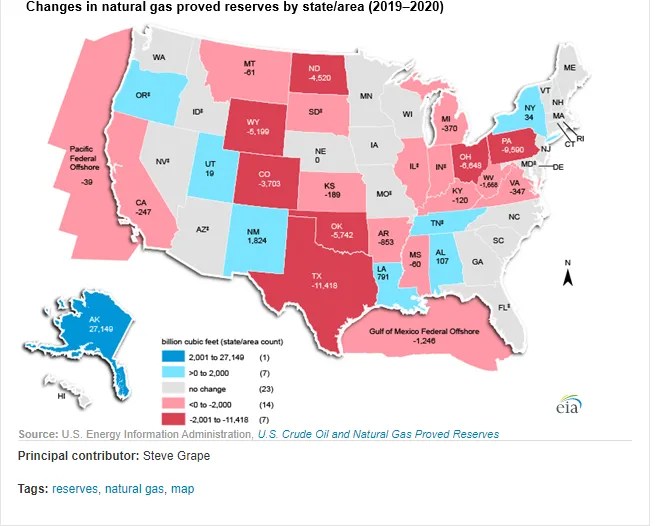
Proved reserves are operator estimates of the volumes of oil and natural gas that geological and engineering data demonstrate with reasonable certainty to be recoverable in the future from known reservoirs under existing economic and operating conditions.
The decline in natural gas reserves in 2020 was largely attributable to lower natural gas prices. The average annual price of natural gas at Henry Hub fell from $2.56 per million British thermal units (MMBtu) in 2019 to $2.03/MMBtu in 2020.
In 2020, low prices caused many operators to revise their proved reserves estimates downward and scale back development plans for new wells. Higher natural gas prices in 2021 will likely lead to more proved natural gas reserves in 2021.
Operators in Texas reported the largest decrease in natural gas proved reserves in 2020, down 11 Tcf, or 9%. Pennsylvania’s natural gas proved reserves fell by 9.6 Tcf, or 9%, in 2020.
In contrast, proved reserves of natural gas increased in Alaska from 9 Tcf to 36 Tcf. A large-scale liquefied natural gas development project received federal approval in May 2020. This project will include a new pipeline to bring natural gas from the north slope of Alaska to liquefaction and export facilities on its southern coast.
That’s according to a report published by North of 60 Mining News.
Coeur said its elevated level of exploration investment at Kensington over the past two years is intended to extend the life of the mine and generate growth opportunities beyond existing reserves and resources.
POLITICS:
From the Washington Examiner, Daily on Energy:
GOP LAWMAKERS WANT WOTUS RULEMAKING SUSPENDED: Congressional Western Caucus Chairman Dan Newhouse and member Rep. Mariannette Miller-Meeks urged the Biden EPA to stop its “waters of the United States” rulemaking process now that the Supreme Court will consider its scope.
The court took the case on Monday in response to an appeal brought by an Idaho couple, which has been in a tug-of-war with EPA for more than a decade. EPA had designated wetlands on their property as “navigable waters,” necessitating a pricey federal permit in order to build a home.
The petitioners asked the court “to provide a clear jurisdictional rule” for the Biden administration as it crafts a new rule, which it plans to do in two parts by restoring the pre-2015 definition and then by crafting a second rule with additional regulations.
CLIMATE CHANGE:
From the Washington Examiner, Daily on Energy:
XI DOWNPLAYS CLIMATE GOALS: China’s Xi Jinping told fellow Communist Party leaders the country’s strategy on climate change will “ensure the normal life of the masses,” raising additional questions as to how aggressive the globe’s top emitter intends to be in pursuing greenhouse gas emissions reductions.
Xi said “reducing emissions is not about reducing productivity, and it is not about not emitting at all, either,” also telling party leaders that China must “overcome the notion of rapid success” on lowering emissions.
A change in tone: Remember that climate envoy John Kerry claimed a major agreement between the U.S. and China to work together on climate change mitigation and to collectively “raise climate ambition” following the COP26 conference.
President Joe Biden had emphasized ahead of the conference his view that China (and Russia, too) isn’t doing enough to cut emissions. And the Biden administration maintains that rapid success is what leading emitters must achieve if the Paris Agreement’s global temperature targets are to remain within reach.
Notably, though, in that agreement, China didn’t agree to any concrete pledges, emissions targets, or timeframes for this decade.
Perhaps the most that could be said about it was that China had agreed at least in principle that it was on the same page as the U.S. in terms of reducing emissions. But now Xi appears to be saying that such goals will be subordinate to China’s other ambitions.
China’s commitments versus what the U.S. would want: On paper, China aims to see its greenhouse gas emissions peak before 2030 and to reach net-zero by 2060, and Xi’s pronouncements mesh with that broad strategy, says Lauri Myllyvirta, lead analyst with the Europe-based Centre for Research on Energy and Clean Air.
“The approach that the leadership is taking over this decade is not to pin down a specific emissions pathway, which we of course from a climate standpoint would want to see,” Myllyvirta told Jeremy.
“The fact that these targets still leave space for emissions to increase until late this decade — that’s a very slow start to getting to net-zero emissions,” he said.
The context: Myllyvirta emphasized that Xi’s words were likely motivated by the severe power shortages China faced last fall, when the Chinese economy suffered major disruptions because of ballooning electricity demand with which supply couldn’t keep up.
The power crunch led some manufacturers to shut down operations, and associated blackouts reached beyond the industrial sector into residential homes.
On economic disruption: Biden administration and European officials have framed the necessary transition to green energy as inherently disruptive, one entailing “wholesale transformation” of economies, as Treasury Secretary Janet Yellen has said.
The mandate is to find ways to manage those disruptions with monetary and energy policies, as European Central Bank executive board member Isabel Schnabel said earlier this month.
“Governments will have to protect the most vulnerable parts of society from higher energy prices in a way that does not delay the green transition,” Schnabel said during an American Finance Association-hosted panel on climate change and the financial system.
But avoiding disruption altogether is an impossible task, said Myllyvirta.
“Over the next decade, it’s going to be disruptive, especially in the next two decades. It’s going to be disruptive in the sense that energy structures and industrial structures and so on will change, and in terms of technologies, and cities and enterprises — there are going to be winners and losers,” he said
Alaskans: sound off on infrastructure! I just launched my Alaskan Infrastructure Roundtable, a fully online platform where you can share your infrastructure priorities directly with me. I want to hear from you!
Today’s Key Takeaways: Justice Breyer retires, replacement will face many decisions impacting resource development. Global oil benchmark hits $90 – first time since 2014. 9 weeks of inventory for 9 weeks of winter. Optimistic state of the state from Governor Dunleavy.
Justice Stephen Breyer will step down from the Supreme Court at the end of the current term, according to people familiar with his thinking.
Breyer is one of the three remaining liberal justices, and his decision to retire after more than 27 years on the court allows President Joe Biden to appoint a successor who could serve for several decades and, in the short term, maintain the current 6-3 split between conservative and liberal justices.
At 83, Breyer is the court’s oldest member. Liberal activists have urged him for months to retire while Democrats hold both the White House and the Senate — a position that could change after the midterm elections in November. They contended that Justice Ruth Bader Ginsburg stayed too long despite her history of health problems and should have stepped down during the Obama administration.
Ginsburg’s death from cancer at 87 allowed former President Donald Trump to appoint her successor, Amy Coney Barrett, moving the court further to the right.
White House press secretary Jen Psaki tweeted a statement on Wednesday, saying, “It has always been the decision of any Supreme Court Justice if and when they decide to retire, and how they want to announce it, and that remains the case today.”
The White House has no additional details or information to share, she added.
Prof. Erwin Chemerinsky, dean of the law school at the University of California at Berkeley, wrote in a Washington Post op-ed in May urging Breyer to retire that there are times “when the stewards of our system must put the good of an institution they love, and of the country they love, above their own interests. They have to recognize that no one, not even a brilliant justice, is irreplaceable, and that the risks presented by remaining are more than hypothetical.”
Biden has pledged to make just such an appointment. Among likely contenders are U.S. Circuit Judge Ketanji Brown Jackson of the Court of Appeals for the District of Columbia, a former Breyer law clerk, and Leondra Kruger, a justice on California’s Supreme Court.
After serving as a district court judge in Washington, Jackson was nominated by Biden for a seat on the U.S. Circuit Court of Appeals for the District of Columbia and confirmed by the Senate in mid-June. She succeeded Merrick Garland, who left the appeals court to become Biden’s attorney general.
Despite calls from some Biden supporters to add more seats to the Supreme Court to counter its current conservative lean, Breyer said in March that such a move would risk undermining confidence in the court. Advocates of court packing, he said, should “think long and hard before embodying those changes in law.”
Brent crude futures, the international oil benchmark, topped $90 on Wednesday for the first time since 2014, adding to oil’s blistering recovery since its pandemic-era lows in April 2020.
The leg higher comes amid growing geopolitical tensions between Russia and Ukraine, and as supply remains tight amid a rebound in demand.
The contract added more than 2%, hitting $90.07. West Texas Intermediate crude futures, the U.S. oil benchmark, also advanced more than 2% to $87.43 per barrel.
CIBC Private Wealth’s Rebecca Babin said the catalyst for higher crude prices is potential sanctions on Russia, which would be triggered by a Ukraine invasion.
″[E]ach day that passes without a de-escalation, we could see more of a supporting bid to crude,” she said.
Goldman Sachs said Wednesday that the firm’s base case is that supply disruptions are unlikely to occur, but that there could be upside for energy prices given an already tight market.
“Commodity markets are increasingly vulnerable to disruptions, after a couple years of historically low outages following the initial Covid shock,” the firm wrote in a note to clients. “Against the backdrop of the tightest inventory levels in decades, low spare capacity and a much less elastic shale sector, this points to the skew of large energy price moves shifting to the upside, reinforcing the case for a rising allocating to commodities in portfolios.”
Earlier this month, Goldman Sachs said that Brent can reach $100 per barrel by the third quarter, adding to a number of Wall Street firms calling for triple-digit oil.
Barclays noted that while prices may be reacting in part to a “geopolitical premium,” the underlying fundamentals are fueling the push higher.
OPEC and its oil-producing allies have been returning oil to the market, but the group’s been unable to ramp up production to hit its targets. Meanwhile U.S. shale oil growth has been low, and omicron hasn’t been the demand hit that was initially expected. Additionally, inventory levels remain depleted.
The Energy Information Administration said Wednesday that crude oil inventories rose by 2.4 million barrels during the week ending Jan. 21. The Street was expecting a build of 150,000 barrels, according to estimates compiled by FactSet.
“Immediately it becomes a question how long we’ll be waiting for triple figures,” said Oanda’s Craig Erlam. “It’s still unlikely that oil and gas will be used as a weapon any time soon but if it was, it could lead to a serious surge in prices given how tight the markets are.”
Europe has nine weeks of natural gas storage reserves at the current rate of withdrawal, with nine weeks of the winter delivery period remaining, an analysis by S&P Global Platts found, even amid the deluge of LNG being received.
With Russian exports to Europe’s key trading hubs still constrained year on year, there is an emerging risk of localized supply issues and regionalized price spikes later in the winter which could spread to other parts of the continent.
According to data from Platts Analytics and Gas Infrastructure Europe, inventory at Platts-assessed markets totaled 36.99 billion cu m on Jan. 23, with net withdrawal in the Jan. 17-23 period amounting to 3.95 Bcm.
In terms of individual countries, Austria, Germany, and the UK were among the most susceptible countries and could potentially see reserves fully depleted before the end of winter. The UK has just five weeks of inventory left if current withdrawal rates are sustained.
Moreover, a comparison of the latest stock level against the drawdown of previous balance-of-winter periods showed Austria in particular would run out of inventory should last winter be repeated. That is even before lower Russian exports to Europe are taken into account.
By the same measure, Germany would have enough in reserve if the balance-of-winter for the past two years was replicated, but without supply from the Yamal pipeline, it too is at risk of exhausting its stocks.
All-in-all, Europe would have 13.45 Bcm in storage by March 31 should last winter be repeated. As things stand, that would be reduced to 4.43 Bcm when missing Russian exports this year are considered.
January-to-date, the Yamal pipeline terminating in Germany has been in reverse-flow mode and has experienced an average swing of 95.94 million cu m/d year on year. Also, exports via Ukraine to Slovakia at Velke Kapusany have been 38.65 million cu m/d lower on average on the year.
In the totality of winter, Europe withdraw 68.1 Bcm during Winter 2020 delivery, which if repeated this year would leave 10.1 Bcm in stock by March 31.
Decisive management?
With traders fully aware of the situation with Russian exports for some time, extensive efforts to replenish stock over the summer have been followed up by careful management of inventory during the winter.
The analysis found that while the Netherlands would be at risk of full drawdown if last year was repeated, it has 13 weeks of reserves left at the most recent rate of withdrawal.
Such a shift in management can be down to tactically injecting or reducing withdrawals at the most opportune times to maximize inventory.
That is preferable at times of comparatively low demand or low prices and could in part explain volatility on the spot market as shippers would need a strong incentive to unwind an already profitable withdrawal profile.
Indeed, such a system could arguably be in place within Russia as well and could serve as a possible explanation for lower exports should it be seeking to keep domestic storage fully topped up. Russia has filled just a fraction of its space in European storage this year, however.
France and Italy, who both legislate for gas storage regulation, should both have a weeks’ worth of aggregate demand in reserve by the end of winter despite high French net withdrawals at present and Italy’s partial exposure to lower Russian exports.
The UK has relatively tiny storage space compared to its annual gas demand and is more accustomed to managing stocks in such a way. The majority of the 1.5 Bcm space it has is owned by utilities who would not need to enter the spot market to replenish.
However, the lack of strategic reserves in the UK was a key contributing factor to the former spot price record set by the ‘Beast from the East’ weather system on March 1, 2018. While originating in the UK, an acute need to source imports from, or at the expense of, other countries spiked neighboring hub prices too.
While the analysis found the UK could have enough stock by March 31 should previous winters be repeated, it did not rule out a full depletion before this time.
Weather or not?
Many market participants have argued that a comparatively mild winter, such as experienced this year, would be enough to prevent inventory being fully depleted.
The analysis showed, however, that historically this could only account for 3.825 Bcm in the Jan. 23 to March 31 period, for around 24-25 Bcm over the entirety of winter delivery, and the effect of lower Russian exports to Europe may not be fully offset in either case.
Therefore, whether full drawdown occurs and price spikes ensue is likely to depend on where countries in need source gas from, and at what expense.
For all its connectivity as Europe’s benchmark, the TTF could be under enormous strain should problems develop in Germany, Austria or the UK, and the rest of Europe is likely to feel it.
The company behind the proposed Pebble mine in Alaska has been saying goodbye — for now — to its lobbyists in Washington.
Pebble LP once had a large team of lobbyists fighting to guarantee development of an enormous copper and gold development near southwest Alaska’s Bristol Bay, home to the nation’s strongest salmon fishery.
That was before the company lost a key fight during the Trump administration, when the Army Corps of Engineers in 2020 rejected Pebble’s application to build the mine. And the Biden administration has since restarted a Clean Water Act veto process that could prevent any large-scale mining near Bristol Bay (Greenwire, Sept. 9, 2021).
Pebble didn’t lobby Congress or agencies on any issues during the last six months of last year and spent no money on federal lobbying efforts during that period, according to disclosures filed last week by firms the company had retained.
In the last year, Pebble has terminated contracts with BGR Government Affairs, Ballard Partners, Buchanan Ingersoll & Rooney, and Windward Strategies, disclosures show. Some big names were representing Pebble through those firms, including former Mississippi Gov. Haley Barbour (R) at BGR and Brian Ballard, a major ally and fundraiser for former President Trump.
Pebble’s sole in-house lobbyist, Peter Robertson, left the company in August, according to his LinkedIn profile. Robertson, who now works at the firm Squire Patton Boggs, did not respond to a request for comment.
The company was, until recently, spending much more on lobbying — with $360,000 in the third quarter of 2020 and $460,000 during the fourth quarter — Pebble said in required filings with Congress.
Pebble’s exodus from K Street “makes sense,” said Tim Bristol, director of SalmonState, a nonprofit that advocates for protecting Alaskan fisheries and opposes the project. He said Pebble’s defeat under the Trump administration has left the company with few options to maneuver.
“All they really have left is, hopefully, they can pull off some legal tricks. I think that’s about it,” Bristol told E&E News. “Maybe they just realized that the political winds are totally in their face on this one.”
Pebble last week said it had filed a formal request to appeal the Army Corps’ record of decision. Beyond the appeal, “legal options [are] also being considered,” Pebble said in a Jan. 19 presentation to investors.
Asked about the lobbying drop-off, Pebble spokesperson Mike Heatwole said the company is currently focused on fighting the Army Corps permit denial.
As Pebble fought skepticism of the mine from many lawmakers, regulators and some Alaska Native tribes, the company became a Washington lobbying juggernaut.
It reported spending more than $1.5 million on lobbying in both 2019 and 2020. It had previously hired major firms, including Akin Gump Strauss Hauer & Feld; Squire Patton Boggs; Gavel Resources; and BGR.
Other lobbyists have included House Science Chair Lamar Smith (R-Texas), former House Natural Resources Chair Richard Pombo (R-Calif.) and former House Transportation and Infrastructure Chair Bill Shuster (R-Pa.).
As of the fourth quarter of last year, Akin Gump, Gavel and Squire Patton Boggs were all on retainer for Pebble but reported no lobbying.
The last time Pebble spent money on federal lobbying was in the second quarter of 2021, when Robertson, the in-house lobbyist, reported expenditures of $15,000 on “All legislative and regulatory matters affecting the proposed Pebble Project in Alaska.”
Alaska Gov. Mike Dunleavy laid out an optimistic vision of the state’s future Tuesday during an election year address to lawmakers that comes amid a period of higher oil prices and follows a year that was marked by drawn-out, bruising legislative sessions.
The Republican, giving his fourth State of the State speech since taking office in late 2018, said he envisioned a state that is a leader in renewable energy, with energy costs among the lowest in the U.S. He also wants Alaska to finally develop its vast stores of natural gas on the North Slope — something policy makers have pursued for decades only to have plans scrapped, stalled or hit dead ends.
He did not go into great detail on how those could be realized. But he told lawmakers there was a “great obligation” to come together around policies that would solve long-standing issues and create opportunities for generations.
Dunleavy has had an at-times rocky tenure, marked by fights with lawmakers over the budget and the annual check paid to residents from the earnings of the state’s oil-wealth permanent fund. He called for settling the dividend issue.
Debate over the size of the check has overshadowed other issues in recent years. Legislative leaders have said they want a long-term resolution to the debate, too, but an agreement so far has been elusive.
Under a redistricting plan that is the subject of litigation, 59 of the Legislature’s 60 members face election this year. Dunleavy faces reelection too.
In his speech, Dunleavy touted his administration’s handling of the pandemic, citing such things as testing and vaccine distribution efforts and efforts to help shore up the healthcare workforce. He has long said that vaccination is a personal decision.
“My administration’s job is to make sure our healthcare system is strong, and you have the tools available for you to take care of yourself,” he said.
The administration has joined efforts nationally to fight federal vaccine mandates.
Dunleavy has faced criticism on both sides for his approach to the pandemic — by some who say he hasn’t done or said enough and from others who have accused the administration of pushing vaccines. Republican Rep. Christopher Kurka, who is running for governor, has posted a petition calling for the state’s chief medical officer, Dr. Anne Zink, to be fired, citing in part her support of vaccines. Dunleavy last week said he stood by Zink.
Oil prices in recent months have been at among their highest levels during Dunleavy’s administration. Prices have been in the upper $80-a-barrel range; this time last year, they were around $55 a barrel.
But Senate Minority Leader Tom Begich, an Anchorage Democrat, said building a budget “on the stock market and the volatile price of oil is not a sustainable plan for our next generation.” Begich has argued the state needs new revenues.
Begich, in a statement, also took issue with Dunleavy’s criticism of the Biden administration.
Dunleavy has been at odds with the federal administration on some resource development issues and, in his speech, Dunleavy said the administration had shown “hostility” toward the state.
Begich said Dunleavy failed to acknowledge “the impact of the billions of dollars brought in by the Biden Administration, which has assisted in our ability to address the pandemic, rebuild our infrastructure, and frankly, address our deficit.”
Senate President Peter Micciche, a Soldotna Republican, said a message he heard in the speech was that “an election year is not an excuse for inaction.” Dunleavy urged lawmakers to prove wrong Alaskans who think nothing will get done because this is an election year.
Micciche told reporters he hopes to see “more of a team effort” this year between lawmakers and the Dunleavy administration.
“I perhaps wear a pair of rose-colored glasses, that when someone stands in front of a mic and talks about a vision, that they mean it,” he said. “The test is going to be, how serious is that vision and is the administration going to put the work in on being here in this building for the next 90 days, guiding us through and working with us. Those big pieces don’t move by themselves. You can’t drop a bill and have it magically pass.”
Sylvera, a London-based startup that aims to provide accurate and independent information about carbon offsets, raised $32.6 million in a Series A funding round co-led by Index Ventures and Insight Partners.
Why it matters: Offsets, like forest planting and preservation, can help businesses become more climate-friendly. But the carbon credit market is notoriously saddled with integrity and verification problems.
How it works: Sylvera says the funding will help its mission to become a “source of truth” in the carbon offset market via accurate ratings information.
The company says it uses proprietary data and machine learning to provide “the most comprehensive and accessible insights and market intelligence.”
Customers thus far include Salesforce, which is also an investor, Delta Airlines, Shell and Cargill, the company said.
What’s next: The company hopes to become the equivalent to Moody’s for the carbon credits market, and says its team has expertise in artificial intelligence, geospatial technology and other relevant fields.
What they’re saying: CEO Allister Furey, in a blog post on the funding, said better data and transparency can make offsets a more effective tool against climate change.
“If weaker credits are removed from the market or discounted, supply tightens,” he writes.
“When buyer confidence in quality increases, demand, and willingness to pay, grows.”
Today’s Key Takeaways: OSHA withdrawing Biden administration vaccine or test mandate. US Supreme court to review case that could have ramifications for oil and gas companies operating on private lands where the EPA may have jurisdiction over waters. A rebalancing year in store for mining. John Kerry calls natural gas a “bridge fuel” in the energy transition.
The Occupational Safety and Health Administration announced Tuesday that it is withdrawing the Biden administration’s temporary COVID-19 vaccine-or-test requirement for large employers.
The big picture: OSHA said it made the decision to withdraw the mandate following the Supreme Court’s decision blocking the rule.
OSHA does not have the power to “regulate public health more broadly,” the court said. “Requiring the vaccination of 84 million Americans, selected simply because they work for employers with more than 100 employees, certainly falls in the latter category.”
The agency added that it’s “prioritizing its resources to focus on finalizing a permanent COVID-19 Healthcare Standard.”
Catch up fast: The administration’s mandate, which was issued in November, said that companies with more than 100 workers must require their employees to either get vaccinated or tested every week.
What they’re saying: The “Department of Labor’s [OSHA] is withdrawing the vaccination and testing emergency temporary standard issued on Nov. 5, 2021, to protect unvaccinated employees of large employers with 100 or more employees from workplace exposure to coronavirus. The withdrawal is effective January 26, 2022,” OSHA said in a statement.
“OSHA continues to strongly encourage the vaccination of workers against the continuing dangers posed by COVID-19 in the workplace.”
The US Supreme Court agreed Jan. 24 to review a court case that could redefine the jurisdiction of the Clean Water Act, especially in regard to isolated wetlands.
The case could have ramifications for oil and gas companies operating on private lands where the Environmental Protection Agency (EPA) and the US Army Corps of Engineers may at times assert a disputed authority to regulate activities that could affect nearby water bodies.
The jurisdiction issue can affect such oil industry responsibilities as pipeline routes and spill prevention control and countermeasures, said Lee Fuller of the Independent Petroleum Association of America (IPAA).
The case is Sackett v. EPA, brought to the court by a married couple who have been trying for 15 years to build a home in a housing development near Priest Lake, Idaho, only to be frustrated by EPA because their property is near a wetland that drains into the lake.
EPA insists the Sacketts need approval from the Corps of Engineers to build on their land, and the US Court of Appeals for the Ninth Circuit agreed in August, accepting EPA’s test to determine whether the couple’s land can have an impact on the quality of water in the nearby wetland and the lake, a tricky subject that includes determining whether the couple’s lot is itself part of the wetland.
The Supreme Court said it granted review to determine “whether the Ninth Circuit set forth the proper test for determining whether wetlands are ‘waters of the United States’ under the Clean Water Act.”
“The Sacketts’ ordeal is emblematic of all that has gone wrong with the implementation of the Clean Water Act,” said Damien Schiff, a senior attorney at Pacific Legal Foundation, in a statement issued after the Supreme Court agreed to take the case. His foundation represents the Sacketts.
“The Sacketts’ lot lacks a surface water connection to any stream, creek, lake, or other water body, and it shouldn’t be subject to federal regulation and permitting,” Schiff said.
Regulations to be revised
The Trump administration tried revising the regulations, but a federal court ruling blocked those changes, and the Biden administration is in the process of revising the regulations to return to what it calls the pre-2015 rules, with updates to take into account court rulings since then. The public comment period on the Biden EPA’s proposal (jointly developed with the Corps of Engineers) will end Feb. 7.
The Clean Water Act mandates that the federal government protect the “chemical, physical, and biological integrity of the nation’s waters.” As for jurisdiction, the law says it is intended to protect “navigable waters,” which means the “waters of the United States.” But it does not define its terms.
It has been accepted since the 1985 Supreme Court ruling in US v. Riverside Bayview Homes Inc. that wetlands adjacent to a navigable river are jurisdictional because of their close ecological interconnection with the river. That leaves much unresolved—such as wetlands that are not adjacent, or land like the Sacketts’ lot.
In 2006, in Rapanos v. United States, the court fractured over the jurisdictional issue. A plurality of four justices agreed that a continuous surface water connection to navigable waters should determine jurisdiction. A fifth justice, Anthony Kennedy, wrote that jurisdiction should hinge on a “significant nexus” analysis of the ecological connections between a location and a jurisdictional water body.
“Ever since then we’ve been fighting over significant nexus and what it meant,” IPAA’s Fuller said.
The court will be revisiting the Rapanos case as it considers the Sackett case, according to Pacific Legal Foundation. The foundation, often arguing for property owners, hopes to see the current court majority adopt the plurality opinion in the Rapanos case.
Singapore, 24 January 2021 – If 2021 was the year of rebound for metals and mining (M&M) commodities, then 2022 is shaping as the year of rebalance, says Wood Mackenzie, a Verisk business (Nasdaq:VRSK).
Wood Mackenzie vice chair Julian Kettle said: “The most likely outcome is an environment where commodity prices can settle from the extraordinary highs of 2021. But there are plenty of risks to this outlook. The pandemic’s tendrils continue to ensnare markets for all mined commodities.”
Much of the evidence points to a year of lower demand growth. Government stimulus could wane, while fiscal and monetary policy will tighten. 2022 should be a year when supply chains refill and start to better meet the needs of consumers.
But there is plenty of uncertainty. With lockdowns out of favour in most places, the demand risks from new variants may be usurped by supply and logistics impacts, as workers isolate or refuse to vaccinate. Stimulus could be prolonged too, as governments, and central banks, fret more about the impact on growth than the looming inflation risk. China’s economy-versus-emissions dilemma will be critical to M&M markets.
Supply: Investment muted despite supply constraints and earnings boom
Mine supply shortages and logistics constraints will remain a feature across M&M markets in 2022. The European and Chinese energy crises are unsolved, directly affecting coal prices, and keeping input costs higher across all products, particularly the energy-hungry base metals. Logistics bottlenecks, container, and chip shortages, plus some unhelpful trade policies, will also keep regional price differentials and product premia skewed.
Vice president Robin Griffin said: “Supply will improve, but we do not expect a meaningful investment spike this year, despite the reinvigorated balance sheets of M&M companies. An obvious question is where will the record earnings of 2021 be directed?
“We know that the diversification trend from fossil fuels to future facing commodities will continue, but there has been a dearth of capital allocated to organic growth from diversified miners.”
Decarbonisation: Increased scrutiny to drive surge in low-cost abatement
With COP26 fresh in the memory, and COP27 already looming, miners can expect mounting pressure to meaningfully align with a 1.5-degree warming scenario. Calls for comprehensive net zero plans, and more sophisticated disclosure, will increase this year as investors seek to rank assets on ESG metrics.
Kettle said: “Miners and consumers will understandably focus on decarbonisation options that make the most economic sense. So, expect a plethora of new renewable PPAs and captive solar and storage plans this year at production sites. Mine haulage will get plenty of attention too with Komatsu’s 930E hydrogen fuel-cell haul truck trial at Anglo’s Mogalakwena platinum mine worth watching. But also look for more traction on battery, gas, bio- and green-diesel haulage options.”
Urban mining – recycling and scrap use – will be front of mind for consumers, both as a low-cost decarbonisation option in ferrous markets and a potential solution to looming supply deficits elsewhere. Expect plenty of noise from the nascent battery recycling sector.
Costs: Inflation to hasten margin decline
Cost inflation was a global phenomenon in 2021, and for the second year in a row will continue to affect most miners and smelter-refiners. Wood Mackenzie’s 2022 mine estimates include modest cost rises in 2022 but the risk is to the upside. Labour, fuel, and electricity costs remain elevated as supply struggles.
Mine labour costs, in particular, could gather momentum due to a combination of lockdowns, sickness and worker movement restrictions that are exacerbated by vaccine mandates. Attracting and retaining skilled mine labour is difficult, particularly in coal markets, and especially where competition from miners of battery raw materials or base metals is high.
The cost increases, combined with revenue falls, will accelerate the decline of margins in 2022. Average annual margins will stay close to 2021 highs, but by year end the current record profits will have fallen to below pre-pandemic levels for most commodities.
China: Both underpinning and undermining commodity markets
China, as ever, will dominate market outcomes across M&M commodities. Decisions around geopolitics, pollution control and energy consumption will be of particular importance.
Griffin said: “We see little chance of an end to current bans on Australian coal imports this year, and major improvements in global bilateral relations are probably too much to ask. Prices for energy commodities in China will remain higher-than-necessary, with implications for energy prices that in turn affect producers and consumers of M&M products.”
China’s approach to decarbonisation and pollution targets will drive uncertainty and volatility. Summary closures of energy intensive industries in order to meet emissions targets have been the modus operandi under China’s ‘dual-control’ regime. While the 2021 closures were bad for steel raw materials and alloys demand, complementary pollution controls saw mined output more than offset demand losses.
Meanwhile, base metals markets saw power-hungry smelter production plummet overnight, creating global supply shortages. Expect more interventions in 2022, although with broadened carve-outs to limit the kind of wild price swings seen last year.
An Alaska agency is taking steps to remove about $24 million in investments issued by financial institutions that have said they won’t finance oil and gas projects in the Arctic.
The Alaska Industrial Development and Export Authority is eyeing a rule change that will prevent its fund managers from buying securities, such as bonds, from banks with policies that prohibit “engagement in oil and gas development” in the region, according to the proposed resolution.
The Arctic includes Alaska’s North Slope region, home to the giant Prudhoe Bay oil field and other large oil and gas prospects.
The resolution would prevent the state agency from buying securities in banks such as Bank of America, JPMorgan Chase, Morgan Stanley, and Citigroup, according to the proposal. Amid growing concerns about climate change, those and other major banks have said they would pull back from supporting new Arctic oil and gas projects.
The resolution is on the table for consideration at the agency’s board meeting on Thursday.
The quasi-independent state agency provides financing and support for Alaska projects.
It holds $23.9 million in securities that would be affected, according to a Dec. 1 memorandum.
The money is an “insignificant” part of a $400 million fund that is conservatively invested, mostly in U.S. government securities, said Alan Weitzner, the agency’s executive director, in an interview on Friday.
If the board approves the measure, the affected assets can be sold and reinvested elsewhere, he said.
The agency hopes its actions raise awareness about policies that he said hurt Alaska communities, such as those on Alaska’s North Slope, that have benefited from oil and gas development and related jobs and revenue, Weitzner said.
“It’s not fair to take sweeping anti-development policies without looking at the benefit to Indigenous and rural communities,” he said. “We’re really just trying to bring awareness.”
During the final days of the Trump administration early last year, the agency acquired seven 10-year leases for rights to explore and drill for oil in the Arctic National Wildlife Refuge. The agency is suing the Biden administration, after the administration suspended those leases to conduct an environmental review.
Bernadette Demientieff, executive director of the Gwich’in Steering Committee, representing 14 Gwich’in communities in Alaska and Canada who oppose oil and gas activity in the Arctic refuge, said she and others met with officials at some of the banks, encouraging them to adopt the policies.
She said the banks are listening to tribes and their people, while the state agency is not.
“It’s sad they are using money as a tool to try and punish people who are listening to our voice,” Demientieff said.
CLIMATE CHANGE:
From the Washington Examiner, Daily on Energy:
THE LATEST ON NATURAL GAS FROM KERRY: Climate envoy John Kerry asserted yesterday the commodity is a “bridge fuel” that can help nations on their path to net-zero emissions — a notion rejected by many climate hawks, and one that’s motivating some EU member states to threaten suit against the European Commission for proposing to treat gas as such.
“Gas can be helpful in this transition,” Kerry said at a U.S. Chamber of Commerce event previewing next year’s COP27 climate change conference. “Gas is going to be important to the transition.”
The “bridge fuel” designation has the ring of an endorsement, but Kerry issued some major qualifications.
“But if we move too fast and too far with too much and build out an infrastructure for 30 and 40 years, with plans to be able to use it for 30 or 40 years without abatement — if it’s abated, terrific. If you can capture 100% and it makes it affordable, that’s wonderful. But we’re not doing that,” he said, also bringing up the consequences of methane leaks.
Looking back to COP26, it’s important to remember participating governments resolved to at least phase down coal, which will have to be replaced with something. The pro-gas Germans told the European Commission last week gas enables “rapid phase-out of coal” and to thus “achieve CO2 savings in the short term.”
The Germans also used “bridge” to positively describe the fuel and lobby the Commission to reduce restrictions on fossil gas in its proposed sustainable finance taxonomy (which, as we mentioned yesterday, Austria and Luxembourg oppose altogether for giving gas any chance at being considered green).
Kerry, who also emphasized the need to get rid of coal yesterday, seems to be in some broad agreement with Germany there.
It’s the latest refinement of the administration’s stance on natural gas from Kerry: Kerry last year, as the administration struggled to articulate a clear position on gas, said that it is not “anything near a long-term solution.” The politics have shifted somewhat since and become even more volatile, with environmentalists voicing displeasure over President Joe Biden’s perceived lack of achievements on the fossil fuel front in his first year.
The counterbalance has been political pressure on Biden to find a way to lower fuel prices, as well as, more recently, the pressure to try to counter Russia’s influence over Europe.
Kevin Book, managing director of ClearView Energy Partners, said the administration is “toeing a narrow line” on the issue of gas, accounting for the especially high, gas-driven prices in Europe and the geopolitics associated with the Russia-Ukraine conflict.
Book mentioned Biden’s comments last week suggesting the U.S. could help Europe by supplying it with more gas.
“Climate risk now appears to be competing with conventional energy security risk for administration bandwidth,” he told Jeremy.
While there's still more work to be done, our industry has made significant progress in reducing methane emissions in key production regions, thanks to industry-driven innovations and initiatives. pic.twitter.com/oPnymbulaB