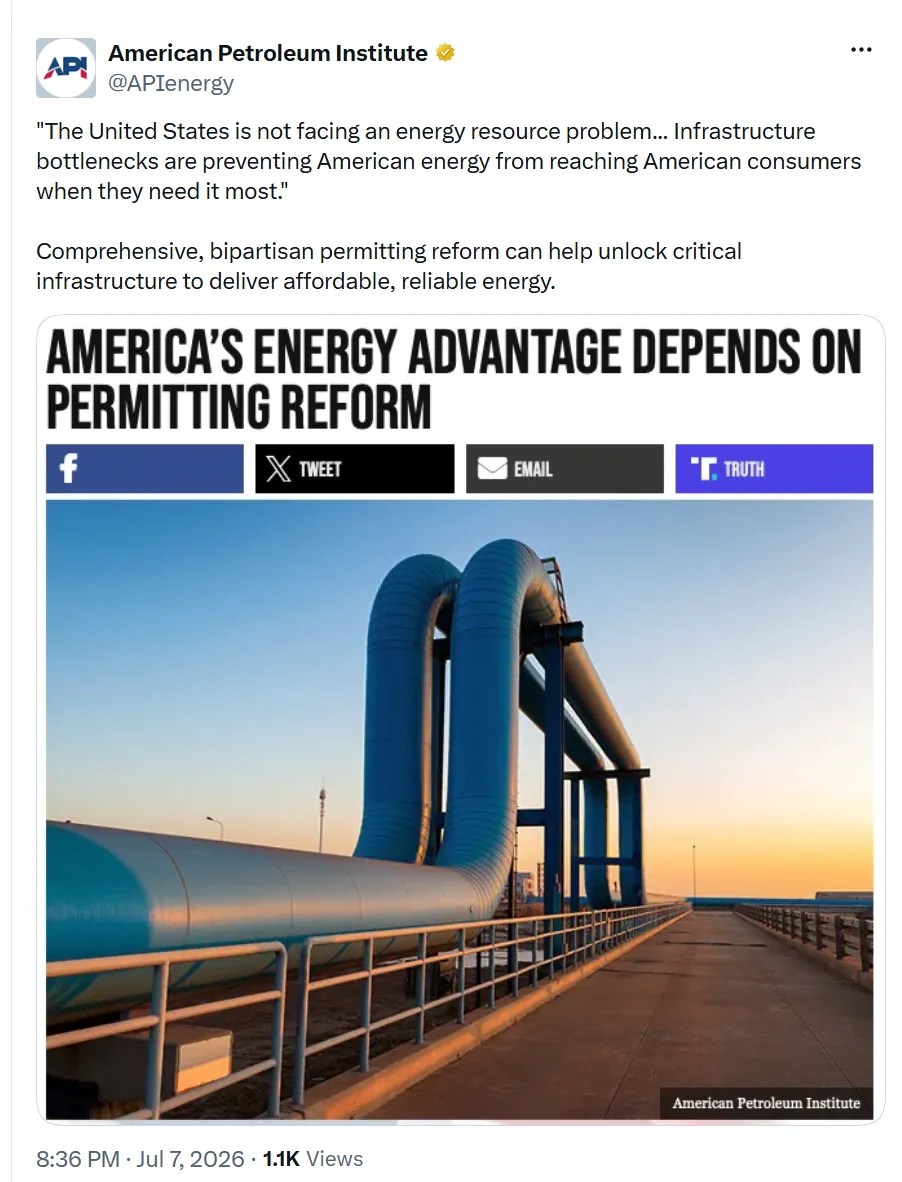
Despite differing priorities, both sides agree on one fundamental point: America cannot build its energy and infrastructure future if it takes longer to permit a project than it does to construct it. The question before Congress is no longer whether the permitting system needs reform—it’s whether lawmakers can seize this rare opportunity to deliver the changes that virtually everyone agrees are overdue.
Window to pass bill to unlock energy projects is closing, key group warns – The warning in this headline comes from Jason Grumet, head of the Clean Power Association
Key Excerpt:
A top clean energy trade group warned that the window for lawmakers to pass meaningful permitting reform is almost closed, with Congress just weeks away from breaking for August recess and no deal in hand.
“We think the window of opportunity there is starting to close this Congress,” American Clean Power CEO Jason Grumet told reporters on Tuesday.
Lawmakers have long sought a deal on major legislation to overhaul the federal permitting process to accelerate approvals for a wide variety of new energy and infrastructure projects, such as pipelines, transmission lines, and highways. The Trump administration is eager to boost energy production to lower electricity prices and help win the race for artificial intelligence. Democrats, meanwhile, are hoping to facilitate the development of carbon-free energy sources.
From David Blackmon’s’ Five Big Energy Stories, July 8, 2026
Wood Mackenzie noted that two structural shifts are working in the same direction at once. It pointed out that “demand continues to grow at a sustained pace” while “supply is becoming harder and more expensive to grow.”
Decade of Cheap Henry Hub Gas Coming to End, WoodMac Warns
Andreas Exharheas, Rigzone, July 8, 2026
In a statement sent to Rigzone recently, Wood Mackenzie warned that the decade of cheap Henry Hub gas is coming to an end.
The company projected in the statement that Henry Hub natural gas prices will approach $5 per million British thermal units (MMBtu) by 2035, which they highlighted would be “up from a nominal range of $2 to $4 per MMBtu that held for most of the past decade”.
Wood Mackenzie outlined in its statement that this Henry Hub price stability “underpinned the buildout of U.S. LNG export infrastructure and the expansion of gas-fired power generation now supporting AI-driven data center growth across the country.” The company highlighted that a recent report from the business focusing on U.S. Henry Hub prices “sets out why those conditions are no longer assured.”