S.E.C. Proposes to Kill Climate Change Disclosure Rule – Oh, be still my beating heart.
As Yul Brynner famously said: So let it be written, so let it be done.
Key Excerpt:
The Securities and Exchange Commission on Friday proposed to repeal a contentious rule that would have required thousands of companies to disclose the risks they face from a warming planet and how their operations contribute to climate change.
The rule was already on hold pending litigation. In February, Mark Uyeda, then the acting chairman of the S.E.C., directed the agency to stop defending the regulation in court against lawsuits from business groups and Republican-led states.
Still, the proposed rollback was a victory for a range of business interests that had lobbied to kill or weaken the regulation, including airlines, oil and gas drillers, farmers, retailers and truckers. It was a blow to climate activists and some corporations that had embraced environmental, social and governance principles, known as E.S.G., in recent years.
The rule was issued under the previous S.E.C. chairman, Gary Gensler, who was nominated by President Joseph R. Biden Jr. Paul Atkins, who was nominated by President Trump and sworn in as the commission chairman last year, said in a statement on Friday that the rule exceeded the agency’s legal authority.
From 5 Big Energy Stories, David Blackmon, June 1, 2026
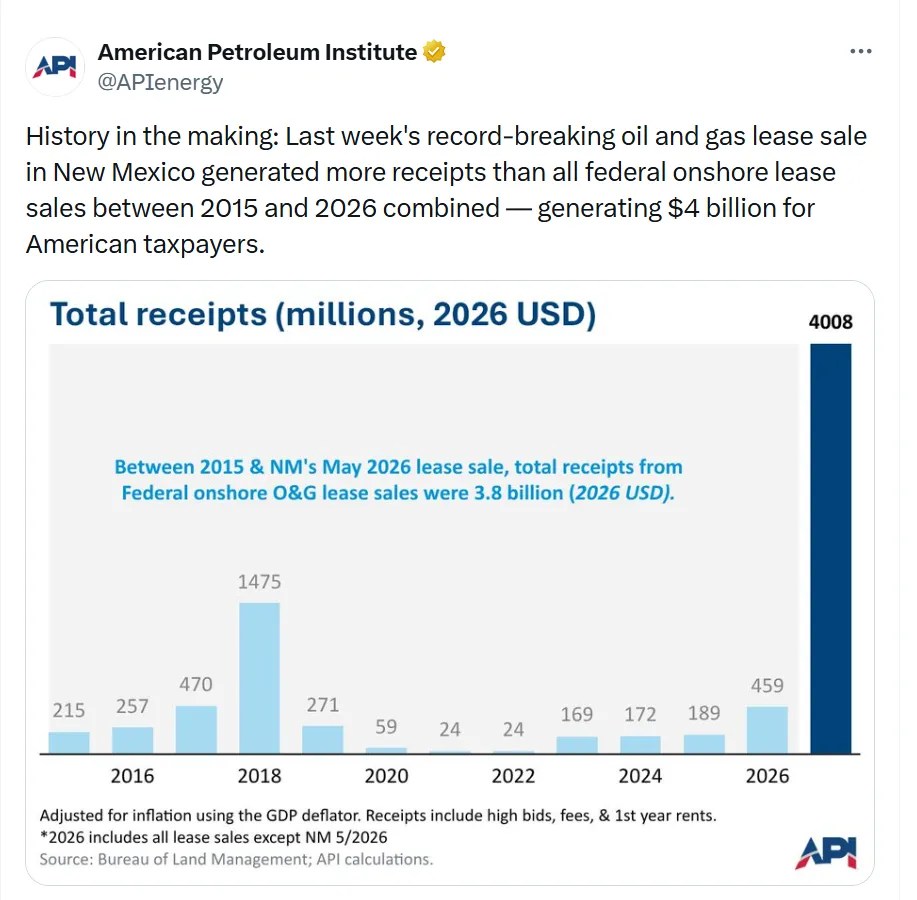
“The hundreds of millions invested in Alaska and billions in New Mexico are proof that domestic production is here to stay and there is room for production across all basins around the nation,”
Alaskan frontier oil boom bodes well for energy industry
Bob Campbell, Odessa Online, June 1, 2026
Alaskan oil production will eventually be greatly boosted from a big lease sale by the U.S. Bureau of Land Management in the National Petroleum Reserve.
With record bids from Exxon, Repsol, ConocoPhillips, Santos, Shell and other companies, Alaska will play a bigger role in the national and global energy industries, but it will never rival Texas.
That’s according to the Permian Basin Petroleum, Texas Independent Producers & Royalty owners and Texas Oil & Gas associations, who say the recent developments may be attributed to the burgeoning worldwide demands for oil and natural gas.
PBPA resident Ben Shepperd said the investments by operators in Bureau of Land Management lease sales in Alaska and New Mexico clearly demonstrate the demand for domestic oil and gas production and the interest in safely and responsibly developing natural resources in the United States.
With gold prices just being what they are — they’ve seen this like historic rise over the last few years — and that’s really attracted a lot of investment and excitement in the industry.
Q&A: The transboundary mining boom in the Coast Range
Alix Soliman, KTOO, May 27, 2026
Several proposed mines in British Columbia are located along transboundary rivers that wind through Southeast Alaska. Residents on the Alaska side of the border say there’s a lack of tribal consultation and some worry about pollution in salmon-bearing streams vital to the region’s fisheries.
KTOO’s Alix Soliman spoke with Max Graham, a journalist who covers mining in Alaska for Northern Journal, about the booming industry.
The geopolitical disruptions in the Middle East have fundamentally shifted global perceptions of energy reliability. Consequently, global buyers are increasingly likely to view North American liquefied natural gas (LNG) suppliers as an attractive choice for energy security. With traditional supply routes interrupted, U.S. and Canadian midstream infrastructure assets are positioning themselves to capture long-term structural growth.
How Geopolitical Shocks Are Fueling the North American LNG Boom
Ella Caruso Fitzgerald, Energy Infrastructure Content Hub, May 29, 2026
Key Takeaways
- Supply disruptions in the Middle East triggered immediate price spikes in Europe and Asia, while infrastructure damage has knocked 17% of LNG capacity from Qatar offline for the next three to five years.
- U.S. LNG export capacity is projected to nearly double by 2031, with over 18 billion cubic feet per day (Bcf/d) of capacity currently under construction.
- The structural shift toward reliable North American energy exports could provide a significant volume tailwind for energy infrastructure ETFs like AMLP and ENFR.